

Vivid Dreams: What Causes Them, Why You Remember Them, and a Calmer Night
Vivid dreams are dreams that feel real: colour, sound, emotion, a plot you can retell at breakfast. Everyone has them sometimes. When they come night after night, there is usually a reason, and the common ones are well understood: catching up on lost sleep, alcohol wearing off, stress, some medicines, and waking more often in the night, which is what turns a dream into a memory. This page explains each cause, what the research says, and the quiet, steady night-time setup our listeners use. The sounds are in Mindael, free to download on the App Store.
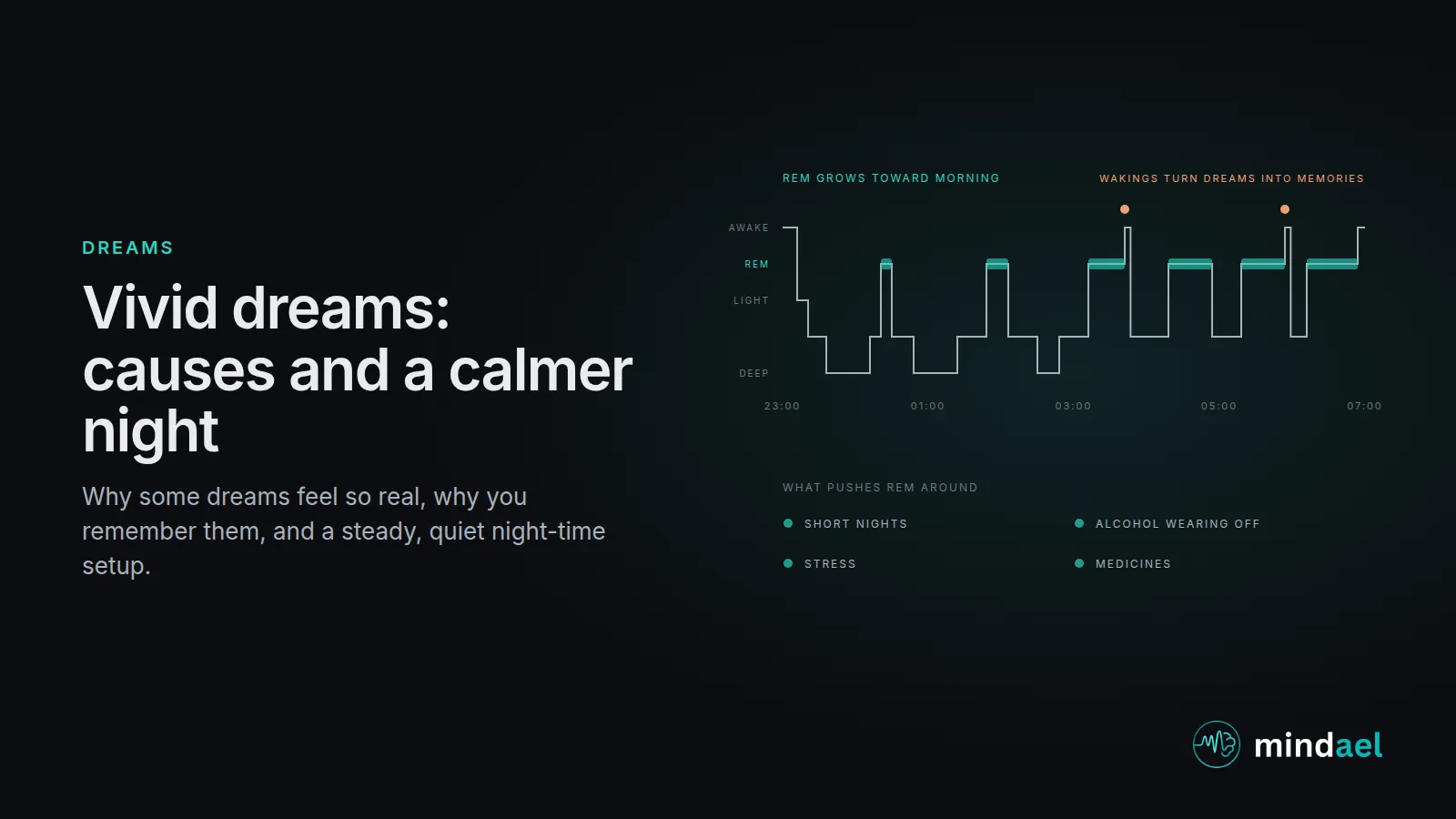
Vivid dreams mostly happen in REM sleep, which is longest in the second half of the night. They become more frequent or intense when REM is pushed around: after short nights, when the body catches up on REM; when alcohol, which suppresses REM early in the night, wears off and REM rebounds later; with stress and big life events; and with some medicines, especially starting or stopping antidepressants. You also remember more dreams when you wake more often, because a dream is only recalled if you wake during or just after it. A regular sleep schedule, no alcohol close to bed, a cool room and a steady low sound that keeps small noises from waking you all help. See a doctor if dreams are distressing, if you act them out, or if they started with a new medicine.
Sounds that work, and why
Brown noise
A deep, soft floor all night, so a door or a car in the REM-heavy early morning is less likely to wake you mid-dream.
Pink noise
For a louder room: a little brighter than brown, with more energy where voices and traffic sit.
Rain
For after a vivid dream wakes you: something natural and steady to rest attention on instead of replaying the dream.
Ocean waves
A slow swell to breathe with, out on the fall, when a dream has left your heart racing.
Delta waves
The 2 Hz beat under rain in the first part of the night, for people who like something underneath on the way down.
Why some dreams are vivid
Most vivid, story-like dreams happen in REM sleep. A night runs in cycles of about ninety minutes, and REM periods get longer as the night goes on, so the second half of the night, roughly 3 a.m. onward, holds most of it. Anything that pushes REM around, squeezes it, delays it or makes it come back harder, tends to make dreams more intense. And anything that wakes you during that REM-heavy stretch makes you remember them.
The common causes
Short or irregular nights. After lost sleep, the body catches up, and REM comes back longer and denser on the following nights. A week of late nights and a lie-in on Saturday is a common route to a weekend of strange dreams.
Alcohol. A drink in the evening suppresses REM in the first part of the night. As the alcohol is metabolised, REM rebounds in the second half, and sleep there gets lighter and more broken (Ebrahim et al., 2013). Intense dreams plus more waking is the result.
Stress and big events. Dreams draw on what the day was full of. In a survey of thousands of dream reports during the 2020 pandemic, dreams carried noticeably more anxiety, illness and threat than normal dream reports (Barrett, 2020). Exams, moves, new jobs and grief do the same on a smaller scale.
Medicines. Antidepressants change REM sleep and dreaming, and people report changes in dream intensity and content both when starting them and when stopping (Tribl et al., 2013). Some other medicines and nicotine patches are also known for it. A pharmacist can tell you whether yours is one of them.
Pregnancy and hormonal change. Many women report more vivid dreams in pregnancy and around menopause, partly because sleep is more broken. Our perimenopause and sleep guide covers that side.
Why you remember them
A dream is only remembered if you wake during it or shortly after. That is why “vivid dreams” often means “more waking”. In a sleep-lab study, people who recalled dreams often had more time awake during the night and their brains reacted more to sounds while asleep than people who rarely recalled dreams (Vallat et al., 2017). A night with fewer brief awakenings tends to be a night with fewer remembered dreams.
That is where the room matters. Heat fragments sleep (Okamoto-Mizuno and Mizuno, 2012), and so do small noises in the early morning, the heating, a car, a partner turning over. A steady low sound masks those changes; steady broadband sound also shortened the time to fall asleep in a sleep-lab model of disrupted sleep (Messineo et al., 2017). We cannot promise it changes your dreams, and it does not touch their content. What it does is keep the room the same at 5 a.m. as at 11 p.m.
The night-time setup
The setup we suggest is brown noise at a low level from a speaker, all night, with rain ready for when a dream wakes them. When that happens: no phone, a long slow out-breath, attention on the sound, and let the dream go. The bedtime practice in meditation for sleep works just as well at 4 a.m., and the sleep sounds guide has more on choosing a sound for the night.
When to see a doctor
See a doctor if nightmares are frequent or frightening enough that you dread sleep, if you shout, punch or kick in your sleep or someone sees you acting out dreams, if you are very sleepy in the day despite enough time in bed, or if the dreams began with a medicine. Nightmares that keep returning have effective treatments, and acting out dreams is worth checking.
How to set it up tonight
- Keep the same sleep timesShort nights followed by long ones push REM around, and catch-up REM is when the most intense dreams come. Same wake time every day, weekends too, smooths that out.
- No alcohol in the last three hoursAlcohol suppresses REM early in the night; as it wears off, REM comes back in the second half, along with lighter, broken sleep. That is the classic recipe for vivid dreams and waking from them.
- Cool, dark, quiet roomA warm room fragments sleep, and so does noise. Around 16 to 19 °C, blackout curtains, and a steady low sound running until morning so small noises do not wake you mid-dream.
- After a vivid dream, breathe, do not replayIf a dream wakes you, do not check the phone. Breathe out slowly, put attention on the sound, and let the dream fade. If it keeps coming back, two lines on paper by the bed can let it go.
- Check new medicinesIf vivid dreams started with a new medicine or after stopping one, mention it to your doctor or pharmacist. Do not stop a medicine on your own.
A steady room until morning.
Mindael has brown and pink noise generated to spec, rain and ocean recorded without loops and delta beats made in our studio, mixed two at a time with all-night play. Free to download, no account, works offline. A low floor for the dreaming hours, and rain for when a dream wakes you.
- Brown and pink noise, rain, ocean and delta beats, studio-made
- All-night play, two sounds at once, fine volume control
- Free to download, no account, works offline
 Free · No account needed · Works offline
Frequently asked questions
What causes vivid dreams?
The common causes are REM rebound after short or broken sleep, alcohol wearing off in the second half of the night, stress and big life events, some medicines, especially starting or stopping antidepressants, and pregnancy. Waking more often in the night also makes dreams seem more vivid, simply because you remember more of them.
Why am I having vivid dreams every night?
Look at what changed: shorter or irregular sleep, more alcohol in the evening, a stressful period, a new or stopped medicine, or more waking in the night from noise, heat or a partner. If nothing changed and the dreams are distressing or come with acting them out, talk to a doctor.
Why do I remember my dreams so clearly?
Dreams are only remembered if you wake during or soon after them. People who recall many dreams tend to have more brief awakenings in the night and respond more to sounds while asleep. A quieter, steadier night often means fewer remembered dreams.
Are vivid dreams a sign of something serious?
Usually not. They are common in stressful periods and with the causes above. See a doctor if nightmares are frequent and distressing, if you shout, kick or act out dreams in your sleep, if you are very sleepy in the day, or if the dreams started with a medicine.
Can sound help with vivid dreams?
Sound does not change what you dream. A steady low sound can mask the small noises that wake you during REM in the early morning, which is when most vivid dreams happen, and gives you something calm to rest on if a dream does wake you.
Does alcohol cause vivid dreams?
It can. Alcohol suppresses REM sleep early in the night. As it is metabolised, REM rebounds in the second half of the night, and sleep there is lighter and more broken, so you are more likely to have intense dreams and wake from them.
Sources
- Ebrahim IO, Shapiro CM, Williams AJ, Fenwick PB. Alcohol and sleep I: effects on normal sleep. Alcoholism: Clinical and Experimental Research, 2013.
- Tribl GG, Wetter TC, Schredl M. Dreaming under antidepressants: a systematic review on evidence in depressive patients and healthy volunteers. Sleep Medicine Reviews, 2013.
- Vallat R, et al. Increased evoked potentials to arousing auditory stimuli during sleep: implication for the understanding of dream recall. Frontiers in Human Neuroscience, 2017.
- Barrett D. Dreams about COVID-19 versus normative dreams: trends by gender. Dreaming, 2020.
- Okamoto-Mizuno K, Mizuno K. Effects of thermal environment on sleep and circadian rhythm. Journal of Physiological Anthropology, 2012.
- Messineo L, et al. Broadband sound administration improves sleep onset latency in healthy subjects in a model of transient insomnia. Frontiers in Neurology, 2017.
This page is for general information and is not medical advice. Please see a doctor if nightmares are frequent or distressing, if you act out dreams in your sleep, if you are very sleepy during the day, or if vivid dreams began with a new medicine. Do not stop or change a medicine without advice.