

Meditation for Sleep: A Fifteen-Minute Practice for Bedtime, the Sound to Use, and What the Research Shows
Meditation for sleep works by lowering arousal, not by knocking you out: in randomised trials, mindfulness practice improved sleep quality in adults with poor sleep, and a 2019 meta-analysis of 18 trials found a moderate improvement. The practice: lights low, lie down, play a steady sound such as rain or brown noise quietly, slow the out-breath, rest attention on the sound, and when a thought pulls you away, notice and come back. Fifteen minutes, then let the sound keep playing. If you wake in the night, the same practice brings you back down. Use it nightly for two weeks; the effect builds.
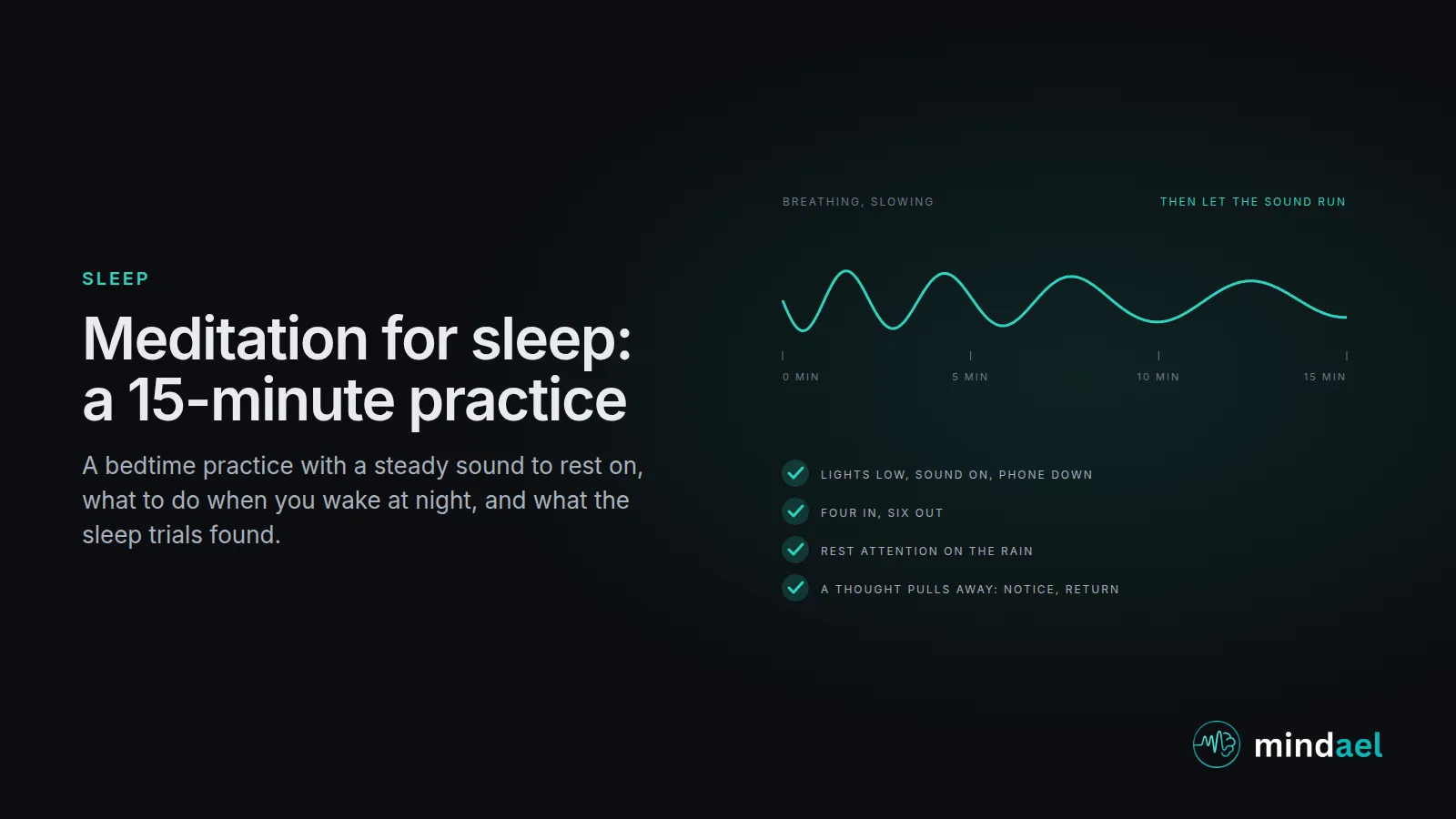
Meditation for sleep is not a trick for switching yourself off. It is a way of turning down the alertness that keeps you awake: the replayed conversation, the list for tomorrow, the body that is tired but still braced. The trials say it works for many people when it is practised nightly. Below is the fifteen-minute practice we suggest, the sound to do it with, and what the research found. The sounds are in Mindael, free to download on the App Store.
Why meditation helps you sleep
Falling asleep needs two things: enough sleep pressure, and low enough arousal. Most nights of lying awake are an arousal problem. The body is ready and the mind is not. Meditation trains the skill of noticing a thought without following it, which is exactly the skill a racing mind at 11 p.m. lacks.
The evidence is reasonable for a non-drug approach. In a randomised trial with older adults who slept poorly, six weeks of mindfulness practice improved sleep quality more than a sleep hygiene course, and reduced daytime fatigue and depression symptoms (Black et al., 2015). In adults with chronic insomnia, mindfulness programmes reduced time awake and insomnia severity (Ong et al., 2014). A 2019 meta-analysis of 18 trials found a moderate improvement in sleep quality compared with control conditions (Rusch et al., 2019). The pattern across studies: it builds over weeks, and it works best as a routine.
The fifteen-minute practice
1. Set the room first. Lights low, phone set up and then face down, sound chosen before you lie down. Rain or brown noise, quiet: you should be able to hear it, not have to listen to it.
2. Lie down and lengthen the out-breath. Breathe in for four, out for six, low into the belly, for a minute or two. Slow breathing with a longer exhale shifts the body toward its resting state (Zaccaro et al., 2018). After that, stop counting and let the breath go at its own pace.
3. Rest attention on the sound. Not on the breath, which is subtle and easy to start controlling. The sound is always there and needs nothing from you. Notice its texture, near and far, high and low.
4. Notice, return. A thought will pull you away within seconds. When you notice, note it lightly, “planning”, “replaying”, and come back to the sound. Each return is the practice, not a failure of it. Our how to start meditation guide covers this loop in detail.
5. Let the sound keep going. After about fifteen minutes stop doing anything. If you are asleep, the sound keeps the room steady. If not, keep resting on it.
Which sound to use
A steady sound with nothing to follow. Music with a melody invites the mind to track it; rain does not. Steady broadband sound also shortened the time to fall asleep in a sleep-lab study, probably by masking the small noises that jolt you back up (Messineo et al., 2017).
- Rain: the most common choice, natural and endlessly varied without changing.
- Brown noise: deeper and softer, best for a noisy street or a partner who snores.
- Ocean waves: a slow swell to breathe with, in on the rise, out on the fall.
- Delta waves: a 2 Hz beat under rain, with headphones, for people who like something underneath.
Our sleep sounds guide has more on picking the sound for the night you are having, and the meditation sounds guide covers sound for daytime practice.
When you wake in the night
Do the same practice, shorter. Do not check the time; the number starts a calculation. Out-breath long, attention on the sound, back when thoughts arrive. If after about twenty minutes you are still wide awake, get up, sit somewhere dim, and go back when sleepy. That rule is part of cognitive behavioural therapy for insomnia, and it protects the bed from becoming a place for lying awake.
Making it work
Same time, every night, for two weeks before judging it. Most people notice falling asleep is easier before they notice anything else. If a night goes badly, that is one night. If sleep stays poor for weeks, talk to a doctor; cognitive behavioural therapy for insomnia is the first-line treatment and works well alongside this practice. For the fastest routines on a hard night, see how to fall asleep fast, and for the body side of winding down, how to relax your nervous system.
Mindael is where we keep the sounds for this practice: rain, ocean, brown noise and delta beats, made in our studio, free to download.
Something steady to rest on.
Mindael has rain and ocean recorded without loops, brown and pink noise generated to spec and delta beats made in our studio, mixed two at a time and played all night. Free to download, no account, works offline. Lights low, sound on, attention on the sound.
- Rain, ocean, brown and pink noise and delta beats, studio-made
- Two sounds at once, fine volume control, all-night play
- Free to download, no account, works offline
 Free · No account needed · Works offline
Frequently asked questions
Does meditation help you sleep?
Yes, for many people, and the evidence is reasonably good. Randomised trials of mindfulness meditation improved sleep quality in older adults with sleep problems and in adults with chronic insomnia, and a 2019 meta-analysis of 18 trials found a moderate improvement in sleep quality. It helps by lowering the mental and physical arousal that keeps you awake, so it works best practised nightly rather than once.
What is the best meditation for sleep?
One you can do lying down, in the dark, without looking at a screen. Resting attention on a steady sound is the easiest for most people: rain or brown noise at a low level, attention on the sound, back to it when thoughts arrive. A slow out-breath underneath helps. A body scan is a good alternative if sound is not for you.
How long should I meditate before bed?
Ten to twenty minutes. Fifteen is a good default: long enough for breathing and heart rate to settle, short enough to do every night. If you fall asleep during it, that is fine; it is a sleep practice, not a test.
Is meditation music good for sleep?
Music with a melody can keep part of the mind following it. For sleep, a steady sound with nothing to follow works better for most people: rain, ocean, brown noise or a low drone. It masks small noises in the room and gives attention somewhere to rest. Keep it quiet and let it run.
What should I do if I wake up at 3 a.m.?
Do not check the time. Start the same practice: slow out-breath, attention on the sound, come back when thoughts arrive. If you are still awake after about twenty minutes, get up, sit somewhere dim and calm, and return when sleepy. Lying awake for long periods teaches the bed to be a place for being awake.
Can meditation replace sleep?
No. Meditation is restful and can lower the stress that follows a bad night, but it does not do what sleep does. Use it to fall asleep, not instead of sleeping.
Sources
- Black DS, et al. Mindfulness meditation and improvement in sleep quality and daytime impairment among older adults with sleep disturbances: a randomized clinical trial. JAMA Internal Medicine, 2015.
- Ong JC, et al. A randomized controlled trial of mindfulness meditation for chronic insomnia. Sleep, 2014.
- Rusch HL, et al. The effect of mindfulness meditation on sleep quality: a systematic review and meta-analysis of randomized controlled trials. Annals of the New York Academy of Sciences, 2019.
- Zaccaro A, et al. How breath-control can change your life: a systematic review on psycho-physiological correlates of slow breathing. Frontiers in Human Neuroscience, 2018.
- Messineo L, et al. Broadband sound administration improves sleep onset latency in healthy subjects in a model of transient insomnia. Frontiers in Neurology, 2017.
This article is for general information and is not medical advice. If poor sleep lasts more than a few weeks, if you snore loudly or stop breathing in your sleep, or if anxiety or low mood are keeping you awake, please talk to a doctor.
This article is part of our sleep guide. Hear the sounds in this article in the Mindael sound library, or see our app comparison checklists.