

How to Start Meditation: A Ten-Minute Beginner's Practice, the First Ten Days, and What the Research Says You Will Get
Start meditation with ten minutes, not twenty; a sound to rest attention on rather than the breath, which beginners find slippery; a timer that fades; and the same time every day. The practice is: sit, play a steady sound low, put attention on it, notice when attention has gone, bring it back without comment, repeat until the sound fades. That noticing and returning is the whole skill. Thirteen minutes a day for eight weeks measurably improved attention, memory and mood in people who had never meditated, and even brief training over four days improved attention and working memory. The habit takes longer than the benefits: on average about two months of daily repetition, with missed days doing no harm. The first ten days are a schedule, not a test.
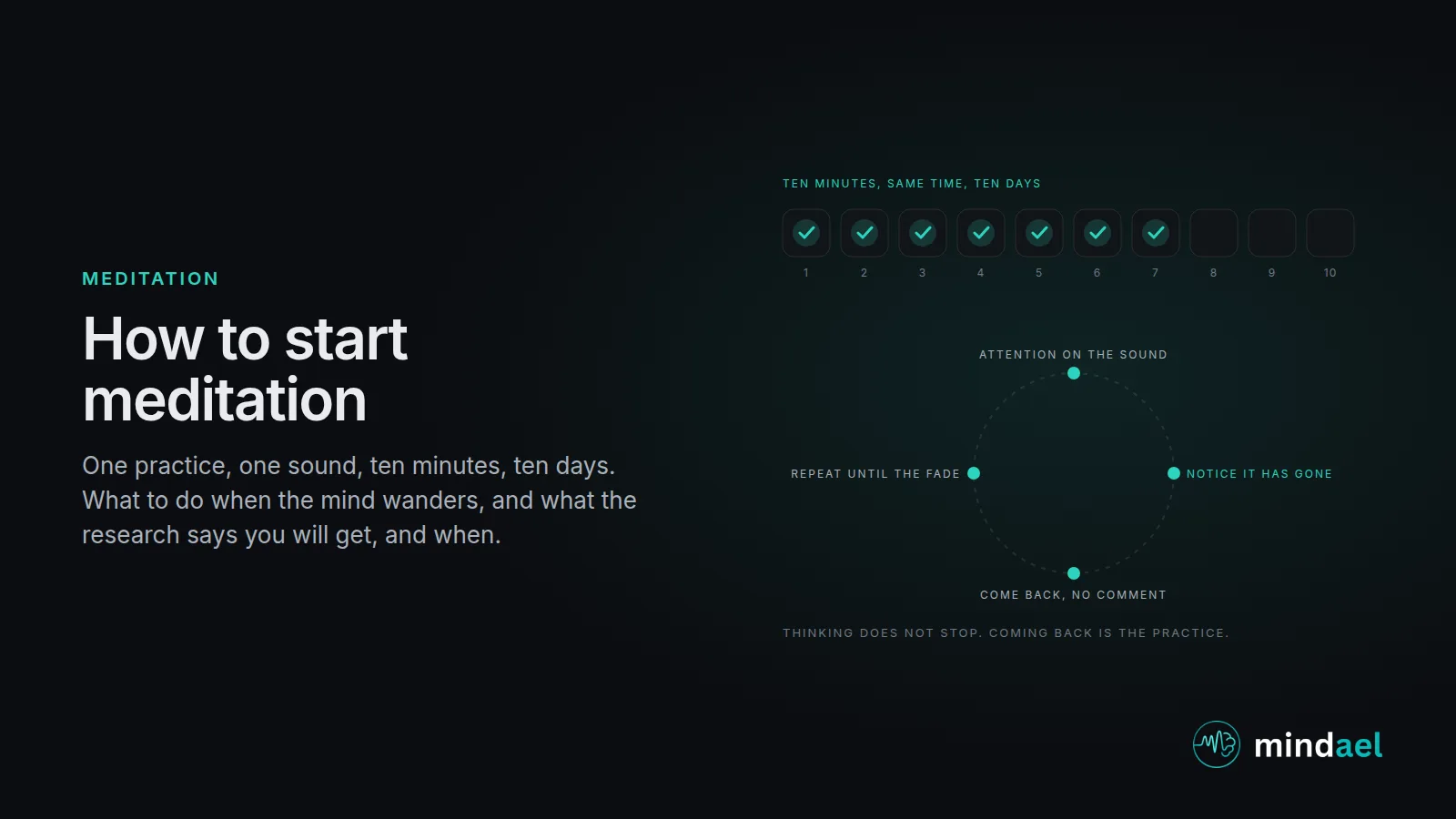
How to start meditation is a question that gets answered with far too much. Postures, lineages, apps, forty kinds of practice, and a beginner who wanted to sit down for ten minutes closes the tab. This is the short version: one practice, one sound, ten minutes, ten days, and the research that says what you will get and when. The sounds and the fading timer are in Mindael, free to download on the App Store, and our meditation sounds guide covers the sits you can grow into once this one is easy.
The practice, in full
Sit on a chair with your feet flat, or on a cushion with your knees below your hips. Back upright but not rigid; hands in your lap. Eyes closed, or half open and lowered.
Play a steady sound at a low level. Rain is the one we recommend for the first ten days: it is always there, it has no pattern to follow, and you cannot control it, which is exactly why it is easier than the breath. Set a timer for ten minutes that fades the sound rather than ringing.
Put your attention on the sound. Not on thinking about it; on hearing it, the way you would listen for someone’s footsteps.
Within a few seconds your attention will have gone: to a plan, a memory, an itch, the question of whether you are doing this right. At some point you will notice that it has gone. That noticing is the moment the practice is about. When it comes, bring attention back to the sound, without a comment on the lapse, and begin again.
Repeat until the sound fades. Sit for a few breaths in the silence, then open your eyes before you move.
That is all of it. A session with fifty returns is not a bad session; it is fifty repetitions of the one skill meditation trains, which is noticing where attention is and choosing where it goes. The mind does not go quiet. What changes, over weeks, is how fast you notice and how calmly you come back, and that change shows up in the rest of the day.
Why a sound, and which one
The breath is the classic anchor, and the hardest. It is subtle, it moves, and the moment you attend to it you start managing it. A sound sits still. Our meditation sounds guide explains the three things a sound does in a sit; for a beginner the one that matters is having somewhere unmistakable to return to.
After the first ten days, two upgrades. The 6 Hz theta beat, in earbuds, under a low drone: a 2017 EEG study found it raised the brain’s theta rhythm, the one associated with a settled, inward state, within ten minutes (Jirakittayakorn and Wongsawat, 2017); the binaural beats article explains why it needs earbuds. And one minute of guided slow breathing at the start, four in and six out, which lowers arousal before you sit (Zaccaro et al., 2018); the breathing guide has the patterns. Then let the breath go natural and return to the sound.
What you will get, and when
Honest expectations help more than enthusiasm. A 2014 review of 47 trials found meditation programmes produced moderate improvements in anxiety, depression and pain, and found no evidence they beat active treatments like exercise or therapy (Goyal et al., 2014). That is the ceiling: real, moderate, not magic.
The timeline is quicker than most people think. Four days of twenty-minute sessions improved attention and working memory compared with a listening control (Zeidan et al., 2010). Thirteen minutes a day for eight weeks, in people who had never meditated, improved attention, memory, mood and emotional regulation; the same group showed no change at four weeks, which is worth knowing when week three feels pointless (Basso et al., 2019). In our listeners’ words, the first thing to change is the speed of coming back from a distraction, usually inside two weeks; the mood effects are slower and quieter.
Making it a habit: the first ten days
The benefits arrive faster than the habit. In a study that tracked people forming a new daily behaviour, it took on average about 66 days to feel automatic, with a wide range, and missing a single day made no measurable difference to the outcome (Lally et al., 2010). So the first ten days are not a test of whether meditation works; they are the start of a schedule.
What makes it stick, from that research and from watching people try: same time, same place, same sound, every day, attached to something you already do. After the coffee, before the phone, is the slot most people keep. Ten minutes, never more in the first month; a target you can hit on a bad day beats a target you can hit on a good one. The sound does double duty here: after a couple of weeks, pressing play is the cue, and the body settles before you have sat down. A tick on a paper calendar each day, nothing fancier. If you miss a day, the next day is day one of nothing; just sit.
What to do when it goes wrong
Restlessness. Normal, especially in the first minutes. Shorten to five minutes rather than quit, and try a lying-down sit with brown noise if sitting upright is the problem.
Sleepiness. Sit earlier in the day, eyes half open, back a little straighter. If you keep falling asleep, you are short of sleep, and the sleep sounds guide is the better page for this month.
Distress. Sitting quietly can bring up what the day has been covering. If that is uncomfortable, open the eyes, shorten the sit, keep the sound on, and if it is persistent, a therapist is the right person to sit with it. Meditation is not a treatment and does not need to be one.
“I’m not doing it right.” If you are noticing that attention has wandered and bringing it back, you are doing it right. There is no other right.
Where to go after ten days
Twenty minutes instead of ten, once ten is easy. The theta beat and a drone instead of rain. A silent mantra practice, which our transcendental-style meditation article lays out step by step, or a chanted one with the Gayatri mantra. A structured body scan through the seven centres, in the chakra meditation guide, for people who like a map. Or just the same ten minutes with the same rain for a year, which is what most of the people who keep meditating actually do.
The short version
Sit, rain on low, ten minutes with a fade. Attention on the sound; notice when it has gone; come back without comment; repeat. Same time every day for ten days, then decide nothing and do ten more. Attention changes in weeks, mood in a couple of months, the habit in about two. Mindael has the rain, the drone, the theta beat and the fading timer, free to download; the sitting is yours.

Something steady to come back to.
Mindael has rain, ocean and a stream recorded without loops, low drones and the 6 Hz theta beat made in our studio, and a timer that fades the sound out at the end of the sit. Free to download, no account, works offline. Press play, sit, and come back to it as many times as you need.
- Rain, ocean, drones and theta beats, studio-made
- A timer that fades instead of ringing
- Free to download, no account, works offline
 Free · No account needed · Works offline
Frequently asked questions
How do I start meditating as a complete beginner?
Sit comfortably, play a steady sound such as rain at a low level, set a ten-minute timer that fades, and rest your attention on the sound. When you notice your attention has gone somewhere else, which will happen within seconds, bring it back to the sound without judging the lapse. That is the entire practice. Do it at the same time each day for ten days before you decide anything about it.
How long should a beginner meditate?
Ten minutes. Long enough for the mind to settle a little, short enough to do daily. The study that found improvements in attention, memory and mood in non-meditators used thirteen minutes a day. Twenty minutes is a fine target for month two; five minutes on a bad day still counts.
What do I focus on when meditating?
Something steady and present. The breath is the classic anchor and the hardest for beginners, because it is subtle and you can accidentally control it. A sound, rain, a low drone or a theta beat, is easier: it is always there, you cannot control it, and returning to it a hundred times is the practice. Once sound feels easy, try the breath.
What if I can't stop thinking during meditation?
You are not supposed to. Thinking does not stop; what changes is how quickly you notice you have drifted and how calmly you come back. Each return is one repetition of the skill. A session with fifty returns is not a failed session; it is fifty reps.
How long before meditation works?
Studies have found measurable improvements in attention and working memory after four days of twenty-minute sessions, and in attention, memory, mood and emotional regulation after eight weeks of thirteen minutes a day. Most people notice they come back from distraction faster within two weeks. The habit itself takes about two months to feel automatic.
Do I need an app to meditate?
No. You need a timer and, ideally, a steady sound. Mindael provides both, free to download, with a timer that fades the sound instead of ringing; a guided voice from any source can run over the top if you want instruction, and our Headspace and Insight Timer alternative pages say what Mindael does and does not do compared with guided apps.
Sources
- Basso JC, et al. Brief, daily meditation enhances attention, memory, mood, and emotional regulation in non-experienced meditators. Behavioural Brain Research, 2019.
- Zeidan F, et al. Mindfulness meditation improves cognition: evidence of brief mental training. Consciousness and Cognition, 2010.
- Goyal M, et al. Meditation programs for psychological stress and well-being: a systematic review and meta-analysis. JAMA Internal Medicine, 2014.
- Lally P, et al. How are habits formed: modelling habit formation in the real world. European Journal of Social Psychology, 2010.
- Jirakittayakorn N, Wongsawat Y. Brain responses to a 6-Hz binaural beat: effects on general theta rhythm and frontal midline theta activity. Frontiers in Neuroscience, 2017.
- Zaccaro A, et al. How breath-control can change your life: a systematic review on psycho-physiological correlates of slow breathing. Frontiers in Human Neuroscience, 2018.
This article is for general information and is not medical advice. Meditation is not a treatment for a mental health condition; if low mood or anxiety is persistent, or if sitting quietly makes distress worse, please talk to a doctor or therapist.
This article is part of our meditation guide. Hear the sounds in this article in the Mindael sound library, or see our app comparison checklists.