
How to Take a Nap: The Setup, the Timing, How to Fall Asleep in Ten Minutes and How to Wake Without Oversleeping
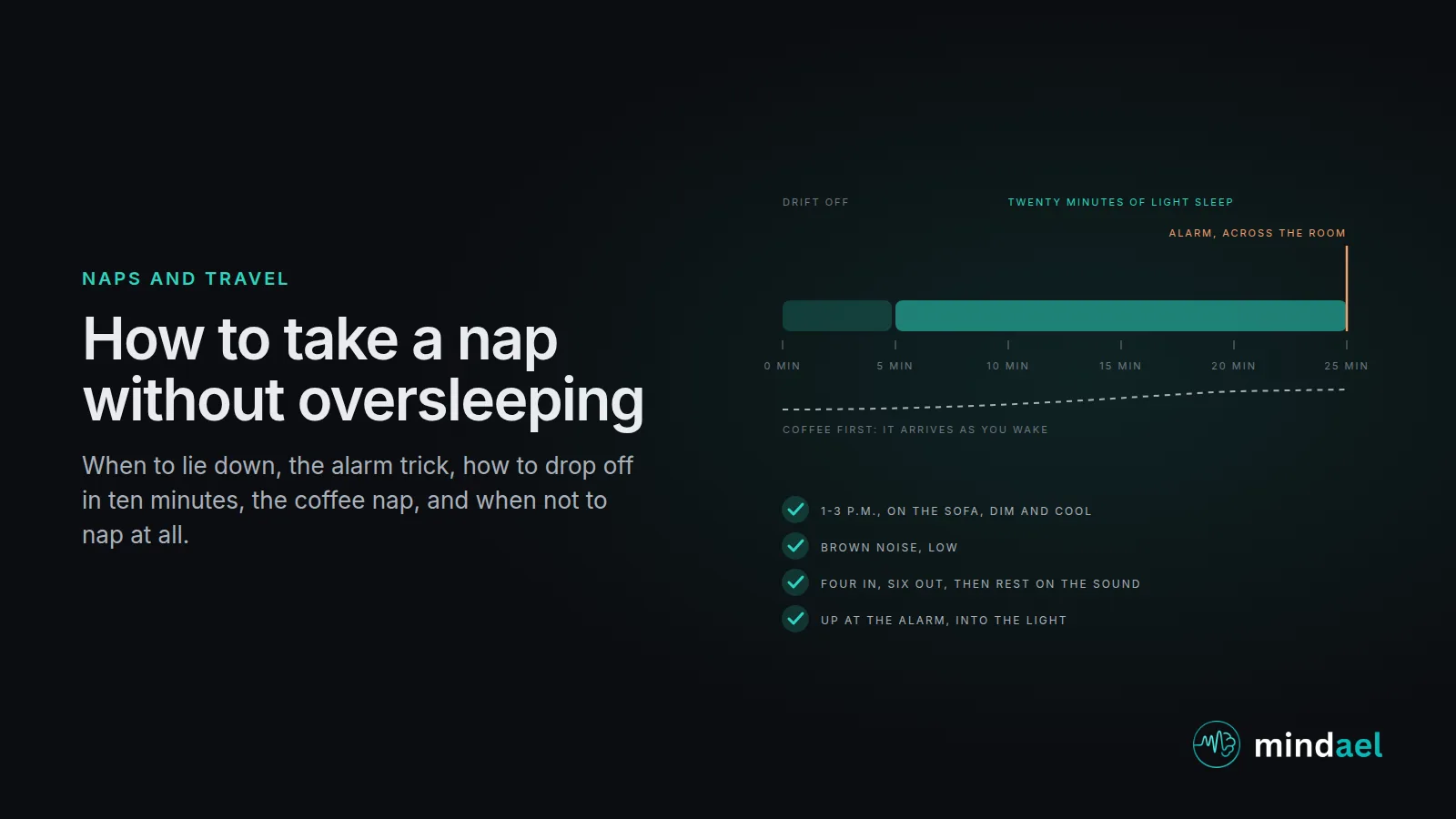
To take a nap that works, lie down between about 1 and 3 p.m., set an alarm for 25 minutes so that you get 20 minutes of sleep after the time it takes to drop off, darken the room or cover your eyes, and play a steady low sound to mask the daytime noise. Lie on your back or side with your phone face down, breathe slowly with a longer exhale, and let attention rest on the sound; you do not have to fall fully asleep for a short nap to help. To avoid oversleeping, put the alarm across the room and nap sitting slightly up. For a stronger effect before a drive or an afternoon of work, drink a coffee just before lying down: it takes about 20 minutes to act, which is exactly when the alarm goes. Skip the nap after about 4 p.m., or if you have insomnia at night.
How to take a nap sounds like a question nobody needs to ask, until you have lain down for twenty minutes and woken two hours later feeling worse than before. A good nap is a small piece of technique: the right time of day, the right length, a room that lets you drop off, and a way of waking that does not depend on willpower. This article is the practical version, step by step. The sounds many of our listeners nap to are in Mindael, free to download on the App Store, and the research on each nap length, with jet lag and shift work, is in our nap guide.
Step 1: Pick the window
The body has a natural dip in alertness in the early afternoon, roughly 1 to 3 p.m. for someone who wakes around 7, and that is when a nap comes most easily and costs least at night. Afternoon naps in that window improved alertness and performance in a review of the napping research, which also found that people who nap regularly fall asleep faster and wake less groggy than occasional nappers (Milner and Cote, 2009). After about 4 p.m., a nap eats into the sleep pressure you need for the night.
Step 2: Set the alarm before you lie down
Twenty-five minutes. Most people take about five minutes to drop off, which leaves twenty minutes of sleep: long enough to help, short enough to stay out of deep sleep. In a 2006 study of different nap lengths after a short night, 10 and 20 minute naps improved alertness and performance for up to about two and a half hours, while a 30 minute nap caused a period of grogginess before its benefits arrived (Brooks and Lack, 2006). If you have lost most of a night, set ninety-five minutes instead, for a full cycle; a 60 to 90 minute nap with deep and dream sleep matched a full night for one kind of learning in a well-known experiment (Mednick et al., 2003). Avoid anything between.
The trick that stops oversleeping: put the phone or alarm across the room, so that turning it off means standing up.
Step 3: Make the room easy
Dim, cool, and steady. Close the blind or use an eye mask. Lie on a sofa or recline in a chair rather than getting into bed, which signals a short sleep and keeps it lighter. And play a steady, low sound: daytime is full of intermittent noise, voices, deliveries, a neighbour’s drill, and each one is a small reason to stay alert. In a lab study, steady broadband sound cut the time to fall asleep by about a third in a noisy setting (Messineo et al., 2017). Brown noise is the easiest to nap under, pink noise if the noise outside is voices and traffic, rain if you dislike static; our noise colours comparison explains the difference. Keep it at a quiet-conversation level or lower.
Step 4: Drop off in ten minutes
Phone face down, out of reach. Lie still, eyes closed. Breathe four counts in and six out, low into the belly, for a minute or two; slow breathing with a longer exhale lowers arousal across many studies (Zaccaro et al., 2018). Then let the breathing go and rest attention on the sound, nothing else. When a thought pulls you away, notice it and come back to the sound. That is the same move our how to fall asleep fast article uses at night, and it works faster in the afternoon dip.
Do not try to sleep. For a short nap, light sleep, the drifting stage where you half hear the room, is most of what you are after, and many people who say they “didn’t sleep” were in it for ten minutes. If you lie there awake until the alarm, you still rested.
Step 5: The coffee nap, when you need it
For a drive, an exam or an afternoon of hard work, drink a cup of coffee quickly, then lie down straight away with the alarm set for twenty minutes. Caffeine takes about that long to act, so it arrives as you wake, and the nap clears the sleepiness the caffeine would only cover. In a driving simulator study, sleepy drivers given a coffee plus a short nap had less sleepiness and fewer incidents than with either alone (Reyner and Horne, 1997). Not after mid-afternoon, for the same reason as the nap itself.
Step 6: Get up properly
When the alarm goes, get up immediately, before the bargaining starts. Light on your face, a glass of water, a short walk or a few minutes of movement. Any grogginess after a 20 minute nap passes in a few minutes; after a long nap, give it half an hour before anything that needs a clear head.
When not to nap
If you have trouble falling or staying asleep at night, skip naps: daytime sleep takes the edge off the sleep pressure that gets you down at night, and the treatment with the best evidence for insomnia limits it. If you need a nap every single day despite a full night in bed, or you nod off without meaning to, that is worth a conversation with a doctor. And never nap behind the wheel; pull over somewhere safe first.
For naps on a plane, in a hotel or across time zones, the sleep in the airplane article and the nap and jet lag guide have the rest. For the night that follows, the sleep sounds guide does.
The short version
Between 1 and 3 p.m. Alarm for 25 minutes, across the room. Dim, cool, on the sofa, a steady low sound. Slow breath, then rest on the sound; sleep is optional. Coffee first when you need the boost. Up at the alarm, into the light. No naps after 4 p.m., and none if your nights are the problem.
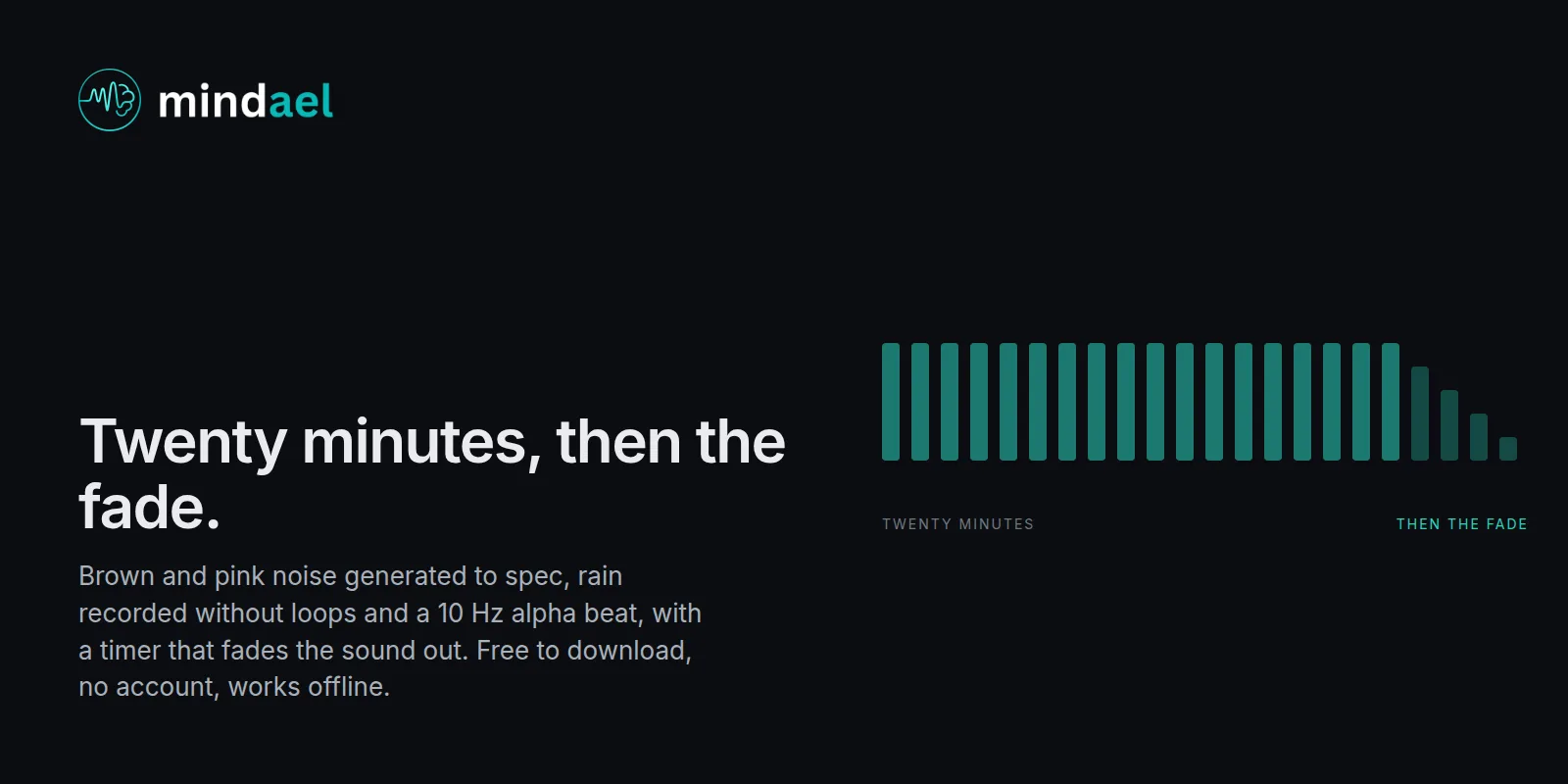
Twenty minutes, then the fade.
Mindael has brown and pink noise generated to spec, rain recorded without loops and a 10 Hz alpha beat made in our studio, with a timer that fades the sound out so waking is gentle. Free to download, no account, works offline. Set twenty-five minutes, lie down, and let the sound end the nap.
- Brown and pink noise, rain and alpha beats, studio-made
- A timer that fades, two sounds at once
- Free to download, no account, works offline
 Free · No account needed · Works offline
Frequently asked questions
How do you take a nap?
Lie down in a dim, quiet place between about 1 and 3 p.m., with a steady low sound playing and an alarm set for 25 minutes. Put the phone face down, breathe slowly with a long exhale and rest attention on the sound. Get up as soon as the alarm goes, and get light on your face. Twenty minutes of sleep is the length that leaves you sharper without grogginess.
How do you take a nap without oversleeping?
Set the alarm before you lie down, for 25 minutes, and put it out of reach so you have to stand up to stop it. Nap on a sofa or a reclined chair rather than in bed, which keeps sleep lighter. A coffee just before the nap helps too, because the caffeine reaches the brain at about the time the alarm goes.
How long should a nap be?
Ten to twenty minutes for alertness, or about ninety minutes for a full cycle when you have lost a night's sleep. Thirty to sixty minutes is the length to avoid on an ordinary afternoon, because you are likely to wake from deep sleep and feel worse for half an hour. Our nap guide has the research on each length.
What if I cannot fall asleep during a nap?
Lie there anyway until the alarm. Quiet rest with eyes closed still lowers arousal, and many people are in light sleep without noticing it. If it happens every time, nap a little later, closer to the natural afternoon dip, and keep the room darker.
What is a coffee nap?
A cup of coffee drunk quickly right before a 15 to 20 minute nap. The caffeine takes about 20 minutes to act, so it arrives as you wake, and the two effects add up. In a driving simulator study, a coffee plus a short nap reduced sleepiness and driving errors more than either alone.
When should you not nap?
After about 4 p.m., because a late nap takes away the sleep pressure you need at night. And if you have trouble falling asleep at night, because naps make that worse; the treatment for insomnia limits daytime sleep. If you need a nap every day despite a full night in bed, mention it to a doctor.
Sources
- Brooks A, Lack L. A brief afternoon nap following nocturnal sleep restriction: which nap duration is most recuperative? Sleep, 2006.
- Milner CE, Cote KA. Benefits of napping in healthy adults: impact of nap length, time of day, age, and experience with napping. Journal of Sleep Research, 2009.
- Reyner LA, Horne JA. Suppression of sleepiness in drivers: combination of caffeine with a short nap. Psychophysiology, 1997.
- Mednick S, Nakayama K, Stickgold R. Sleep-dependent learning: a nap is as good as a night. Nature Neuroscience, 2003.
- Messineo L, et al. Broadband sound administration improves sleep onset latency in healthy subjects in a model of transient insomnia. Frontiers in Neurology, 2017.
- Zaccaro A, et al. How breath-control can change your life: a systematic review on psycho-physiological correlates of slow breathing. Frontiers in Human Neuroscience, 2018.
This article is for general information and is not medical advice. If you need to nap every day despite a full night in bed, fall asleep without meaning to, or snore loudly with pauses in breathing, please talk to a doctor. Never nap at the wheel; pull over somewhere safe first.
This article is part of our travel, jet lag and naps guide. Hear the sounds in this article in the Mindael sound library, or see our app comparison checklists.