
Morning Affirmations: How to Write Ones That Work, What the Research Says, and a Five-Minute Morning Practice
Morning affirmations are one of the simplest spiritual practices: a few sentences, said or written at the start of the day, to set its tone. The research behind them is more interesting than the slogans suggest. Affirmations about what you value, in your own words, have a solid evidence base. Big positive statements you do not believe can make you feel worse. This page explains the difference, shows how to write morning affirmations that work, and gives a five-minute practice with a steady sound. The sounds are in Mindael, free to download on the App Store.
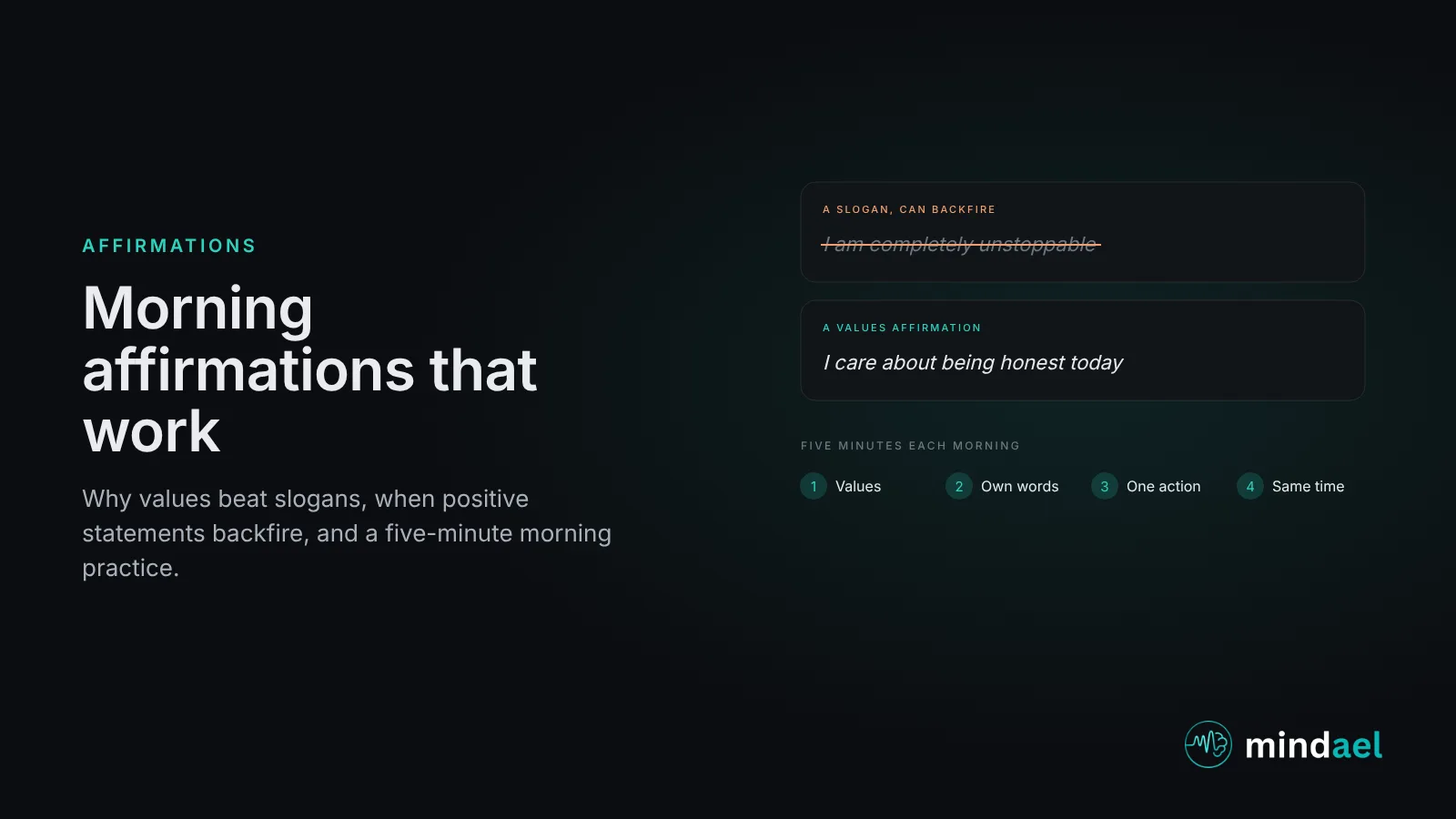
The morning affirmations that work are about your values, not your wishes. In psychology, self-affirmation means reflecting on what matters most to you, such as family, honesty or curiosity, and it has been tested in many studies: it made people more open to difficult information and, in a meta-analysis, had small positive effects on health intentions and behaviour. In a brain-imaging study, reflecting on future-oriented values activated systems linked to self-related thinking and reward. Big positive statements are different: repeating 'I am a lovable person' lifted the mood of people with high self-esteem and made people with low self-esteem feel worse. So write two or three sentences about what you value and how you want to act today, say them slowly with a steady sound, and pair them with one action.
Sounds that work, and why
528 Hz tone
A soft, warm tone many people use for a morning intention, steady enough to hold attention while you speak or write.
Theta waves
A 6 Hz beat in earbuds for a quiet, reflective five minutes before the day starts.
Rain
The simplest anchor: steady, natural and easy to return to when your mind runs ahead to the to-do list.
Ocean waves
A slow swell to breathe with: say one affirmation on each out-breath.
Alpha waves
A 10 Hz beat under rain for the transition from reflection to the first task of the day.
Two kinds of affirmation
Most lists of morning affirmations mix two very different things. One is the slogan: “I am abundant”, “everything is working out for me”, “I am confident and unstoppable”. The other is the values affirmation: a sentence about what matters to you and how you want to act. They feel similar. The research treats them very differently.
What the research supports
In psychology, self-affirmation means reflecting on your core values, usually by writing about one that matters to you. It has been tested in a large number of studies. A major review describes how it helps people stay open when they face threats to their sense of self, from a hard conversation to a health warning, and how small affirmations at the right moment can have lasting effects (Cohen and Sherman, 2014). A meta-analysis of health studies found small positive effects of self-affirmation on accepting health messages, intentions and actual behaviour (Epton et al., 2015).
There is a brain side too. In an imaging study, people who reflected on their important values, especially values about the future, showed more activity in brain systems linked to thinking about the self and to reward than people who did not (Cascio et al., 2016). Affirming what you care about seems to feel rewarding in a real, measurable way.
When affirmations backfire
Slogans are the risky kind. In two experiments, people with low self-esteem who repeated “I am a lovable person” felt worse afterwards than people who did not, while people with high self-esteem felt slightly better (Wood et al., 2009). When a statement is far from what you believe, the mind notices the gap, not the statement. That is why “I am rich” on a hard month can sting.
The fix is simple: say things you can honestly agree with. “I am learning to be patient” works where “I am completely calm” does not. Values are the safest ground, because you already hold them.
How to write your own
Start with two or three values: family, honesty, health, creativity, kindness, courage. Write one sentence for each in your own words. Then add how you will act on it today. “I care about my health, so I will walk at lunch.” “Honesty matters to me; I will say what I think in the meeting.” That last part connects the morning practice to the day, which is the same principle behind our manifesting on paper page and the manifestation guide.
A five-minute morning practice
Same time each day, before the phone. Put on a steady sound, such as rain, a soft 528 Hz tone or a theta beat in earbuds. Breathe slowly for a minute. Say each affirmation on an out-breath, three times. Finish with the one action you will take today. If you want to sit a little longer, our how to start meditation article has a ten-minute beginning, and the morning guide covers the rest of the first hour. Mindael is where we keep our morning sounds: rain, ocean, a 528 Hz tone and binaural beats, made in our studio, free to download.
How to set it up tonight
- Choose two or three valuesWhat matters most to you: family, honesty, health, creativity, kindness. Pick the ones you want to live by today.
- Write them in your own words'I care about being honest with people I love.' Not a slogan, a sentence you actually believe.
- Add how you will act'Today I will tell my sister the truth about the trip.' One concrete action makes the value real.
- Say them slowly with a soundRain or a soft tone on, one sentence per out-breath, three times. Five minutes in all.
- Keep the same time and soundAfter the first coffee, before the phone. Repetition in the same context turns it into a habit.
Five quiet minutes, then the day.
Mindael has rain and ocean recorded without loops, a 528 Hz tone and theta and alpha beats made in our studio, two at a time. Free to download, no account, works offline. A steady sound for a morning practice that sets the tone without asking for attention.
- Rain, ocean, 528 Hz and binaural beats, studio-made
- Two sounds at once, fine volume control
- Free to download, no account, works offline
 Free · No account needed · Works offline
Frequently asked questions
Do morning affirmations work?
Affirmations about your values, in your own words, have good evidence behind them: they help people stay open under stress and had small positive effects on health behaviour in a meta-analysis. Generic positive statements you do not believe can backfire, especially for people with low self-esteem.
What are good morning affirmations?
Sentences about what you value and how you want to act today, in your own words. For example: 'I care about my health, so today I will walk at lunch.' 'Kindness matters to me; I will listen properly when my partner talks.' They work better than 'I am rich' or 'everything goes my way'.
Why do some affirmations make me feel worse?
Because the gap between the statement and what you believe is what you notice. In a 2009 study, people with low self-esteem felt worse after repeating 'I am a lovable person'. Choose statements you can honestly agree with, or switch to values.
How long should I say morning affirmations?
Five minutes is enough. Two or three sentences, said slowly, then one action. The value comes from doing it most mornings, not from length.
Should I say affirmations out loud or write them?
Either. Writing them helps you choose your words carefully; saying them slowly with a steady sound helps you take them in. Many people write them once a week and say them each morning.
Can affirmations replace therapy or medication?
No. They are a small daily practice, not a treatment. If you are struggling with low mood or anxiety, please talk to a doctor or therapist.
Sources
- Cohen GL, Sherman DK. The psychology of change: self-affirmation and social psychological intervention. Annual Review of Psychology, 2014.
- Epton T, et al. The impact of self-affirmation on health-behavior change: a meta-analysis. Health Psychology, 2015.
- Cascio CN, et al. Self-affirmation activates brain systems associated with self-related processing and reward and is reinforced by future orientation. Social Cognitive and Affective Neuroscience, 2016.
- Wood JV, Perunovic WQE, Lee JW. Positive self-statements: power for some, peril for others. Psychological Science, 2009.
This page is for general information and is not medical or psychological advice. Affirmations are a daily practice, not a treatment. If you are struggling with low mood, anxiety or thoughts of self-harm, please talk to a doctor or a crisis line.