

Manifesting on Paper: What Writing a Goal Down Actually Does, the 369 Method and Scripting Explained, and a Five-Minute Page That Works
Manifesting on paper covers three popular formats: the 369 method (writing an affirmation 3 times in the morning, 6 in the afternoon, 9 at night), scripting (writing a page in the present tense as if the goal were already true), and the plain goal list. None of them works by sending a signal to the universe; there is no evidence for that and no mechanism. What the research does support is narrower and more useful: writing a goal down makes it concrete and keeps it in mind; writing the steps and the obstacles, with an if-then plan for each, roughly doubles follow-through across 94 studies; picturing the process beats picturing the prize; and a short gratitude list lifts mood over weeks. Pure wishful writing, the kind that pictures only the finished result, measurably lowers the energy to act. We give a five-minute page that keeps what works and drops the rest.
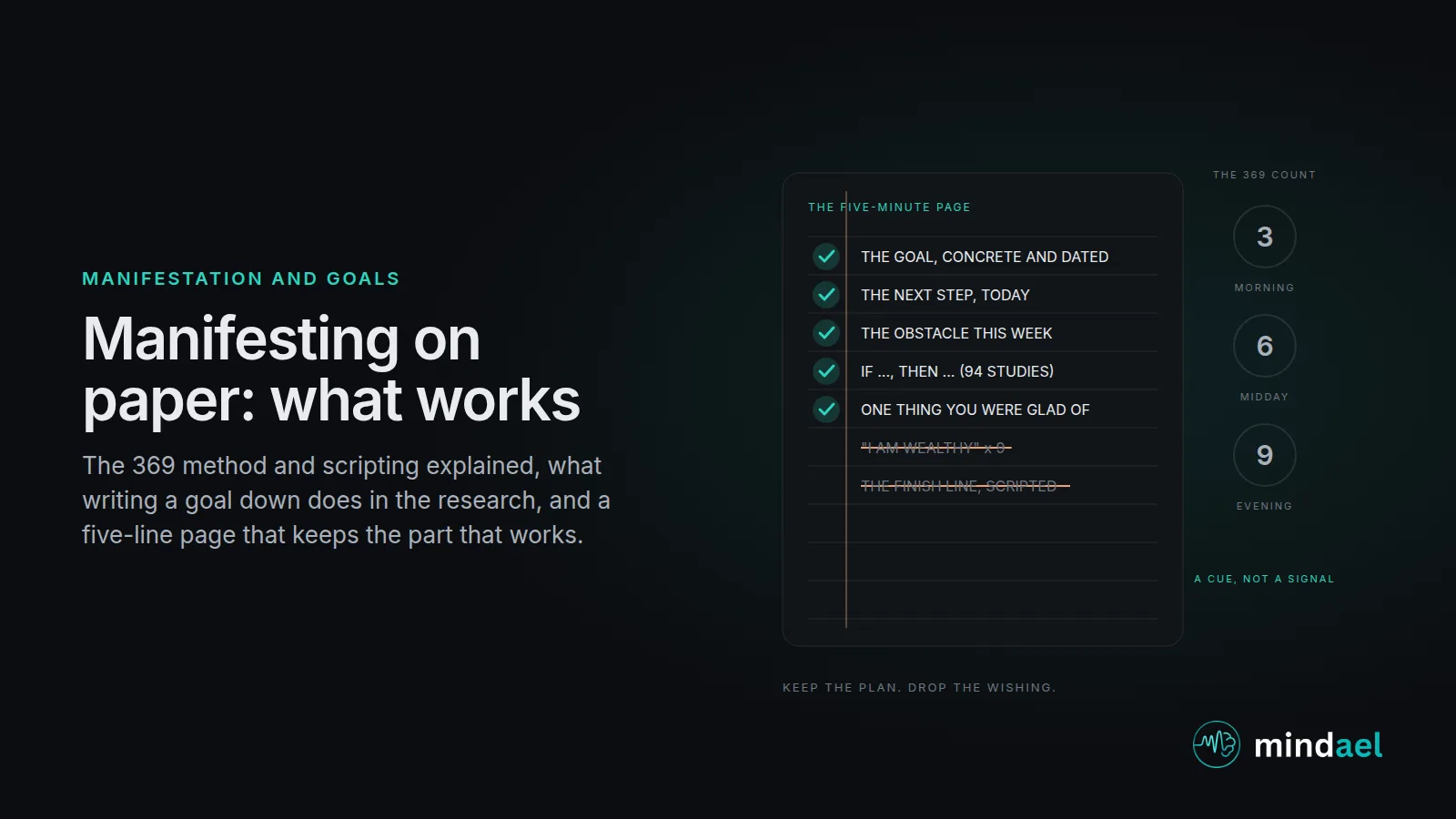
Manifesting on paper is the version of the law of attraction that most people actually try, because it needs nothing but a notebook: write the goal, write it again, write it as if it were already true. The formats have names, the 369 method and scripting, and millions of views. This article explains what each one is, what writing a goal down genuinely does according to the research, which parts of the practice work for ordinary reasons, which part does not work at all, and then gives a five-minute page that keeps the useful bit. The sound many of our listeners write to is in Mindael, free to download on the App Store, and the full morning practice around the page is in our law of attraction guide.
The three formats
The 369 method. Write a short affirmation of the goal three times in the morning, six times in the afternoon and nine times at night, usually for 21 or 33 days. The numbers are credited to Nikola Tesla’s reported fascination with 3, 6 and 9, which is folklore about a man who had nothing to say about goal-setting. Stripped of the story, the method is a reminder of a goal at three fixed times a day, with the goal written in one sentence. That is not nothing, as we will see; it is also not more than that.
Scripting. Write a page, or several, in the present tense, in detail, as if the goal has already happened: the office, the view, the feeling. The instruction is to feel it as real. It is the most enjoyable of the three formats, and the one the research is least kind to.
The plain list. Goals written down, sometimes with a date, sometimes with “I am” in front of each. Older than social media, and the format that the goal-setting research mostly studied.
The claim, stated fairly
Behind all three is the law of attraction: that a thought held with enough feeling sends out a frequency the universe matches, and that writing concentrates the thought. We said in the law of attraction guide what we repeat here: there is no evidence for that claim and no mechanism by which paper could carry it, and anything in these methods that works, works through you. That is good news rather than bad, because the parts that work through you are well studied and the studies say how to do them.
What writing a goal down does
It makes the goal concrete. The act of writing forces a vague wish (“be healthier”, “more money”) into a sentence, and a sentence has to be specific to be finished. A dated, concrete goal is the first thing every goal-setting study asks for, and the thing most people skip when they only think about a goal.
It roughly doubles follow-through, if you write the plan and not only the goal. The largest effect in this literature belongs to implementation intentions: a written if-then sentence tying a situation to an action (“if it is Tuesday at 7 p.m., then I go to the pool”). Across 94 studies with more than 8,000 participants, adding one to a goal had a medium-to-large effect on whether people actually did the thing (Gollwitzer and Sheeran, 2006). That sentence is the single most useful line that can go on a manifesting page, and almost no manifesting format includes it.
Picturing the process helps; picturing the prize does not. Students who spent a few minutes a day mentally rehearsing how they would study for an exam began studying earlier, studied longer and scored higher than a control group; students who spent the same minutes picturing themselves having already got a high grade gained nothing on the control group (Pham and Taylor, 1999). Scripting, as usually taught, is the second condition.
Fantasy about the finished result lowers energy. In four studies, people who indulged in positive fantasies about an idealised future, the slimmer body, the job, the exam passed, showed lower systolic blood pressure, a marker of mobilised energy, and reported less energy, than people who imagined the future more realistically, obstacles included (Kappes and Oettingen, 2011). The body treats the imagined success as partly achieved and relaxes. This is the specific, replicated problem with scripting the finish line.
Affirmations backfire for the people who most want them. Repeating “I am a lovable person” raised mood a little in people who already had high self-esteem and made people with low self-esteem feel worse, in a 2009 study, because the sentence invited an internal argument the person lost (Wood et al., 2009). A 369 affirmation written 18 times a day is a lot of invitations.
A gratitude line lifts mood over weeks. People who listed a few things they were grateful for each week, for ten weeks, reported better mood and more optimism than people who listed hassles or neutral events (Emmons and McCullough, 2003). Many manifesting pages end with gratitude, and that is the part of them we would keep without changes.
The habit takes about two months. Daily repetition of a small action at a fixed cue became automatic after a median of 66 days in the one real-world study to measure it, with missed days doing little harm (Lally et al., 2010). The 369 method’s 21 or 33 days are too short for a habit and too long for a stunt, but the fixed times are a genuinely good cue.
The five-minute page
Same time each morning, before the phone. The same sound, low, for the whole five minutes: rain on a speaker or the 6 Hz theta beat in earbuds, which has research behind it for the easy, picturing kind of attention (our binaural beats article explains what that research does and does not show). The sound’s job is to be the cue for the page, so that after a few weeks sitting down with it is the habit, not a decision.
Five lines, in this order:
- The goal. One sentence, concrete and dated. “Submit the application by 15 November,” not “get the job.”
- The next step. The next physical action, something that can be done today. “Email Dana for the reference.”
- The obstacle. The most likely thing this week to stop step two. Naming it is what the fantasy studies found missing.
- The if-then. “If it is 7 p.m. and the email is not sent, then I send a two-line version before dinner.” This is the line with the 94 studies behind it.
- One thing from yesterday you were glad of. Specific, small, true.
Then close the notebook and do step two before the page is allowed to count. If you want to keep a 369 rhythm, read the goal line at lunch and in the evening, once each; writing it nine more times adds nothing. If you want to keep scripting, write the next week as it will go, the work and the obstacles and the step, in the present tense if you like. Process, not prize.
What to drop, and why
The “I am” affirmations, because they backfire for the people who need them most. The nine repetitions, because repetition of a sentence is not a mechanism. The script of the finish line, because it measurably lowers the energy to get there. The idea that a goal missed means you doubted hard enough, because it is cruel and has no evidence. And the belief that the paper does the work: it is a planning tool, and a good one, and the plan still has to be carried out by the person who wrote it.
For the quiet sit on the days you want the sound without the planning, our how to start meditation article is the beginner’s version, and the morning guide covers the first hour the page sits in. If the goal is rest rather than a project, solfeggio frequencies and the chakra meditation guide are the tradition’s own practices, presented with the same honesty.
The short version
Writing a goal down works because it makes the goal concrete and keeps it in view. Writing the step, the obstacle and an if-then plan roughly doubles follow-through; picturing the process helps and picturing the prize does not; a gratitude line lifts mood. Fantasy about the finished result lowers energy, and “I am” affirmations backfire for low self-esteem. Five lines, same time, same sound, every morning, then the first step. The universe is not reading it. You are.

Same sound, same page, every morning.
Mindael has rain, ocean and a stream recorded without loops, the 6 Hz theta beat made in our studio for the three minutes of picturing the steps, and a timer that fades when the page is done. Free to download, no account, works offline. Press play, write the five lines, then do the first step.
- Rain, ocean, stream and the 6 Hz theta beat, studio-made
- Two sounds at once, a timer that fades, the same sound each morning
- Free to download, no account, works offline
 Free · No account needed · Works offline
Frequently asked questions
Does manifesting on paper work?
Writing a goal down works, for ordinary reasons: it makes the goal concrete, keeps it in front of you, and if you also write the next step and an if-then plan for the obstacle, it roughly doubles the odds that you act. The part that does not work is the claim that the writing itself attracts the outcome. Nothing in the research supports that, and pages that only picture the finished result lower the energy to pursue it.
What is the 369 method?
A format popular on TikTok: write a short affirmation of the goal three times in the morning, six times in the afternoon and nine times before bed, for a set number of days. The numbers are attributed to Nikola Tesla's fondness for 3, 6 and 9, which is folklore. As a practice it is a repeated reminder of a goal at three fixed times, which is a reasonable habit cue; writing the same sentence 18 times does nothing beyond that.
How do you manifest something on paper?
Write the goal in one concrete, dated line. Under it write the next physical step, this week's most likely obstacle, and an if-then sentence for it: 'if it is 7 p.m. and I have not called, then I call before dinner.' Add one line of something from yesterday you were glad of. Then do the step. Five minutes, same time, same sound, every morning. That page keeps everything the research supports and drops the wishing.
What is scripting in manifestation?
Writing a page in the present tense as if the goal has already happened: 'I am sitting in my new office...'. It is vivid and enjoyable, which is the problem: studies on positive fantasy find that picturing the finished result as already true lowers the energy to pursue it. If you like the format, script the process, the next week of work as it will go, rather than the finish.
What should I write when manifesting?
The goal, specific and dated; the next step; the obstacle; the if-then plan; and one gratitude line. Not affirmations about yourself ('I am wealthy'), which backfire for people with low self-esteem in the research, and not the finished scene. Concrete nouns, this week's verbs.
When is the best time to manifest on paper?
Morning, before the phone, because the page sets what the day's first hour goes to, and because the same time each day is what turns it into a habit. The time of day has no other significance. A fixed sound at the same time helps the habit form; it does not add power to the writing.
Sources
- Gollwitzer PM, Sheeran P. Implementation intentions and goal achievement: a meta-analysis of effects and processes. Advances in Experimental Social Psychology, 2006.
- Pham LB, Taylor SE. From thought to action: effects of process- versus outcome-based mental simulations on performance. Personality and Social Psychology Bulletin, 1999.
- Kappes HB, Oettingen G. Positive fantasies about idealized futures sap energy. Journal of Experimental Social Psychology, 2011.
- Emmons RA, McCullough ME. Counting blessings versus burdens: an experimental investigation of gratitude and subjective well-being in daily life. Journal of Personality and Social Psychology, 2003.
- Wood JV, Perunovic WQE, Lee JW. Positive self-statements: power for some, peril for others. Psychological Science, 2009.
- Lally P, et al. How are habits formed: modelling habit formation in the real world. European Journal of Social Psychology, 2010.
This article is for general information and is not medical, financial or psychological advice. Writing a goal down is a planning tool; it does not change events outside your actions. If low mood, anxiety or hopelessness is behind the wish for a change, a doctor or therapist is the right next step.
This article is part of our manifestation and the law of attraction guide. Hear the sounds in this article in the Mindael sound library, or see our app comparison checklists.