
Best Mindfulness App: What the Trials Found, What to Look For, and Where Mindael Fits
Mindfulness apps work, modestly, for the people who keep using them: across dozens of randomised trials they reduced stress, anxiety and low mood by a small to moderate amount. The catch is the keeping. In one trial, most people used their app nearly every day for ten days, and fewer than one in five still used it twice a week a month later. This page is the checklist of what a mindfulness app should do to keep you practising, where each item comes from, and where Mindael, a calm sound app, fits and where it does not. Free to download on the App Store.
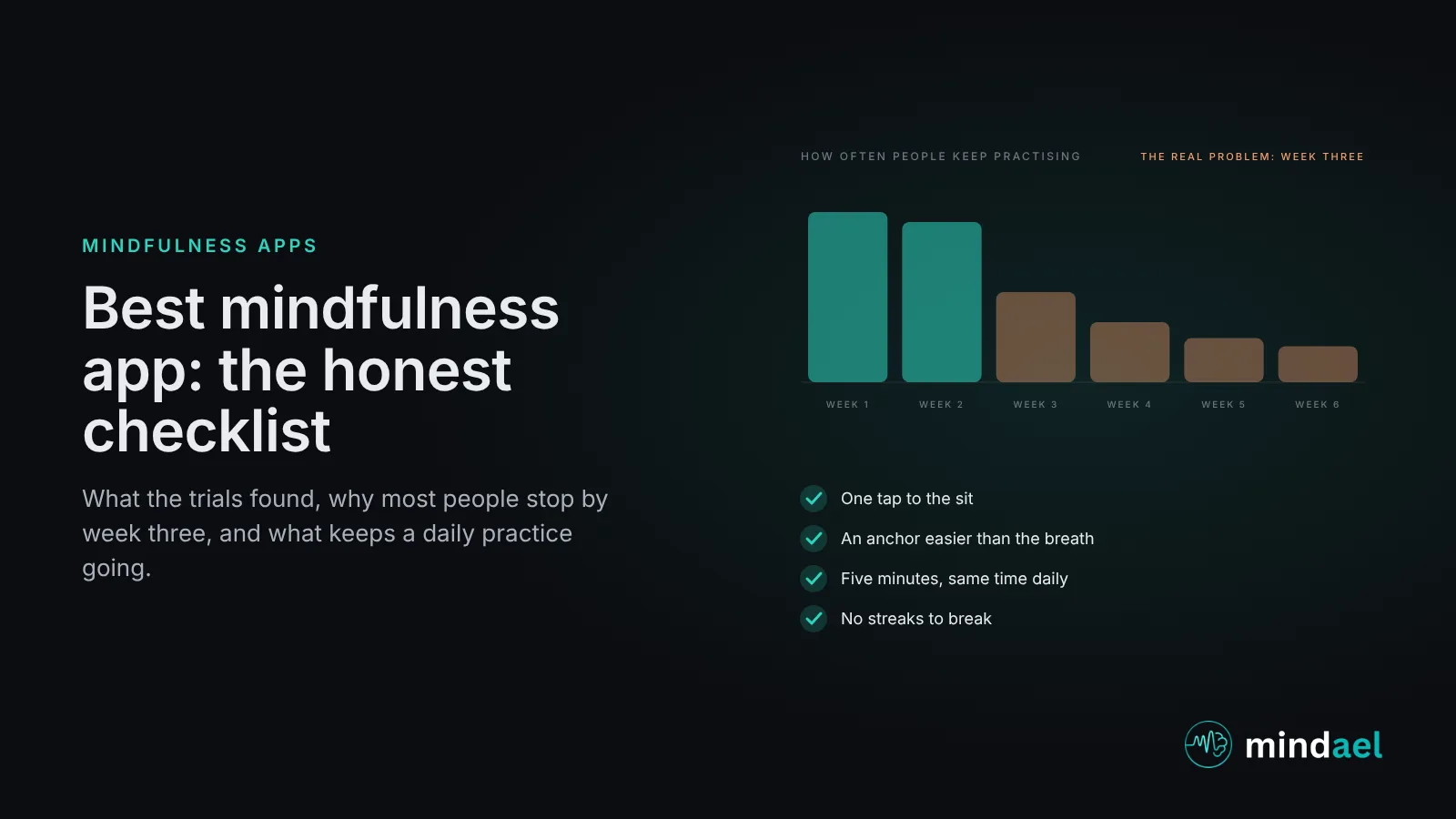
The best mindfulness app is the one you still open in week six. A meta-analysis of 34 randomised trials found mindfulness apps reduced perceived stress, anxiety and depressive symptoms by a small to moderate amount, and a ten-day trial of two popular apps found real short-term gains but steep drop-off afterwards. So look for an app that makes the daily sit easy: one tap to start, an anchor that is easier than the breath, no streaks to break, and something you can use offline at the same time every day. Mindael covers the sound side: rain, ocean, singing bowls, drones and theta beats made in our studio, mixed two at a time, free to download. It is not a guided course; if you want a teacher's voice and a structured programme, pair it with one.
What to look for, and how Mindael covers it
| What you need | In Mindael |
|---|---|
| One tap to the sit | The last sound you played is there. Press play and sit; nothing to choose, read or log |
| An anchor easier than the breath | A steady sound to return to: rain, ocean, a singing bowl or a low drone, studio-made |
| Short sits that count | Five or ten minutes, the same sound every day, so the practice survives busy weeks |
| No streaks, no badges | Mindael keeps no score. Missing a day is a missed day, not a broken record |
| Works offline, no account | Every sound is on the phone: on the train, in a park, in airplane mode |
| Mindfulness off the cushion | The same sound under a walk, a body scan or the dishes, so the practice moves into the day |
| Guided courses and a teacher's voice | Not something Mindael does. If you want guidance, pair it with a course or a local class |
| Price | Free to download on the App Store |
The real problem is week three
Most comparisons of mindfulness apps list features. The research points somewhere else. In a randomised trial of two popular apps, 208 students were asked to practise ten minutes a day for ten days. They did, on about eight days out of ten, and their mood and adjustment improved compared with a control app. Then they were given a month of free access. Fewer than one in five still used the app twice a week (Flett et al., 2019). The practice worked; keeping it going was the hard part.
So the best mindfulness app is less about which voice or which course and more about which app you will still open in week six. Everything on the checklist above is about that.
What the trials found
Across 34 randomised trials with more than 7,500 people, mindfulness apps reduced perceived stress, anxiety and depressive symptoms by a small to moderate amount, and improved psychological well-being (Gál et al., 2021). The authors call for caution: many trials were small and short. That is a fair summary of the whole field. An app is a useful way to practise, not a treatment, and its benefits depend on practice continuing.
Why practise at all? In a study that sampled thousands of moments of people’s days, minds wandered almost half the time, and people were less happy while wandering than while focused on what they were doing (Killingsworth and Gilbert, 2010). Mindfulness trains the moment of noticing that you have drifted, and coming back.
The checklist, explained
One tap to the sit. Every screen between you and the practice is a reason to skip it. The right app opens on the sound you used yesterday.
An anchor easier than the breath. Beginners are told to follow the breath and find it slippery. A steady sound is easier to rest on and easier to find again. Our how to meditate properly article explains the four-step loop of drifting and returning, and why a sound helps.
Short sits that count. Habits form through repetition in the same context; in a real-world study, a daily behaviour took about two months on average to become automatic (Lally et al., 2010). Five minutes at the same time every day builds that faster than forty minutes once a week.
No streaks. A broken streak is a common reason people stop. Mindfulness is practice in not judging the last minute; an app that judges your last week works against it.
Mindfulness off the cushion. The same sound under a short walk or a body scan carries the practice into the rest of the day.
Where Mindael fits
Mindael is the anchor: one tap to rain, ocean, a singing bowl or a drone, the same every day, offline, no account and no score. Pair it with five minutes at a fixed time and the beginner’s plan in how to start meditation. For guided lessons and a teacher’s voice, add a course or a local class; we would rather say so than pretend. Our meditation sounds guide has three sessions to try this week, and the free meditation apps checklist covers meditation apps more widely.
How to switch in five minutes
- Download MindaelFree on the App Store, no account. Pick one sound for your practice and keep it.
- Choose a time, not a goalAfter the first coffee, or before you open the laptop. The same time each day is what turns a sit into a habit.
- Sit for five minutesSound on, eyes down. Rest attention on the sound; when it drifts, notice where it went and come back. That return is the practice.
- Grow it slowlyAdd a few minutes a week until ten or twenty feels normal. Short and daily beats long and rare.
- Take it off the cushionOnce a day, do something ordinary with full attention for one minute: a sip, a doorway, a sound outside.
Press play. Sit. Come back.
Mindael has rain and ocean recorded without loops, singing bowls, drones and theta beats made in our studio, two at a time. Free to download, no account, no streaks, works offline. The same sound every morning is an anchor that does not slip away like the breath.
- Rain, ocean, bowls, drones and theta beats, studio-made
- One tap to the sound you used last
- Free to download, no account, works offline
 Free · No account needed · Works offline
Frequently asked questions
What is the best mindfulness app?
The one you keep using. Look for an app that starts in one tap, gives you an anchor that is easy to return to, has no streaks to break and works offline. Mindael is a calm sound app built for that kind of daily sit, free to download. If you want guided lessons and a teacher's voice, a course-based app or a local class adds that part.
Do mindfulness apps actually work?
Modestly, for people who use them. A meta-analysis of 34 randomised trials found small to moderate reductions in stress, anxiety and depressive symptoms. A ten-day trial of two popular apps found improvements in mood and adjustment, but most people stopped using the app regularly within the following month.
How long should I use a mindfulness app each day?
Five to ten minutes is a good start and enough to build the habit. In the ten-day trial, participants practised ten minutes a day. Longer sits help later; consistency matters more than length at the beginning.
Is Mindael a guided meditation app?
No. Mindael is a sound app: rain, ocean, singing bowls, drones and binaural beats made in our studio. It gives your practice an anchor and masks the room. It does not have guided lessons or a teacher's voice.
Are there free mindfulness apps?
Mindael is free to download with no account. Many mindfulness programmes also have free tiers, and some health services and universities offer courses for free.
Can I practise mindfulness without an app?
Yes. An app is a convenience: a timer, an anchor and a reminder of when you sit. A quiet corner, a fixed time and a sound outside the window are enough. Many people use an app for the first months and need it less later.
Sources
- Gál É, Ștefan S, Cristea IA. The efficacy of mindfulness meditation apps in enhancing users' well-being and mental health related outcomes: a meta-analysis of randomized controlled trials. Journal of Affective Disorders, 2021.
- Flett JAM, et al. Mobile mindfulness meditation: a randomised controlled trial of the effect of two popular apps on mental health. Mindfulness, 2019.
- Killingsworth MA, Gilbert DT. A wandering mind is an unhappy mind. Science, 2010.
- Lally P, et al. How are habits formed: modelling habit formation in the real world. European Journal of Social Psychology, 2010.