
Focus at Work Music: The Sound for an Open-Plan Office, a Home Desk and a Deep Work Block
Focus at work music is the most common workaround for a noisy office, and the research gives it a clear shape. The biggest enemy of concentration at work is not noise but other people's speech, and the best fix is often not music but a steady sound that hides it. Songs with lyrics can be as distracting as a colleague's phone call. This page covers what to play in an open-plan office, at a home desk and in a deep work block, and why. The sounds are in Mindael, free to download on the App Store.
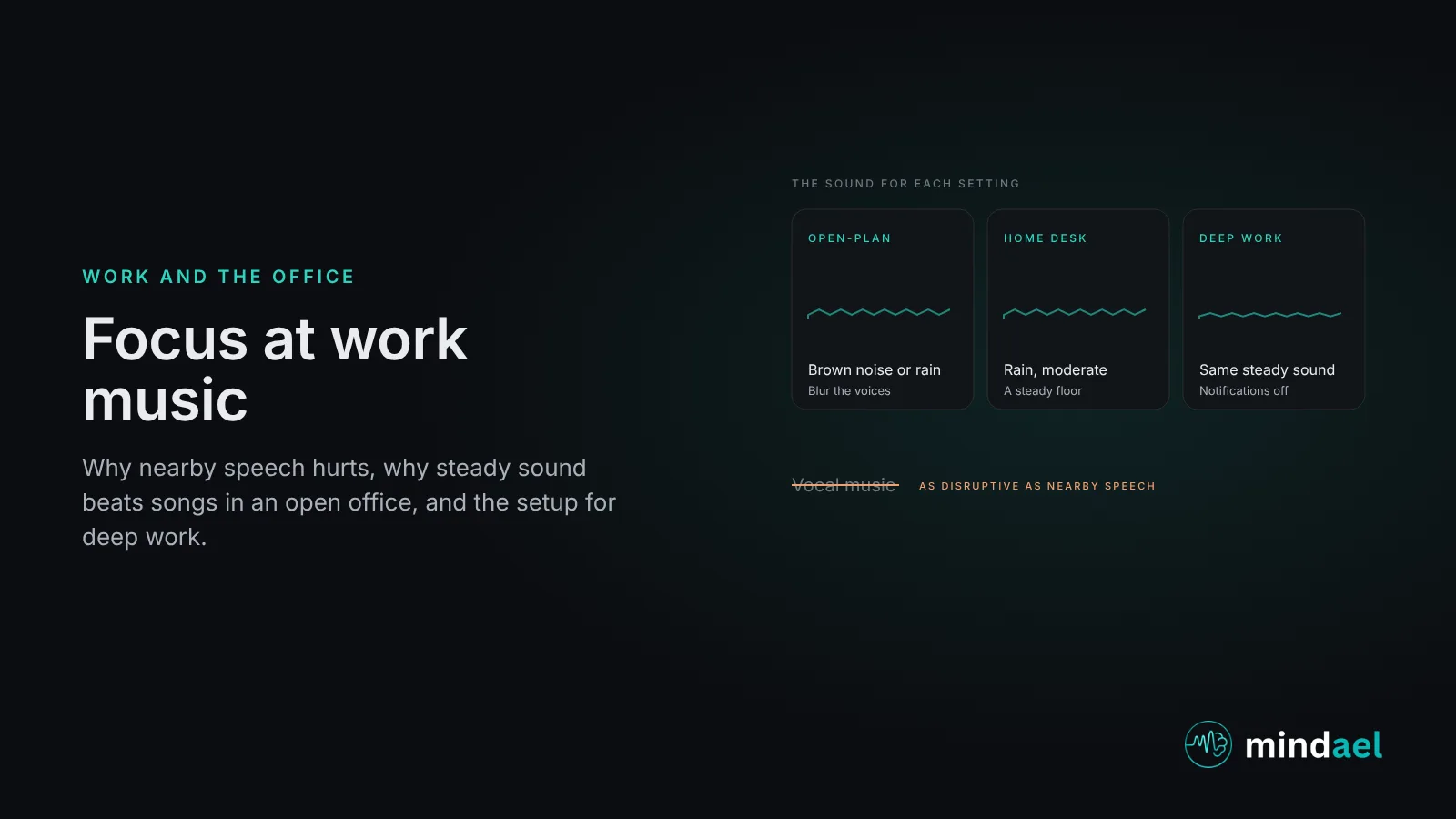
For focus at work, the main thing to block is nearby speech: in office experiments, background speech hurt tasks that rely on short-term memory, such as reading, writing and checking figures. A steady masking sound helps more than music: in a test of five masking sounds, a water sound was the best speech masker, and vocal music disrupted work about as much as speech itself. So in an open-plan office, use brown noise, pink noise or rain in headphones, just loud enough to blur voices. At home, rain or a moderate background suits writing and planning. For routine tasks, music you like can lift mood; in a five-week field study of software developers, mood and quality of work were lower without music. Protect deep work blocks from interruptions too, which raised stress even when work got done faster.
Sounds that work, and why
Brown noise
The open-office default: deep and soft, it blurs the low end of voices and can run for hours without becoming another thing to notice.
Pink noise
A little brighter than brown, for offices where voices are close and you need more of the speech range covered.
Rain
The natural option: a water sound with nothing to follow, and in research a water sound was the most effective speech masker of five tested.
Beta waves
A beta beat under brown noise in headphones, for a deadline block of 25 to 45 minutes, not for the whole day.
Alpha waves
A calmer 10 Hz beat under rain, for planning, email and the lighter half of the afternoon.
Speech is the real problem
Most people say the office is too noisy. The research says something more specific: it is speech. Your brain processes words automatically, whether you want to or not, and that competes for the same short-term memory you use to read, write and check numbers. In office experiments, background speech disrupted tasks that rely on holding and rehearsing information much more than tasks that do not (Jahncke, 2012). That is why a call at the next desk wrecks a report but barely touches filing.
The same logic explains why songs with lyrics can hurt. In a test of five masking sounds in a simulated open-plan office, vocal music disrupted work about as much as speech itself, while a steady water sound was the best speech masker and the most pleasant to work in (Haapakangas et al., 2011). The authors concluded that constant masking sounds should be preferred over instrumental or vocal music in open-plan offices.
When music helps
Music is not the enemy. In a five-week field study, software developers listened to music they chose at work, and their mood and the quality of their work were lower on the days without it (Lesiuk, 2005). Music lifts mood, and a better mood helps with long, repetitive stretches. The trick is matching it to the task: music you like for routine work, a steady sound with no words for anything that needs reading or writing. Our music for writing guide goes stage by stage for writing, and the focus sounds guide covers the general principles.
The sound for each setting
An open-plan office. Brown noise or rain in headphones, just loud enough that voices blur. If colleagues are very close, pink noise covers more of the speech range. The point is not volume but steadiness.
A home desk. The problem is often the opposite: silence broken by a doorbell or a neighbour’s drill. Rain at a moderate level gives the room a steady floor so the sudden sounds stand out less. For writing and planning, a café-level background can help ideas flow.
A deep work block. One task, notifications off, the same steady sound every time, 25 to 50 minutes. For a deadline push, add a beta beat under brown noise. Our how to focus better article has the habits around the block, and how to concentrate better covers the attention side.
Interruptions cost more than time
In an experiment on interrupted office work, people who were interrupted finished their tasks faster but reported more stress, frustration and time pressure (Mark et al., 2008). They compensated by rushing, and paid for it. A focus sound does not stop a colleague walking over, but headphones and a steady sound signal a deep work block, and a block with notifications off removes the interruptions you control. Mindael is where we keep our work sounds: brown and pink noise, rain, ocean and beta and alpha beats, made in our studio, free to download.
How to set it up tonight
- Find what breaks your focusFor most people it is speech: a call, a meeting at the next desk. If it is, you need masking, not music.
- Mask with a steady soundBrown noise or rain in headphones, just loud enough that voices blur into the background. Not louder.
- Save lyrics for routine workSongs you like for filing, inbox and formatting. For reading, writing and numbers, no words.
- Block your deep workNotifications off, one task, 25 to 50 minutes, the same sound every time so it becomes a cue.
- Take a real breakHeadphones off, away from the screen, five to ten minutes. The next block starts faster.
Blur the room. Keep the work.
Mindael has rain and ocean recorded without loops, brown and pink noise generated to spec and beta and alpha beats made in our studio, two at a time. Free to download, no account, works offline. A steady sound for the open office that never asks to be listened to.
- Brown, pink noise, rain and binaural beats, studio-made
- Two sounds at once, fine volume control
- Free to download, no account, works offline
 Free · No account needed · Works offline
Frequently asked questions
What is the best music to focus at work?
For tasks that need memory and reading, such as writing, checking figures or coding, a steady sound with no words works better than music: brown noise, pink noise or rain. For routine tasks, instrumental music you like can lift mood. Avoid songs with lyrics when the task involves words.
Why is office chatter so distracting?
Your brain processes speech automatically, and that competes with tasks that hold information in short-term memory. In office experiments, background speech disrupted memory and reading tasks much more than tasks that did not need rehearsal. Intelligible speech, a colleague you can understand, is the worst kind.
Is it OK to listen to music at work?
Often, yes. In a five-week field study, software developers had better mood and quality of work on days with music they chose. The catch is task type: music with lyrics competes with reading and writing. Many people use music for routine work and switch to a steady sound for deep work.
What noise is best for an open-plan office?
A steady one. In a test of five masking sounds, a water sound masked speech best and was the most pleasant, filtered pink noise also helped, and vocal music was as disruptive as speech. Brown noise, pink noise and rain at a moderate level are the practical choices.
How loud should focus sounds be at work?
Just loud enough that nearby voices blur and you stop following them, and well below the level of a conversation. If you have to raise it through the day, take a break instead; long sessions at high volume are not good for hearing.
Does music help with working from home?
At home the problem is often too little sound, or sudden sounds like a delivery or a neighbour. A moderate background such as rain at café level can help with writing and planning, and a steady sound hides the sudden ones.
Sources
- Jahncke H. Open-plan office noise: the susceptibility and suitability of different cognitive tasks for work in the presence of irrelevant speech. Noise and Health, 2012.
- Haapakangas A, et al. Effects of five speech masking sounds on performance and acoustic satisfaction: implications for open-plan offices. Acta Acustica united with Acustica, 2011.
- Lesiuk T. The effect of music listening on work performance. Psychology of Music, 2005.
- Mark G, Gudith D, Klocke U. The cost of interrupted work: more speed and stress. Proceedings of CHI 2008, 2008.