

Sleep Noise: The Best Noise for Sleep, Matched to Your Room, Your Mind and Your Night
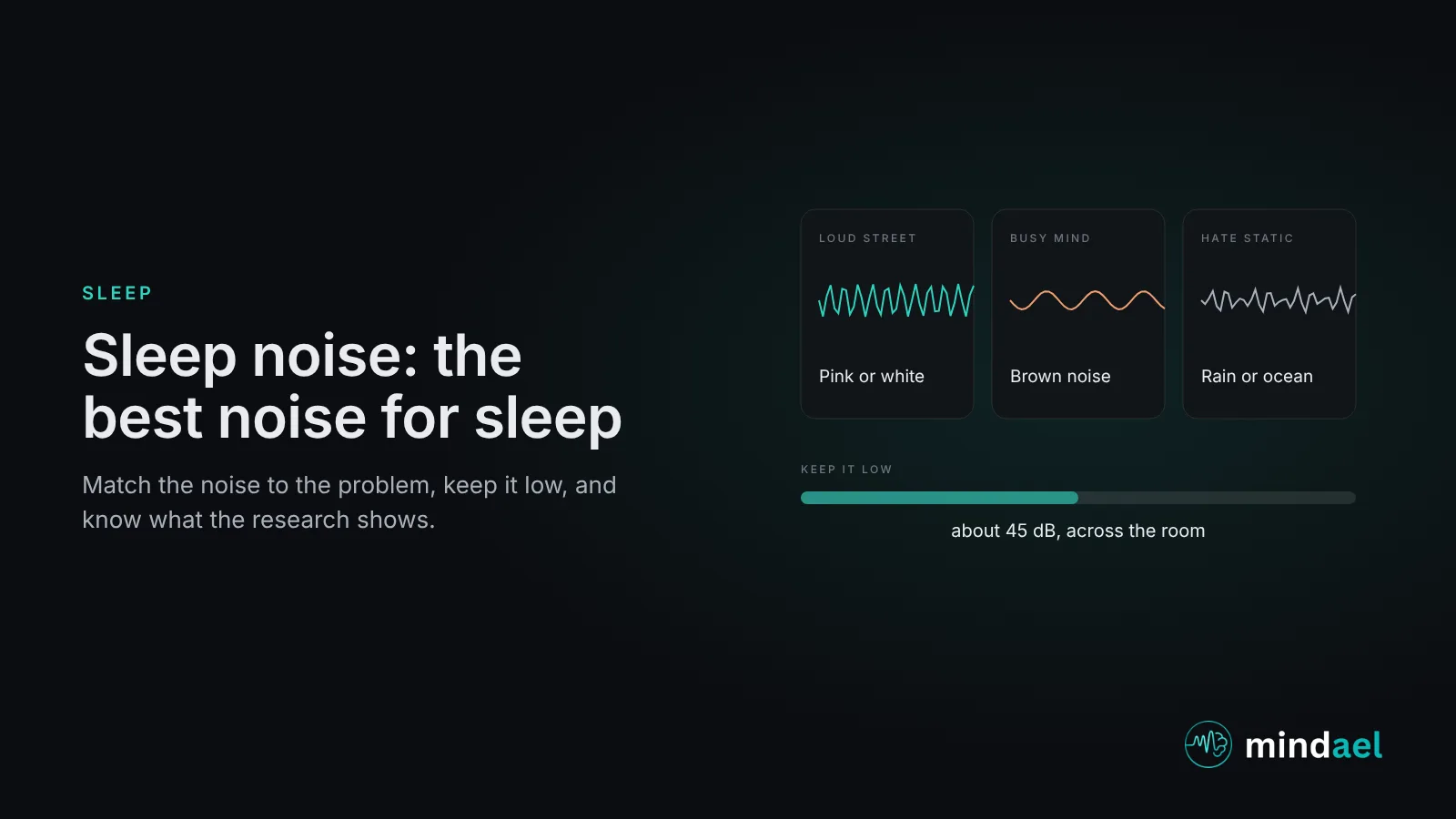
Sleep noise is a steady sound played at night to cover the noises that keep you awake or wake you up. Environmental noise is a real cause of broken sleep, and in a lab study broadband sound cut the time healthy adults took to fall asleep by 38 percent on a simulated bad night. The wider evidence is thinner than its popularity: a systematic review of 38 studies rated the evidence that continuous noise improves sleep as very low quality and urged caution about volume. So choose the noise for the problem: pink or white noise for traffic and voices, brown noise for a quiet room and a busy mind, rain or ocean if static bothers you. Keep it low, around 45 dB, on a speaker across the room, and use a fading timer unless the room is loud all night.
Sleep noise is a steady sound you play at night to cover the sounds that keep you awake or wake you up: traffic, a neighbour, a partner’s snoring, a house that creaks. It works for many people, and the research is more mixed than the marketing. This article explains why it helps, how to pick the noise for your problem, and how loud and how long to play it. The sounds we suggest are in Mindael, free to download on the App Store.
Why noise can help you sleep
Most sounds that wake you are not loud; they are sudden. A door, a car, a voice: the brain notices the change against a quiet background. Noise at night is a real problem for sleep, and a major review in The Lancet listed sleep disturbance among the main health effects of environmental noise (Basner et al., 2014).
A steady sound raises the background, so those changes stand out less. In a lab study that simulated a bad first night, broadband sound cut the time healthy adults took to fall asleep by 38 percent (Messineo et al., 2017).
What the research does not show
Sleep noise is not a proven treatment. A systematic review of 38 studies rated the evidence that continuous noise improves sleep as very low quality, because the studies differed so much in sound, volume and measurement, and it cautioned that continuous noise may also affect sleep and hearing (Riedy et al., 2021). The striking pink noise results you may have read about came from lab systems that played short bursts timed to deep-sleep brain waves, not from a speaker running all night (Ngo et al., 2013).
So use it for what it does well, covering disturbing sounds, keep it low, and judge it by how you sleep after a week.
The best noise for your night
A loud street or voices through the wall. Pink noise first, white if pink is not enough. Both put energy where traffic and speech sit. Our noise masking guide has the setup for snoring and neighbours.
A quiet room but a busy mind. Brown noise. It is deep and soft, gives attention something steady to rest on and has no hiss to grow sharp over hours.
You dislike static. Water noise: rain or ocean waves. They are broadband like pink noise but sound natural. Pick recordings without loops, thunder or birds.
Early-morning waking. Low brown or pink noise all night, so the first bus or a neighbour’s alarm does not end your sleep early. Our REM paradoxical sleep article explains why those hours matter.
Not sure what the colors mean? Our white, pink and brown noise guide compares them side by side.
How loud and how long
Aim for about 45 dB, a level at which you could still hear someone speaking softly in the room. Put the speaker or phone across the room, not by the pillow, and avoid earbuds all night. Measurements of infant sleep machines found that several could exceed recommended limits at full volume and close range (Hugh et al., 2014), and distance and a low setting fixed that; our white noise device guide covers babies.
If you only struggle to fall asleep, use a timer that fades the sound out after 30 to 45 minutes. If the room is loud all night or you wake in the early hours, keep a low sound running until morning, so the room does not change halfway through.
Free noise, and why the source matters
Free noise is everywhere, but not every track is what it says; our nature sounds app checklist lists what to check. Long videos are often compressed, looped every few minutes or mislabelled, and a loop you can hear is a change your brain can notice. Mindael generates its noise colors to spec on the phone and plays rain and ocean recorded without loops, offline, two at a time. It is free to download on the App Store, and our sleep sounds guide has the full night-time setup.
The right noise, at the right level.
Mindael has white, pink and brown noise generated to spec on the phone and rain and ocean recorded without loops, two at a time, with fine volume control and a timer that fades. Free to download, no account, works offline. A steady sound you stop noticing.
- Noise colors generated to spec, not compressed tracks
- Rain and ocean without loops, two sounds at once
- Free to download, no account, works offline
 Free · No account needed · Works offline
Frequently asked questions
What is the best noise for sleep?
It depends on what keeps you awake. For traffic, voices and a loud street, pink or white noise covers the most. For a quiet room and a busy mind, brown noise is deeper and softer. If static bothers you, rain or ocean waves do a similar job and sound natural. The best one is the one you can stop noticing.
What is the best color noise for sleep?
Pink noise is the one sleep researchers use most and a good default. White noise masks the most but can sound sharp. Brown noise is the deepest and the favourite of people who find white noise hissy. Try each for a few nights at a low volume.
Is it good to sleep with noise all night?
If the room is loud all night or noises wake you in the early hours, a low steady sound through the night can help, and keeping it constant avoids a change in the room halfway through. If you only need help falling asleep, a timer that fades after 30 to 45 minutes is the gentler choice. Keep it quiet either way.
How loud should sleep noise be?
Low, around 45 dB, quieter than a normal conversation: loud enough to soften the sounds you want to cover and no louder. Put the speaker across the room rather than by your head, and avoid earbuds all night.
Is water noise good for sleep?
Rain and ocean waves are broadband sounds, like white or pink noise with a natural texture, so they mask in a similar way. Choose recordings without loops, thunder or birds, which can catch your attention.
Is there free sleep noise?
Many apps and videos offer noise. Be aware that some online tracks are compressed or mislabelled, so the sound is not what the title says. Mindael is free to download on the App Store, with noise generated to spec on the phone and no streaming at night.
Sources
- Basner M, et al. Auditory and non-auditory effects of noise on health. The Lancet, 2014.
- Messineo L, et al. Broadband sound administration improves sleep onset latency in healthy subjects in a model of transient insomnia. Frontiers in Neurology, 2017.
- Riedy SM, Smith MG, Rocha S, Basner M. Noise as a sleep aid: a systematic review. Sleep Medicine Reviews, 2021.
- Ngo HVV, Martinetz T, Born J, Mölle M. Auditory closed-loop stimulation of the sleep slow oscillation enhances memory. Neuron, 2013.
- Hugh SC, et al. Infant sleep machines and hazardous sound pressure levels. Pediatrics, 2014.
This article is for general information and is not medical advice. If you sleep badly most nights for more than a few weeks, snore loudly or stop breathing in your sleep, or if you have hearing loss or ringing in the ears, please see a doctor.
This article is part of our sleep guide. Hear the sounds in this article in the Mindael sound library, or see our app comparison checklists.