
Yoga Music: What to Play for Flow, Stretching and Savasana, and Why Tempo Matters
Yoga music is not just background. The tempo of what you play changes how fast you breathe, and in yoga the breath is the practice. Faster music raises breathing rate and heart rate; slow sound and short silences bring them down. So the right yoga music depends on the part of the session: a steady pulse for flow, slow sound for long holds, and very quiet sound or silence for savasana. The sounds are in Mindael, free to download on the App Store, and below we explain what to play when and why.
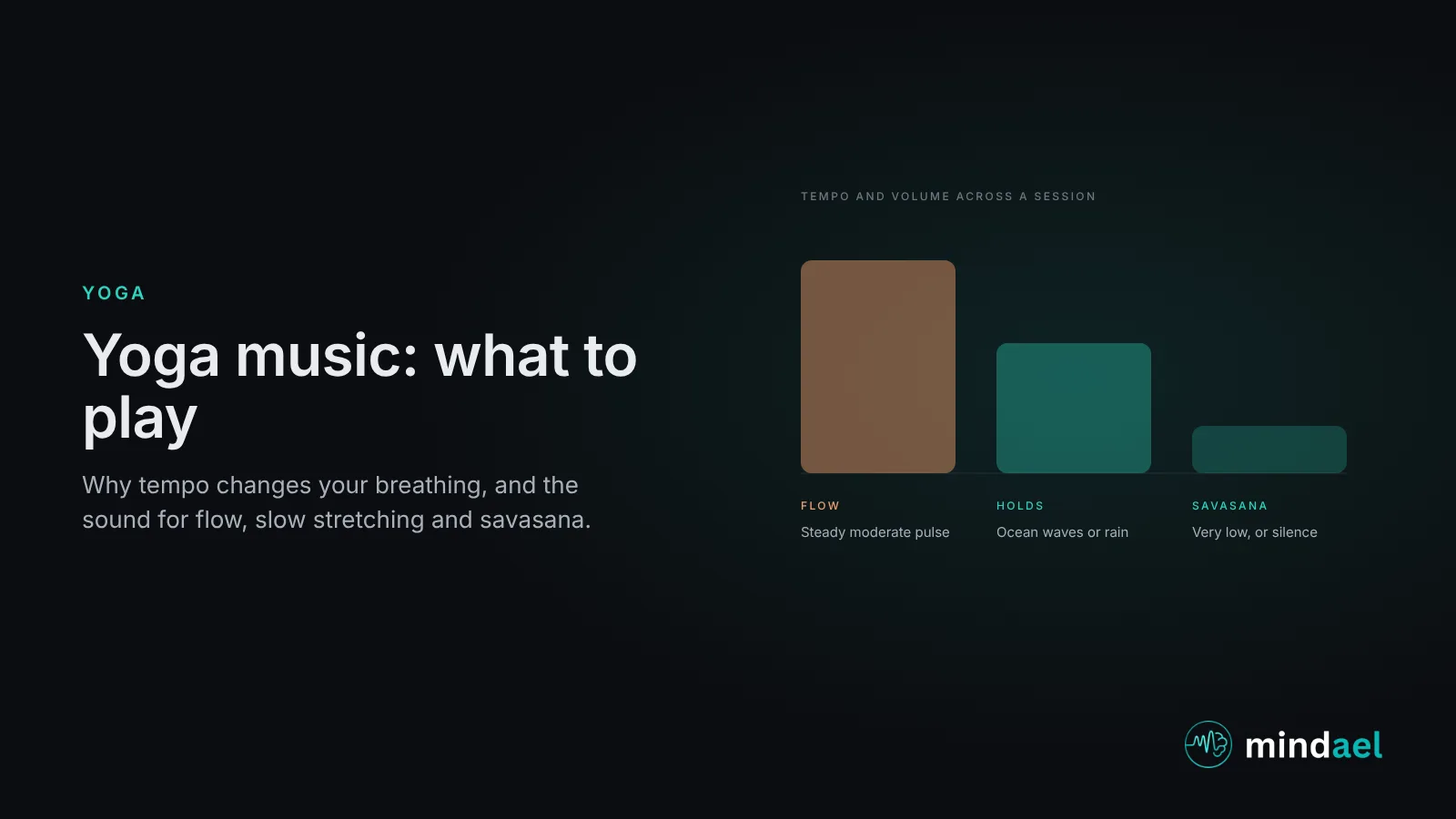
For yoga, match the sound to the part of the session. In a heart study of six music styles, faster tempo raised breathing rate, heart rate and blood pressure, and a two-minute silence brought them below the starting level. So for a flowing practice, use a steady, moderate pulse; for slow stretching, yin and long holds, use slow sound without a beat such as ocean waves or rain; for savasana, very low sound or silence. Keep lyrics out of the quieter parts, and the volume low enough to hear your breath and the teacher. Music makes exercise feel better: a meta-analysis of 139 studies found it improved mood during exercise and lowered perceived effort. Yoga itself is linked to lower cortisol and resting heart rate in a meta-analysis of 42 trials, so the music's job is to support the breath, not compete with it.
Sounds that work, and why
Ocean waves
The slow rise and fall of waves is close to a calm breath, which makes it the easiest sound to breathe with in long holds and yin.
Rain
Steady and featureless, for a home practice where you want the room to feel quiet without silence.
528 Hz
A soft, steady tone many people like for the closing minutes and savasana. We use it as a calm sound, not as a cure for anything.
Theta waves
A slow binaural beat under ocean waves for a meditation after the practice. Earbuds needed, and keep it low.
Brown noise
Deep and soft, for blocking a noisy flat or a gym next door so the practice has a floor of steady sound.
Why tempo matters in yoga
In most exercise, music is there to make the work feel easier. In yoga, the breath is the work, and music changes the breath. In a study in the journal Heart, people listened to six styles of music while researchers measured their breathing and circulation. Faster tempo raised breathing rate, heart rate and blood pressure; slower music lowered them; and a two-minute silence between tracks brought them below the starting level (Bernardi et al., 2006). The style mattered less than the tempo.
That gives a simple rule: the slower and calmer the part of the practice, the slower and quieter the sound.
Music makes movement feel better
Music is not a distraction to be avoided. A meta-analysis of 139 studies found that music during exercise improved mood, lowered how hard the effort felt and improved performance, with larger effects for faster music on performance (Terry et al., 2020). That is why a moderate pulse helps a flowing practice or a warm-up. It is also why fast music is the wrong choice for the end of a session, when you want breathing to slow down.
Yoga itself does the calming work. A meta-analysis of 42 randomised trials found yoga practice was linked to lower cortisol, lower resting heart rate and lower blood pressure (Pascoe et al., 2017). The music’s job is to support that, not to compete with it.
What to play for each part
Flow and vinyasa. Steady instrumental music with a moderate pulse, or rain with a soft beat under it. Nothing so fast that you start moving ahead of your breath.
Slow stretching, yin and long holds. Sound without a beat: ocean waves, rain or a low drone. Waves are especially easy to breathe with, because their rise and fall is close to a slow breath.
Breathwork. Very little sound. A low steady noise such as brown noise can hide a noisy room, but anything with a rhythm will fight your count. Our breathing and exercise article covers the slow breathing cool-down, which raised heart rate variability across many studies (Laborde et al., 2022).
Savasana. Lower the sound or stop it. A soft tone such as 528 Hz or quiet waves works if silence feels too bare, but the Heart study suggests the pause itself is where the body settles most.
Free yoga music at home
At home, the room is often the problem: traffic, neighbours, a TV through the wall. A steady sound under the music, or instead of it, gives the practice a quiet floor. Set the volume once, low enough to hear your breath, and use the same sound each time so it becomes a cue to slow down. For a meditation after the practice, our meditation music guide has the setup, and the breathing guide has the patterns. Mindael is where we keep the sounds we practise with, free to download.
How to set it up tonight
- Choose by the part of the sessionA steady moderate pulse for flow, slow sound with no beat for holds and stretching, very low sound or silence for savasana.
- Breathe first, then press playTake a few slow breaths before the music starts, so the breath sets the pace and the music follows it.
- Keep it quietLow enough that you can hear your own breath and the teacher. If you have to raise your voice, it is too loud.
- Save lyrics for the warm-upSongs with words pull attention. Use them for an energetic warm-up if you like, and drop them for holds and the close.
- Let the end be quietLower the sound for savasana or stop it. A short silence after music is when breathing and heart rate fall furthest.
Breathe first. Let the sound follow.
Mindael has ocean and rain recorded without loops, brown noise generated to spec and steady tones and binaural beats made in our studio, two at a time. Free to download, no account, works offline. A slow sound for long holds and a quiet one for savasana.
- Ocean, rain, brown noise, tones and binaural beats
- Two sounds at once, fine volume control
- Free to download, no account, works offline
 Free · No account needed · Works offline
Frequently asked questions
What music is best for yoga?
It depends on the style and the moment. For a flowing practice, steady instrumental music with a moderate pulse. For slow stretching, yin and long holds, slow sound without a beat, such as ocean waves or rain. For savasana, very low sound or silence.
Does the tempo of yoga music matter?
Yes. In a study of six music styles, faster tempo raised breathing rate, heart rate and blood pressure, and slower music lowered them. A short silence lowered them below the starting level. For calm practice, slow or no tempo works best.
Is it better to do yoga with or without music?
Both are fine. Music can make a session feel easier and more enjoyable, and in a large meta-analysis it improved mood during exercise. Silence keeps attention on the breath. Many people use sound for the flow and silence for the end.
Can I use yoga songs with lyrics?
For an energetic warm-up or a power flow, songs you like can help with motivation. For holds, breathwork and savasana, words compete for attention, so instrumental music or a natural sound works better.
What is good music for savasana?
Very quiet, steady sound with nothing to follow: soft ocean waves, rain or a low tone, or simply silence. The aim is that you stop listening and rest.
How loud should yoga music be?
Low. You should hear your breath clearly and, in a class, the teacher's voice without effort. Music that needs to be talked over is too loud for yoga.
Sources
- Bernardi L, Porta C, Sleight P. Cardiovascular, cerebrovascular, and respiratory changes induced by different types of music in musicians and non-musicians: the importance of silence. Heart, 2006.
- Terry PC, et al. Effects of music in exercise and sport: a meta-analytic review. Psychological Bulletin, 2020.
- Pascoe MC, Thompson DR, Ski CF. Yoga, mindfulness-based stress reduction and stress-related physiological measures: a meta-analysis. Psychoneuroendocrinology, 2017.
- Laborde S, et al. Effects of voluntary slow breathing on heart rate and heart rate variability: a systematic review and a meta-analysis. Neuroscience and Biobehavioral Reviews, 2022.