
Breathing and Exercise: How to Breathe During a Workout, Before It and After
During exercise, let your body set the breathing: breathing faster and harder is how muscles get oxygen, and feeling out of breath at a hard pace is normal. Breathe through the nose at an easy pace and switch to mouth breathing when the effort rises. Breathing exercises help most before and after a workout. Training the breathing muscles improved endurance performance in healthy people in a 2012 meta-analysis, with bigger gains in less fit people. For people with COPD, breathing exercises such as pursed lip breathing improved walking capacity in a Cochrane review, though not breathlessness itself. After a workout, a few minutes of slow breathing, around six breaths a minute, is a simple cool-down: slow breathing raised heart rate variability across 223 studies. Before a race or a lift, box breathing can settle nerves.
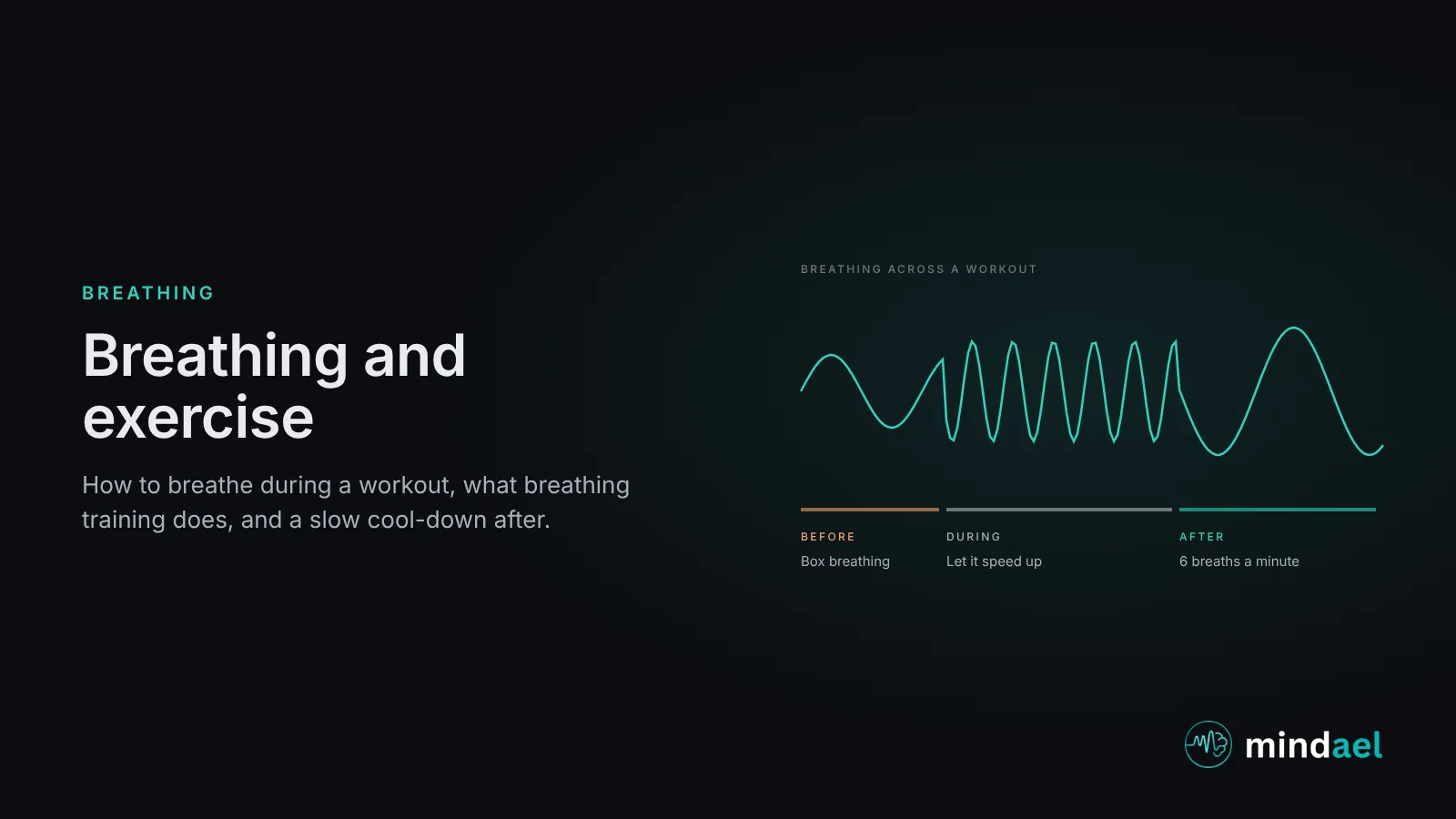
Breathing and exercise go together in two ways: how you breathe while you move, and how breathing exercises before and after a workout can help. The first is mostly something your body handles on its own. The second is where a few minutes of practice pays off. This article covers both, with the research behind each. The sounds we use for the cool-down are in Mindael, free to download on the App Store, and the full set of breathing patterns is in our breathing exercises guide.
During exercise: let your body lead
When you work harder, your muscles need more oxygen and produce more carbon dioxide, so you breathe faster and deeper. Feeling out of breath at a hard pace is that system doing its job, not a sign that you are breathing wrong. It should ease within a few minutes of stopping.
A few practical points:
Nose at an easy pace, mouth when it gets hard. Many people find nasal breathing comfortable on an easy walk, jog or ride. Once the effort rises, the nose cannot move enough air, and switching to the mouth is normal.
In strength training, breathe out on the effort. Exhale as you push or lift, inhale as you lower. Avoid holding your breath for long sets.
Stop if it feels wrong. Breathlessness that comes on suddenly, with chest pain, dizziness or wheeze, or that is much worse than usual, is a reason to stop and see a doctor.
Can breathing training make you fitter?
Training the breathing muscles themselves, usually with a device that adds resistance to each breath, has been studied in athletes and ordinary exercisers. A 2012 meta-analysis found that respiratory muscle training improved endurance performance in healthy people, with greater improvements in less fit people and in longer events (Illi et al., 2012). It is a niche tool, not a substitute for training, but it shows the breathing muscles respond to practice like any other.
Pursed lip breathing and breathlessness
For people with lung conditions, breathing technique matters more. Pursed lip breathing means breathing in through the nose and out slowly through lips pursed as if to whistle, letting the out-breath take longer. A Cochrane review found that breathing exercises over four to 15 weeks, including pursed lip, diaphragmatic and yoga breathing, improved walking capacity in people with COPD, though they did not consistently reduce breathlessness (Holland et al., 2012). If you have a lung condition, learn these with your care team. Our abdominal breathing article covers the diaphragm side.
Before: settle the nerves
Before a race, a match or a heavy lift, nerves can help up to a point and then get in the way. A short breathing pattern gives them somewhere to go. In a 2023 study, five minutes a day of structured breathing, including box breathing and cyclic sighing, improved mood and reduced physiological arousal (Balban et al., 2023). Box breathing, four counts in, hold, out and hold, is a simple choice in the minutes before you start.
After: a slow cool-down
Once your breathing has started to settle, take three to five minutes of slow breathing: about four seconds in and six out, around six breaths a minute. A 2022 meta-analysis of 223 studies found slow breathing raised heart rate variability, a marker of the body’s calming system, during the practice, right after it and after weeks of training (Laborde et al., 2022). Lying on your back with a steady sound such as ocean waves or brown noise makes it easier to keep the slow rhythm. Our yoga music guide has the sounds we use for stretching and the last minutes of a session.
Keep long breath holds like 4-7-8 for bedtime rather than straight after a workout, when your body still wants extra air. Mindael is where we keep our cool-down sounds, free to download, and the breathing guide has the other patterns and when to use them.
Train hard. Come down slowly.
Mindael has rain and ocean recorded without loops, brown noise generated to spec and alpha beats made in our studio, two at a time. Free to download, no account, works offline. A steady sound for five slow minutes after the last set.
- Rain, ocean, brown noise and alpha beats, studio-made
- Two sounds at once, fine volume control
- Free to download, no account, works offline
 Free · No account needed · Works offline
Frequently asked questions
How should you breathe while exercising?
Mostly, let it happen. At an easy pace, breathing through the nose is comfortable for many people. As effort rises, switch to the mouth: your body needs more air than the nose can move. In strength training, breathe out on the effort and avoid holding your breath for long.
Is it normal to be out of breath when exercising?
Yes. Breathing faster and deeper is how your body meets the higher oxygen demand. It should ease within a few minutes of stopping. Breathlessness that is sudden, comes with chest pain or dizziness, or is much worse than usual is a reason to stop and see a doctor.
Do breathing exercises improve fitness?
Training the breathing muscles can. A 2012 meta-analysis found respiratory muscle training improved endurance performance in healthy people, with bigger gains in less fit people and longer events. Slow breathing exercises are more useful for recovery and calm than for fitness itself.
What is pursed lip breathing?
Breathing in through the nose and out slowly through lips pursed as if to whistle, with the out-breath longer than the in-breath. It is taught to people with lung conditions such as COPD, and a Cochrane review found breathing exercises like it improved walking capacity.
What breathing is best after a workout?
Slow breathing, about four seconds in and six seconds out, for three to five minutes once your breathing has started to settle. A large meta-analysis found slow breathing raised heart rate variability, a marker of the body's calming system, during and after practice.
Should I do 4-7-8 breathing after exercise?
Not straight after. Long breath holds feel uncomfortable when your body still needs extra air. Use simple slow breathing for the cool-down, and keep 4-7-8 for bedtime, including on evenings when you trained.
Sources
- Illi SK, Held U, Frank I, Spengler CM. Effect of respiratory muscle training on exercise performance in healthy individuals: a systematic review and meta-analysis. Sports Medicine, 2012.
- Holland AE, Hill CJ, Jones AY, McDonald CF. Breathing exercises for chronic obstructive pulmonary disease. Cochrane Database of Systematic Reviews, 2012.
- Laborde S, et al. Effects of voluntary slow breathing on heart rate and heart rate variability: a systematic review and a meta-analysis. Neuroscience and Biobehavioral Reviews, 2022.
- Balban MY, et al. Brief structured respiration practices enhance mood and reduce physiological arousal. Cell Reports Medicine, 2023.
This article is for general information and is not medical advice. If you have asthma, COPD, a heart condition, or breathlessness that is sudden, painful or worse than usual, please talk to a doctor before changing how you exercise.
This article is part of our breathing guide. Hear the sounds in this article in the Mindael sound library, or see our app comparison checklists.