

Relaxing Sleep Music: What Makes Music Relaxing Enough to Sleep To, From the Research
Relaxing sleep music helps many adults sleep better. In a study of students with sleep complaints, 45 minutes of relaxing music at bedtime for three weeks improved sleep quality, while an audiobook did not, and a meta-analysis of trials found a moderate improvement in sleep quality with music-assisted relaxation. A Cochrane review of 13 trials agreed that music likely improves how people rate their sleep. What makes music relaxing is mostly tempo: slower music lowered breathing and heart rate in a heart study, and faster music raised them. So choose slow, quiet music without words, such as soft piano, or a natural sound such as rain, play it for the first 30 to 45 minutes, keep the volume low, and let it fade.
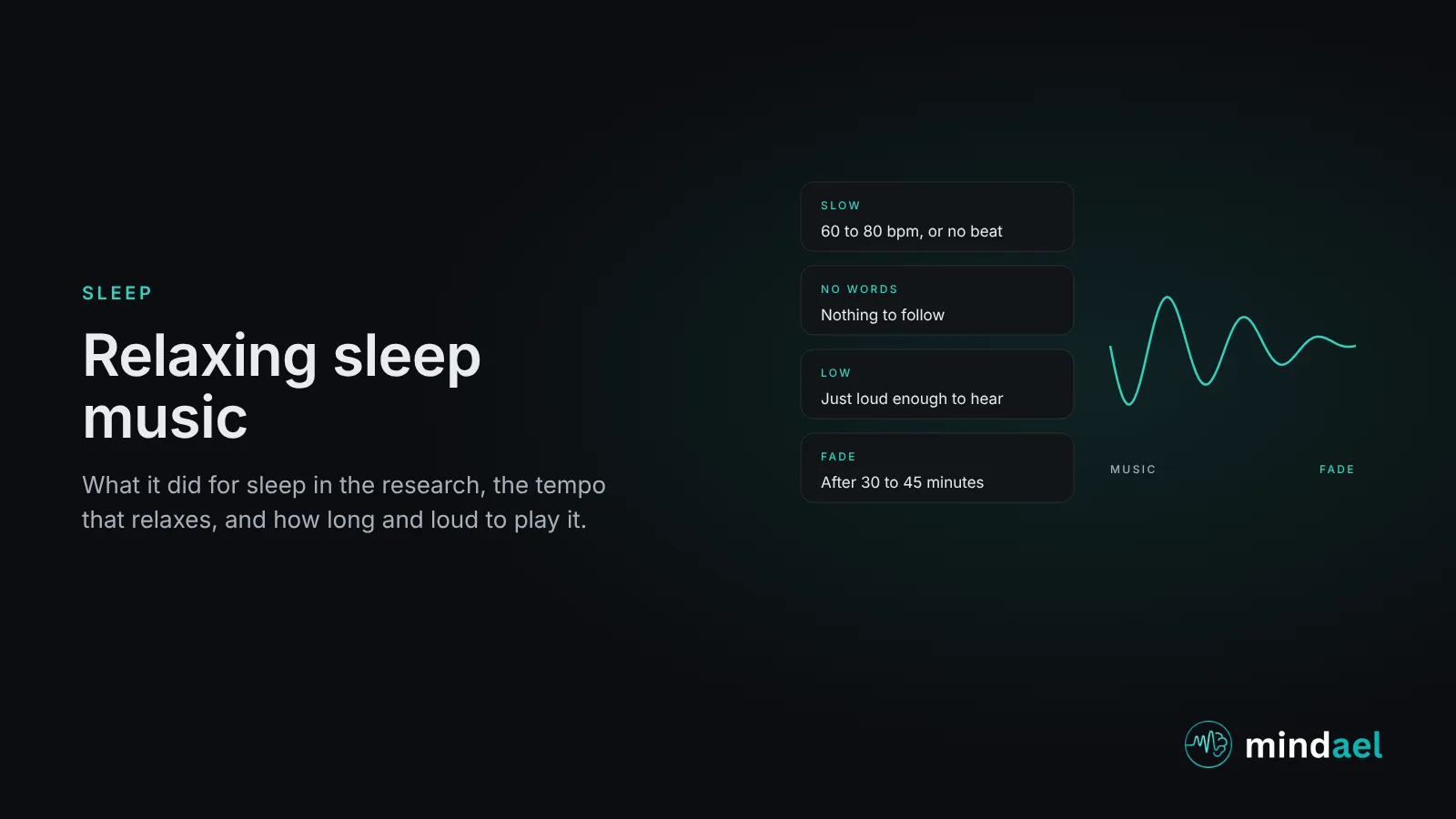
Relaxing sleep music is one of the most common ways people try to sleep better, and it is one of the few that research supports with a fairly consistent picture. This article explains what music did for sleep in studies, what makes a piece relaxing enough to sleep to, and how to use it. The sounds we use are in Mindael, free to download on the App Store, and the full guide is our sleep sounds page.
What the research shows
In a study of 94 students with sleep complaints, one group listened to 45 minutes of relaxing classical music at bedtime for three weeks, one to an audiobook and one to nothing. Sleep quality improved significantly in the music group, and not in the others (Harmat et al., 2008). A meta-analysis of trials with people with sleep complaints found a moderate improvement in sleep quality with music-assisted relaxation (de Niet et al., 2009). And a Cochrane review of 13 trials found that music likely improves how adults with insomnia symptoms rate their sleep, with no reported side effects (Jespersen et al., 2022).
The honest limit: the clearest effect is on how well people feel they slept. Measured effects, such as minutes to fall asleep, were weaker. Our deep sleep music article covers what music cannot do.
What makes music relaxing
Tempo, more than style. In a study in the journal Heart, people listened to six kinds of music while their breathing and circulation were measured. Faster music raised breathing rate, heart rate and blood pressure; slower music lowered them; and a two-minute silence brought them below the starting level (Bernardi et al., 2006). That gives a simple rule for sleep music:
- Slow: around 60 to 80 beats a minute, or no clear beat at all.
- No words: lyrics give the mind something to follow.
- No surprises: no sudden jumps in volume, tempo or key.
- Something you like: music you find unpleasant will not relax you.
Soft piano, slow strings and ambient pads fit all four. So do natural sounds such as rain and ocean waves, which many people find more relaxing than any melody.
How to use it
Start when you lie down, not earlier. Let the music become the cue for sleep, the same way every night.
Play it for 30 to 45 minutes, which is how long most trials used, then let it fade out. A sudden stop can wake you.
Keep it quiet. Just loud enough to hear. If you catch yourself listening, turn it down.
Switch to a steady sound if you need sound all night. Music with a melody is best for falling asleep; for the rest of the night, a low, steady sound such as rain or brown noise masks noises without changing. Our noise colors comparison explains the difference.
When music is not enough
If you lie awake for a long time most nights, music alone is unlikely to fix it. The habits around it matter more: a fixed wake time, a dim last hour, and getting up if you are awake for a long stretch. Our how to fall asleep fast article covers those, and meditation for sleep has a practice to pair with the music. Mindael is where we keep our night sounds, free to download.
Slow to start. Quiet to finish.
Mindael has rain and ocean recorded without loops, soft drones and delta beats made in our studio, and brown noise generated to spec, two at a time. Free to download, no account, works offline. A slow sound to fall asleep to, and a steady one for the rest of the night.
- Rain, ocean, drones, delta beats and brown noise
- Two sounds at once, fine volume control
- Free to download, no account, works offline
 Free · No account needed · Works offline
Frequently asked questions
Does relaxing music really help you sleep?
For many people, yes. In a three-week study of students with sleep complaints, relaxing music at bedtime improved sleep quality while an audiobook did not. A Cochrane review of 13 trials found that music likely improves how adults with insomnia symptoms rate their sleep.
What is the most relaxing music for sleep?
Slow, quiet music without words and without sudden changes: soft piano, slow strings, ambient pads or a natural sound such as rain or ocean. The research suggests tempo matters more than style, so pick something slow you like.
Is piano music good for sleep?
Soft, slow piano is one of the most popular choices, and it fits what the research suggests: steady, calm and without lyrics. Avoid pieces with big jumps in volume or tempo, which can pull you back toward waking.
How long should I play sleep music?
About 30 to 45 minutes, which is how long most trials played it. Use a timer that fades the music out rather than stopping it suddenly. If you want sound through the night, switch to something steadier, such as rain or brown noise.
How loud should relaxing sleep music be?
Quiet, just above the level where you can hear it clearly. If you find yourself listening closely, it is too loud or too interesting. Use a speaker on the bedside table rather than earbuds if you sleep on your side.
Is music or white noise better for sleep?
They do different jobs. Relaxing music helps you wind down and fall asleep. A steady noise masks sounds that might wake you later. Many people use music for the first half hour and a low steady sound after.
Sources
- Harmat L, Takács J, Bódizs R. Music improves sleep quality in students. Journal of Advanced Nursing, 2008.
- de Niet G, et al. Music-assisted relaxation to improve sleep quality: meta-analysis. Journal of Advanced Nursing, 2009.
- Jespersen KV, et al. Music for insomnia in adults. Cochrane Database of Systematic Reviews, 2022.
- Bernardi L, Porta C, Sleight P. Cardiovascular, cerebrovascular, and respiratory changes induced by different types of music in musicians and non-musicians: the importance of silence. Heart, 2006.
This article is for general information and is not medical advice. If you sleep badly most nights for more than a few weeks, snore loudly, stop breathing in your sleep or feel very sleepy in the day, please see a doctor.
This article is part of our sleep guide. Hear the sounds in this article in the Mindael sound library, or see our app comparison checklists.