

REM Sleep: Why It Is Called Paradoxical Sleep, What Happens in the REM Phase, and Why It Matters
REM stands for rapid eye movement, the stage of sleep discovered in 1953 when researchers saw the eyes of sleepers dart under closed lids and found that people woken then usually reported dreams. It is called paradoxical sleep because the brain looks close to awake, active and dreaming, while the body is almost completely still: the muscles that move the limbs are switched off. REM comes in periods roughly every 90 minutes and they get longer toward morning, so it makes up about a fifth to a quarter of adult sleep, mostly in the second half of the night. Researchers link it with memory and with processing emotional experiences. Short nights, an early alarm and alcohol in the evening cut into it, and a regular wake time protects it.
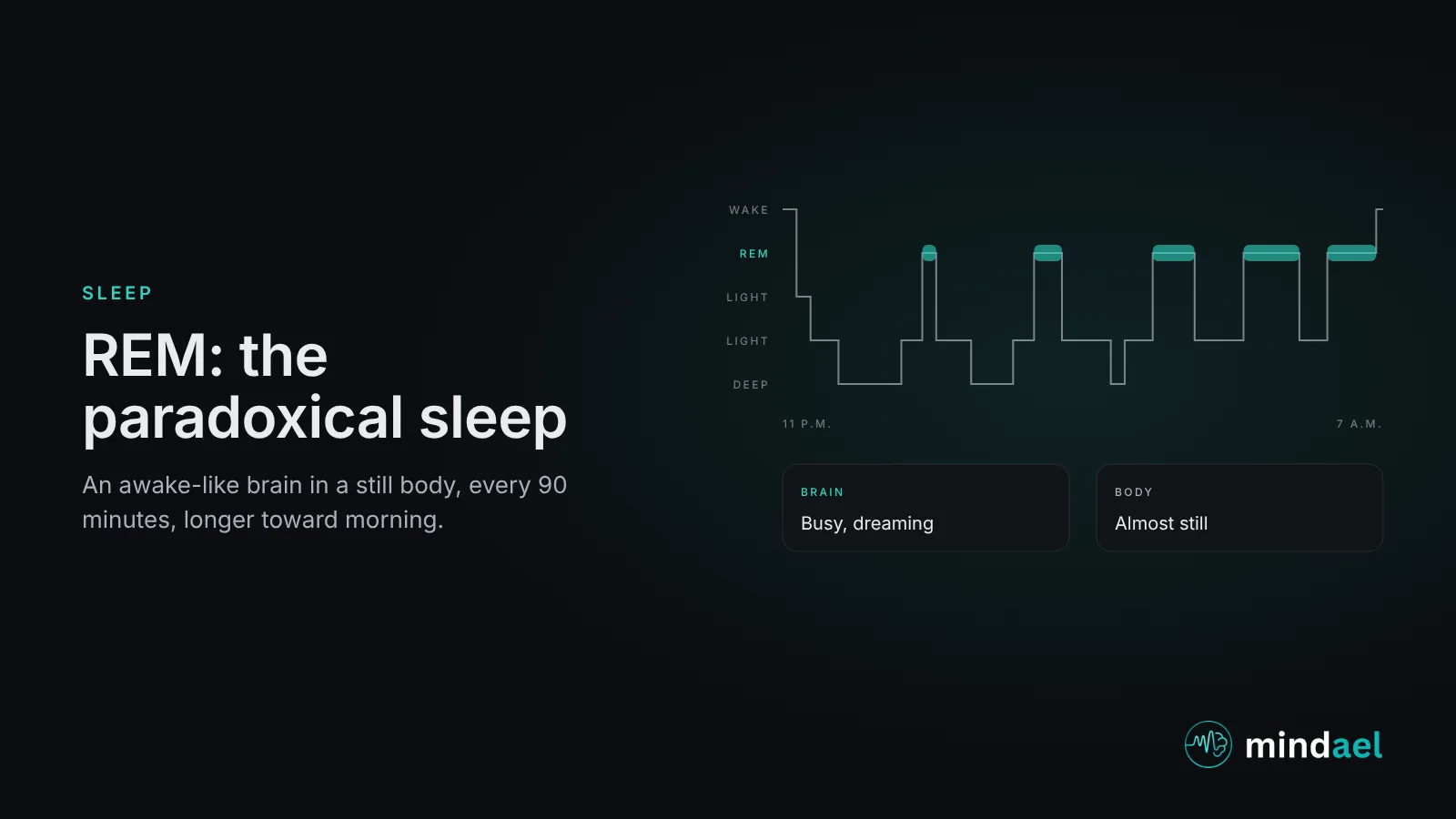
REM paradoxical sleep is one stage with two names. REM is short for rapid eye movement; paradoxical sleep is what French researchers called the same stage, for a reason that still surprises people. This article explains what happens in the REM phase, why it is called a paradox, when it comes in the night and what cuts into it. We make Mindael, a sound app for sleep, free to download on the App Store, and the steady sound we suggest for the early-morning hours is in it.
What REM means
In 1953 two researchers in Chicago noticed that, at regular points in the night, the eyes of sleeping people darted quickly under their closed lids. When they woke sleepers during these periods, most said they had been dreaming; woken at other times, far fewer did (Aserinsky and Kleitman, 1953). The stage was named after the eye movements, rapid eye movement sleep, and it was the first clear sign that sleep is not one state but several.
Today sleep is split into non-REM stages, from the light drift into sleep to deep slow-wave sleep, and REM. Our sleep sounds guide covers how sound fits into each part of the night.
Why it is called paradoxical sleep
Two things happen in REM that do not seem to belong together. The brain is busy: its electrical activity looks closer to waking than to deep sleep, and this is the stage of the long, vivid, story-like dreams. Yet the body is almost completely still. The brainstem switches off the muscles that move the arms and legs, so only the eyes, the breathing muscles and small twitches keep going (Peever and Fuller, 2017).
An awake-looking brain in a body that cannot move: that is the paradox. The muscle switch-off is protective, because it keeps you from acting out what you dream. When it fails, people can shout, kick or leave the bed in their dreams, which is a condition for a doctor rather than something to manage at home.
When the REM phase comes
REM arrives in periods, one per sleep cycle. The first usually comes about 90 minutes after you fall asleep and lasts only a few minutes. After that, the cycle of non-REM and REM repeats roughly every 90 minutes, and each REM period tends to be longer than the last. Deep sleep is front-loaded into the first cycles; REM is back-loaded into the last.
Over a whole night, REM makes up roughly a fifth to a quarter of adult sleep. A meta-analysis of sleep studies from childhood to old age found that the share of REM changes much less with age than the share of deep sleep does (Ohayon et al., 2004). The early-morning stretch, roughly from 3 a.m. on, is where most of it sits, which is why that is also when you most often wake from a dream. Our vivid dreams guide explains why some nights bring more of them.
What REM sleep seems to do
The honest answer is that researchers are still working it out. The main ideas link REM with memory and with emotion. One influential review proposed that REM sleep helps the brain take the emotional sting out of the day’s experiences while keeping the memory of them (Walker and van der Helm, 2009). That is a hypothesis with a lot of supporting work, not a settled fact, but it fits a common experience: things often feel more manageable after a full night. Our benefits of REM sleep article covers the research on emotion, creativity and memory.
REM is also the stage behind most lucid dreams, dreams in which you know you are dreaming. Our how to be a lucid dreamer article explains the techniques that worked in studies, and our lucid dream app checklist covers what an app can and cannot add.
What cuts into REM sleep
Short nights. Because REM is concentrated toward morning, an alarm an hour early cuts mostly REM. Two short nights in a row, and the body tends to catch up with longer, more intense REM periods later, which is when people notice very vivid dreams.
Alcohol in the evening. A review of the research found that alcohol close to bed suppresses REM in the first half of the night, and REM tends to rebound later as the alcohol wears off (Ebrahim et al., 2013). The result is broken, dream-heavy early mornings.
Noise in the early hours. REM is the stage most packed into the hours when the street starts to wake up: the first bus, a door, a neighbour’s alarm. Each brief waking can end a REM period early.
How to protect it
There is no trick for more REM, only for not losing it. Give yourself enough time in bed, seven to nine hours for most adults. Keep the same wake time every day, weekends included, so the long morning REM periods are not cut short. Keep alcohol well away from bedtime. And keep the room steady through the early hours: dark, cool and quiet, or with a low, unchanging sound such as brown noise or pink noise running all night, so small sounds do not wake you. Our white, pink and brown noise guide explains how to choose, and how to fall asleep fast covers the start of the night.
The short version
REM, rapid eye movement sleep, is called paradoxical sleep because the brain looks nearly awake while the body is held still. It comes about every 90 minutes, grows longer toward morning and fills about a fifth to a quarter of the night. Sleep long enough, wake at the same time, skip the late drink and keep the early-morning room steady. To set that room up with sound, Mindael is free to download on the App Store.
Protect the morning hours.
Most REM sleep comes in the early morning, when a door, a car or a neighbour can wake you mid-dream. Mindael has brown and pink noise generated to spec and rain recorded without loops, two at a time, for a steady room until you wake. Free to download, no account, works offline.
- Brown noise, pink noise and rain for a steady room
- Two sounds at once, studio-made
- Free to download, no account, works offline
 Free · No account needed · Works offline
Frequently asked questions
Why is REM sleep called paradoxical sleep?
Because two things that do not seem to fit happen at once. The brain's activity looks close to waking, fast and busy, and this is when most vivid dreams happen. At the same time the body is almost completely still, because the muscles that move the arms and legs are switched off. A brain that looks awake in a body that cannot move is the paradox.
What does REM mean in sleep?
REM stands for rapid eye movement. During this stage the eyes move quickly under closed eyelids. The name comes from the 1953 study that first described it, in which sleepers woken during these eye movements usually said they had been dreaming.
When does the REM phase of sleep happen?
The first REM period usually comes about 90 minutes after you fall asleep and is short. The stage then returns about every 90 minutes, and each REM period tends to be longer than the last. Most REM sleep therefore falls in the second half of the night, in the early morning hours.
How much REM sleep is normal?
In healthy adults REM takes up roughly 20 to 25 percent of total sleep, so about 1.5 to 2 hours in a seven to eight hour night. The share is much higher in babies and changes little through adult life.
Why is the body paralysed during REM sleep?
The brainstem switches off the muscles that move the limbs during REM, which stops you from acting out your dreams. Breathing and eye movements keep going. When this switch fails, people can act out dreams, a condition called REM sleep behaviour disorder, which needs a doctor.
How can I get more REM sleep?
Mostly by sleeping long enough and at regular times. Because REM is concentrated toward morning, cutting a night short by an hour cuts mostly REM. Alcohol close to bed suppresses REM early in the night. A fixed wake time, enough time in bed and a quiet room that does not wake you in the early hours protect it.
Sources
- Aserinsky E, Kleitman N. Regularly occurring periods of eye motility, and concomitant phenomena, during sleep. Science, 1953.
- Peever J, Fuller PM. The biology of REM sleep. Current Biology, 2017.
- Ohayon MM, et al. Meta-analysis of quantitative sleep parameters from childhood to old age in healthy individuals. Sleep, 2004.
- Walker MP, van der Helm E. Overnight therapy? The role of sleep in emotional brain processing. Psychological Bulletin, 2009.
- Ebrahim IO, et al. Alcohol and sleep I: effects on normal sleep. Alcoholism: Clinical and Experimental Research, 2013.
This article is for general information and is not medical advice. If you act out your dreams, fall asleep suddenly in the day, often wake unable to move, or sleep badly most nights for several weeks, please see a doctor.
This article is part of our sleep guide. Hear the sounds in this article in the Mindael sound library, or see our app comparison checklists.