

Best Lucid Dream App: What an App Can and Cannot Do for Lucid Dreaming, and Where Mindael Fits
A lucid dream app promises to help you realise you are dreaming. The research behind lucid dreaming is real, but most of what works needs a notebook and a habit more than an app. This page is the honest checklist: what the studies tested, what a phone can and cannot do while you sleep, and the one step where sound helps. We make Mindael, a sound app for sleep, free to download on the App Store. It is not a lucid dream app, and we say exactly where it fits.
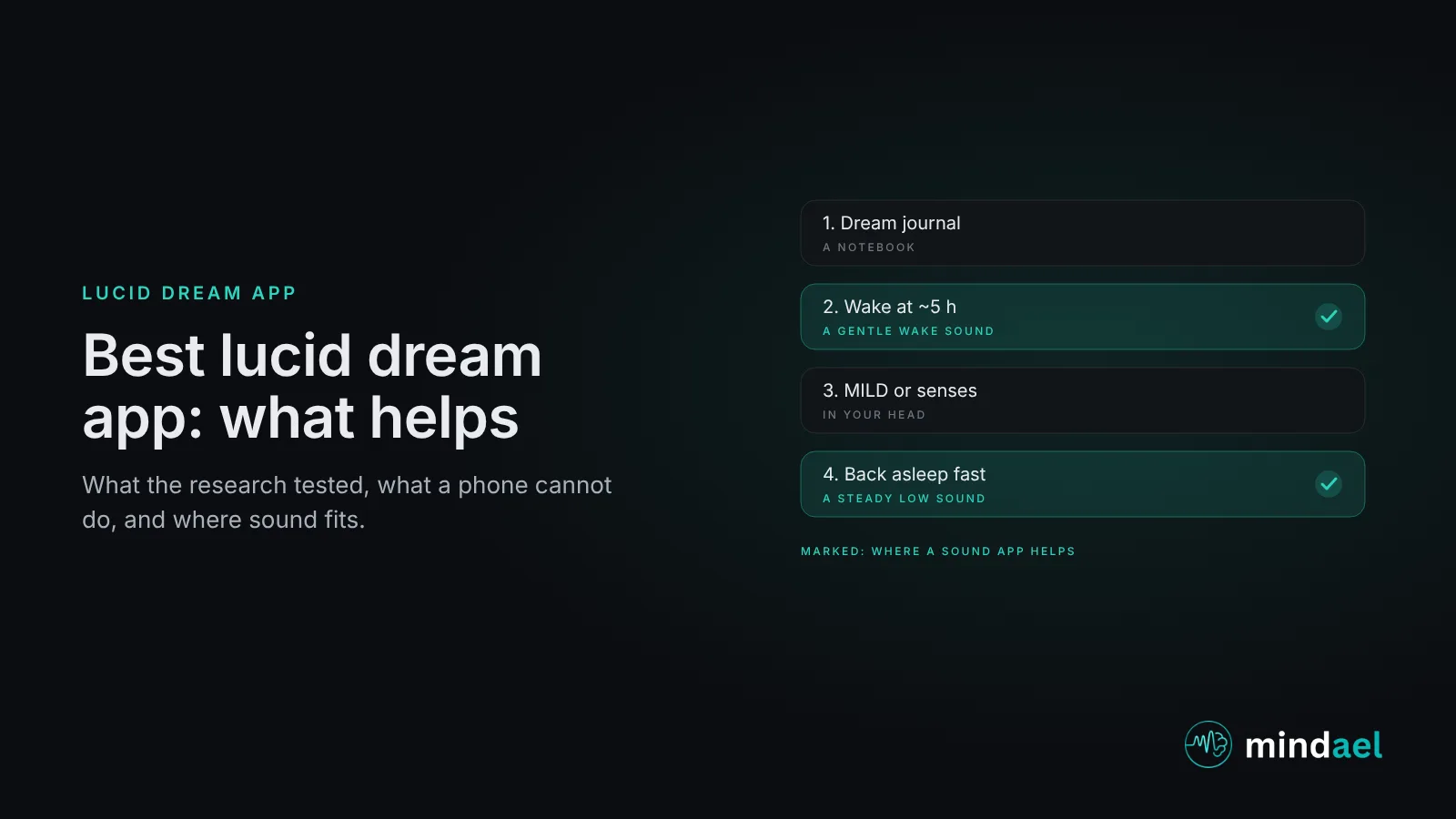
What helped people have lucid dreams in studies was a combination: better dream recall from a dream journal, a short wake-up in the early morning followed by going back to bed, a mental technique such as MILD or cycling through the senses as you fall back asleep, and falling asleep again quickly. In the largest induction study, people who fell back asleep within ten minutes were much more likely to succeed. Lab studies that played cues during REM sleep raised lucid dream rates, but they detected REM with brain recordings, which a phone on the bed cannot do reliably. So the parts an app can genuinely help with are a quiet early-morning alarm and a steady sound to fall back asleep to. Mindael covers that last step with rain, brown noise and a fading timer; it has no dream journal, reality-check reminders or REM detection.
What to look for, and how Mindael covers it
| What you need | In Mindael |
|---|---|
| A dream journal | Not in Mindael. A paper notebook by the bed or your phone's notes app works; write before you check anything else |
| A quiet early-morning wake-up | Mindael has gentle wake sounds instead of a beep, for the wake-back-to-bed step about five hours after sleep |
| A technique as you fall back asleep | MILD or cycling through your senses; both are mental exercises and need no app |
| Fall back asleep quickly | Rain, ocean or brown noise at a low volume, the same sound every time, with a timer that fades |
| Mixing | Rain over brown noise, or a delta beat under ocean waves: two sounds at once |
| Works offline | Every sound is on the phone; nothing streams at 5 a.m. |
| Cues during REM sleep | Not in Mindael. The lab studies detected REM with brain recordings, which a phone cannot do reliably |
| Price | Free to download on the App Store |
What actually helped people have lucid dreams
A lucid dream is a dream in which you know you are dreaming, and it almost always happens in REM sleep, the stage that fills the early morning. Our REM paradoxical sleep article explains why that stage is so dream-heavy.
The induction methods have been tested. A systematic review found the most promising approaches combined a short wake-up in the early morning with a mental technique on the way back to sleep (Stumbrys et al., 2012). The International Lucid Dream Induction Study then tested combinations with hundreds of people over a week: waking about five hours into the night, then using MILD (rehearsing that you will notice you are dreaming) or cycling attention through the senses as you fall back asleep (Adventure-Heart, 2020). Good dream recall predicted success, and so did falling back asleep within about ten minutes.
None of that needs an app. A notebook, a quiet wake-up, one technique and a fast return to sleep do the work. Our how to be a lucid dreamer guide has the full plan.
What a phone can and cannot do while you sleep
Some apps promise to detect REM and play a cue, a sound or a flash, that you learn to notice inside the dream. The idea comes from real lab work: in one study, people trained before a morning nap and then cued during REM had signal-verified lucid dreams far more often than people who were not cued (Carr et al., 2020).
But that lab knew when REM had started from brain-wave recordings. A phone on the mattress can only guess from movement and sound. A review of validation studies found smartphone apps were reasonable at telling sleep from wake in good sleepers, and much weaker on sleep stages and in people who sleep poorly (Fino and Mazzetti, 2019). A cue at the wrong moment is more likely to wake you than to make you lucid.
Where Mindael fits
Mindael is a sound app, not a lucid dream app. It does not keep a dream journal, send reality-check reminders or detect REM. It helps with the two practical steps: a gentle wake sound for the early-morning wake-up instead of a jarring beep, and a low, steady sound, rain, ocean or brown noise, to fall back asleep to quickly, with a timer that fades. Use the same sound every time, so it becomes a cue for going back down. Our vivid dreams guide has the wider night-time setup, and the best alarm app checklist covers waking gently.
Protect your sleep first
Lucid dreaming is not risk-free for everyone. A review urged caution: the benefits are less certain than popular accounts suggest, and practice that breaks up sleep night after night may cost more than it gives (Soffer-Dudek, 2020). Keep the early wake-ups to two or three nights a week, skip them before demanding days, and stop if you sleep worse or feel detached during the day.
How to switch in five minutes
- Start a dream journalEvery morning, before the phone, write whatever you remember, even one image. Recall comes first.
- Download MindaelFree on the App Store, no account needed. Pick one low, steady sound, such as rain or brown noise, and keep it the same.
- Wake once, about five hours inTwo or three nights a week, a quiet wake sound, a few minutes up, then back to bed.
- Rehearse one techniqueMILD or cycling through your senses, as you lie back down with the sound low and the screen face down.
- Protect your sleepSkip the practice on nights you need full rest, and stop if your sleep gets worse.
Back to sleep, quickly.
The step that predicted success in the largest lucid dream study was falling back asleep fast. Mindael has rain and ocean recorded without loops and brown noise generated to spec, two at a time, with a timer that fades. Free to download, no account, works offline. The same low sound every time.
- Rain, ocean and brown noise, studio-made
- Two sounds at once, fading timer
- Free to download, no account, works offline
 Free · No account needed · Works offline
Frequently asked questions
Do lucid dream apps work?
The techniques behind them can. In a large one-week study, a combination of an early-morning wake-up, a mental technique such as MILD and falling back asleep quickly produced lucid dreams for a good share of people. An app can remind you and play sound, but the parts that do the work are the habit and the technique.
Can an app detect REM sleep and play cues?
Lab studies that played sound or light cues during REM raised lucid dream rates, but they detected REM with brain recordings. A phone on the mattress estimates sleep from movement and sound and is much less reliable at telling sleep stages apart, so cues may arrive at the wrong moment and wake you.
Is Mindael a lucid dream app?
No. Mindael is a sound app for sleep and focus. It helps with one step that matters for lucid dreaming, falling back asleep quickly after the early-morning wake-up, with low, steady sounds and a timer that fades. It has no dream journal, reality-check reminders or REM detection.
What sound is best for lucid dreaming?
A low, steady sound you already find calming, such as rain or brown noise, used the same way every time. Its job is to help you fall asleep again quickly. Avoid anything with words or sudden changes, which pull attention away from the technique.
Do reality check reminders work?
On their own, not much in the short term. In a one-week study, people doing reality checks during the day had no more lucid dreams than before. They may help as part of a longer practice, but they are not the strongest part.
Is lucid dreaming safe?
For most people an occasional lucid dream is harmless. The concern is practice that breaks up sleep night after night, and for some people a blurring of dreams and waking life. Stop if you sleep worse or feel detached in the day, and talk to a doctor if you have a sleep or mental health condition.
Sources
- Adventure-Heart DJ (Aspy DJ). Findings from the International Lucid Dream Induction Study. Frontiers in Psychology, 2020.
- Stumbrys T, Erlacher D, Schädlich M, Schredl M. Induction of lucid dreams: a systematic review of evidence. Consciousness and Cognition, 2012.
- Carr M, et al. Combining presleep cognitive training and REM-sleep stimulation in a laboratory morning nap for lucid dream induction. Psychology of Consciousness: Theory, Research, and Practice, 2020.
- Fino E, Mazzetti M. Monitoring healthy and disturbed sleep through smartphone applications: a review of experimental evidence. Sleep and Breathing, 2019.
- Soffer-Dudek N. Are lucid dreams good for us? Are we asking the right question? A call for caution in lucid dream research. Frontiers in Neuroscience, 2020.