
How to Be a Lucid Dreamer: The Techniques That Worked in Studies, a Simple Plan, and What to Watch For
A lucid dream is a dream in which you know you are dreaming. About half of people have had at least one, and roughly a quarter have them monthly. To become a lucid dreamer, start by remembering more dreams with a dream journal, then combine a short wake-up in the early morning with a technique. In the largest induction study, MILD, rehearsing the intention to notice you are dreaming as you fall back asleep, and SSILD, cycling attention through sight, sound and body sensation, worked about equally well, while reality checks alone did little in a week. The people who succeeded remembered dreams well and fell back asleep within ten minutes. Protect your sleep while you practise: if it starts to cost you rest, or dreams feel more real than waking life, stop.
How to be a lucid dreamer is a question with a better evidence base than most people expect. Sleep researchers have tested the main techniques in the lab and in large online studies, and a few of them work for a good share of people within a week. This article explains what a lucid dream is, the techniques that worked, a simple plan to try, and when to stop. The steady sound we suggest for falling back asleep during practice is in Mindael, free to download on the App Store, and the wider picture of dreaming and sleep is in our vivid dreams guide.
What a lucid dream is, and how common
A lucid dream is a dream in which you know you are dreaming. Sometimes that is all: a moment of “this is a dream” before you wake. Sometimes you can steer what happens next. A meta-analysis of 50 years of research estimated that about 55% of people have had at least one lucid dream and about 23% have one at least once a month (Saunders et al., 2016). So most people are not learning something new; they are learning to make it happen more often.
Step 1: Remember more dreams
You cannot become lucid in a dream you will not remember. Keep a notebook by the bed and, every morning before you check the phone, write down whatever you recall, even a single image. Within a week or two most people recall more. In the largest induction study, good dream recall was one of the clearest predictors of success. Our elusive dreams article has the four-step morning method for catching a dream before it fades.
Step 2: Wake briefly in the early morning
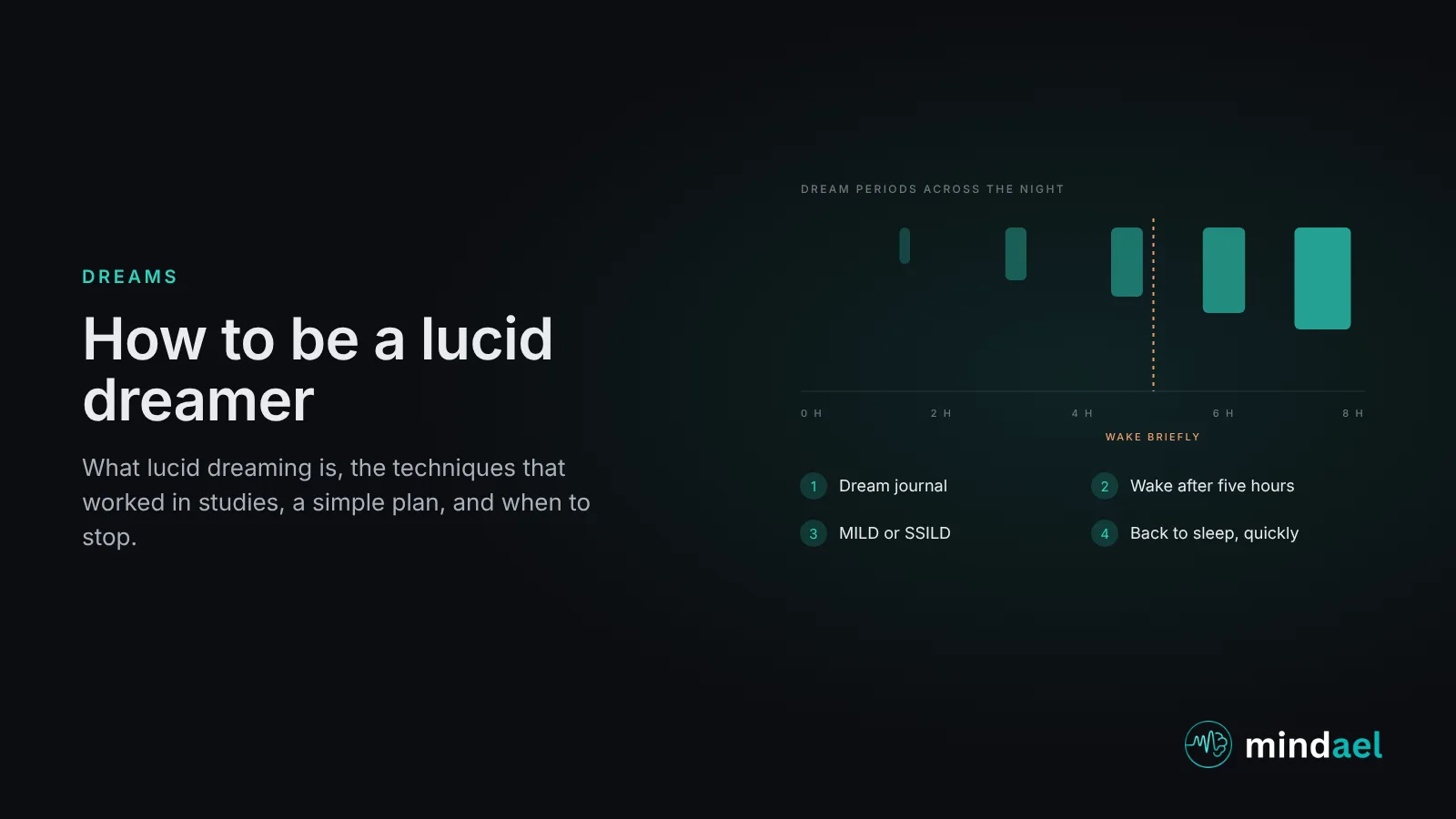
The longest, most vivid dream periods come in the last part of the night. Set a quiet alarm for about five hours after you fall asleep, get up for a few minutes, then go back to bed. This wake-back-to-bed step was part of the most successful combinations in the research, and a systematic review found it among the more promising approaches (Stumbrys et al., 2012). Do it two or three nights a week, not every night.
Step 3: Use one technique as you fall back asleep
The International Lucid Dream Induction Study tested several techniques with hundreds of people over a week (Adventure-Heart, 2020). Two stood out, with similar results:
MILD. As you lie back down, replay a recent dream and imagine noticing that it is a dream. Repeat a phrase like “next time I am dreaming, I will remember I am dreaming” until you fall asleep.
SSILD. Cycle your attention through your senses for a few seconds each: what you see behind closed eyes, what you hear, what you feel in the body. Repeat several rounds, then let go and fall asleep.
Reality checks on their own, such as looking at your hands or reading a line twice during the day, did not increase lucid dreams in a week.
Step 4: Fall back asleep quickly
The same study found that people who fell asleep within ten minutes after the technique were much more likely to succeed. This is where the room matters. Keep the light off, the phone away and the room steady. A low, unchanging sound such as rain or brown noise gives the mind something to rest on instead of the day ahead. If falling asleep is the hard part for you, how to fall asleep fast has more.
When to slow down or stop
Lucid dreaming is not risk-free for everyone. A review urged caution: the benefits are less clear than popular accounts suggest, and practice that repeatedly breaks up sleep may cost more than it gives (Soffer-Dudek, 2020). In the induction study, success did not lower sleep quality, but that was a one-week trial. Stop if you are sleeping worse, if you feel detached or unreal during the day, or if dreams start to feel more real than waking life. If you have a mental health condition or a sleep disorder, talk to a doctor before starting.
The short version
Keep a dream journal. Two or three nights a week, wake after about five hours, stay up a few minutes, then fall back asleep rehearsing MILD or cycling through your senses. Keep the room dark and the sound steady so you fall asleep quickly. Protect your sleep above all, and stop if it starts to suffer.
Back to sleep, quickly.
Mindael has rain and ocean recorded without loops and brown noise generated to spec, two at a time. Free to download, no account, works offline. A steady, low sound for the early-morning wake-up, so you drift back into the dream instead of into your thoughts.
- Rain, ocean and brown noise, studio-made
- The same low sound every time, as a cue
- Free to download, no account, works offline
 Free · No account needed · Works offline
Frequently asked questions
How do you become a lucid dreamer?
Remember more dreams first: write down whatever you recall every morning. Then, two or three nights a week, set an alarm for about five hours after you fall asleep, stay up briefly, and go back to sleep rehearsing the intention to notice that you are dreaming. In the largest study of these methods, falling back asleep quickly was one of the strongest predictors of success.
How common is lucid dreaming?
A meta-analysis of 50 years of research estimated that about 55% of people have had at least one lucid dream and about 23% have them at least once a month. It is common, and for most people it happens by chance rather than by training.
What is the MILD technique?
MILD stands for mnemonic induction of lucid dreams. As you fall back asleep after a short wake-up, you replay a recent dream, imagine noticing that it is a dream, and repeat a phrase such as 'next time I am dreaming, I will remember I am dreaming'. It was one of the two most effective techniques in an international study.
Do reality checks work?
On their own, not much, at least in the short term. In a one-week study, people doing reality checks, such as looking at their hands or reading a line twice during the day, had no more lucid dreams than before. They may help as part of a longer practice.
Is lucid dreaming safe?
For most people an occasional lucid dream is harmless, and in the largest induction study success did not reduce sleep quality. The concern is practice that breaks up sleep night after night, and for some people, blurring the line between dreams and waking life. If you sleep worse, feel detached during the day or have a mental health condition, stop or talk to a doctor.
Can sound help with lucid dreaming?
A steady sound can help you fall back asleep quickly after the early-morning wake-up, which is one of the things successful lucid dreamers did. It does not create lucid dreams. Keep it low and use the same one every time.
Sources
- Saunders DT, et al. Lucid dreaming incidence: a quality effects meta-analysis of 50 years of research. Consciousness and Cognition, 2016.
- Stumbrys T, Erlacher D, Schädlich M, Schredl M. Induction of lucid dreams: a systematic review of evidence. Consciousness and Cognition, 2012.
- Adventure-Heart DJ (Aspy DJ). Findings from the International Lucid Dream Induction Study. Frontiers in Psychology, 2020.
- Soffer-Dudek N. Are lucid dreams good for us? Are we asking the right question? A call for caution in lucid dream research. Frontiers in Neuroscience, 2020.
This article is for general information and is not medical advice. Do not practise lucid dream techniques if they disturb your sleep, and talk to a doctor first if you have a sleep disorder, a mental health condition, or experiences of feeling detached from reality.
This article is part of our dreams guide. Hear the sounds in this article in the Mindael sound library, or see our app comparison checklists.