
Best Alarm App: What an Alarm Should Do to Wake You Well, With the Research, and Where Mindael Fits
The best alarm app is the one that gets you up on time and leaves you less groggy, and the research says the sound and the routine matter more than any feature. A 2020 study linked melodic alarms to less morning grogginess than harsh beeps, and a regular wake time does more for mornings than anything an app can add. This page is the checklist of what an alarm app should do, where each item comes from, and how Mindael, a sleep sound app with gentle wake-up sounds, fits. Free to download on the App Store.
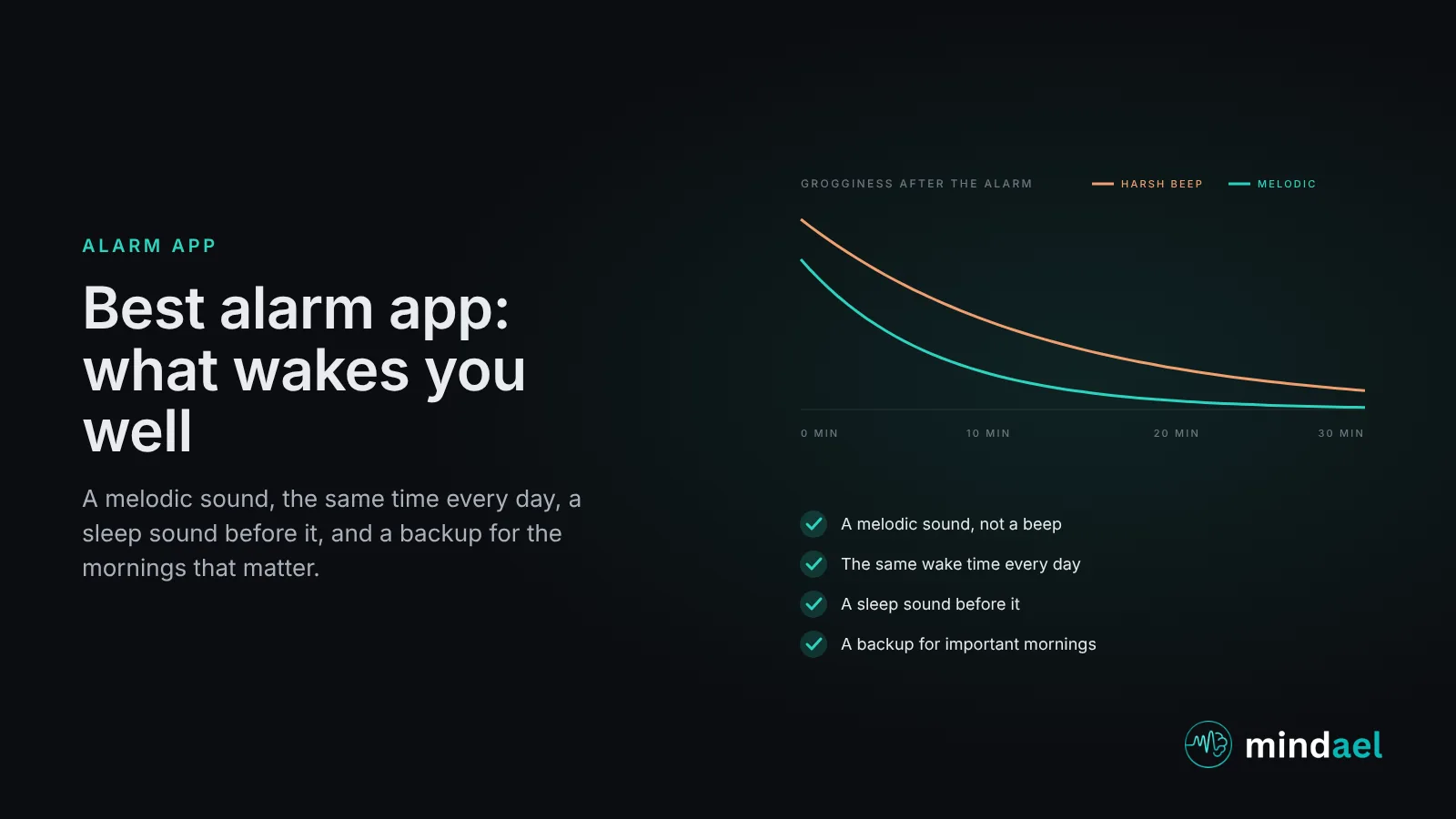
The best alarm app wakes you reliably with a sound that does not jolt: melodic rather than a harsh beep, which a 2020 study linked to less sleep inertia. It makes a fixed wake time easy, because regular timing shapes the body clock more than any sound. It pairs well with a steady sound at night, which protects the deep sleep whose shortage causes most morning grogginess. Mindael has gentle wake-up sounds, Rainy Morning, Crystal Dawn and Zen Wake, alongside the sleep sounds you fall asleep to, free to download. For a flight or an exam, keep the phone's built-in clock alarm as a backup; that is good advice for any alarm app.
What to look for, and how Mindael covers it
| What you need | In Mindael |
|---|---|
| A melodic sound, not a beep | Gentle wake-up sounds: Rainy Morning, Crystal Dawn, Zen Wake |
| The same wake time every day | Set it once for the week, weekends included; the regular time is what trains the body clock |
| A sleep sound before it | Brown noise, rain or a delta beat through the night protects the deep sleep the morning depends on |
| Sleep and wake in one place | The sound you fall asleep to and the sound you wake to, without switching apps at midnight |
| No streaks, no sleep scores | Mindael does not grade your night, which keeps the bed from becoming a test |
| A backup for important mornings | For a flight or an exam, also set the phone's built-in clock alarm. We recommend this for every alarm app |
| Price | Free to download on the App Store |
What an alarm is for
An alarm has one job, to get you up on time, and one side effect it should keep small: the grogginess of the first half hour, called sleep inertia. That grogginess is worst when the alarm pulls you out of deep slow-wave sleep and when the night was short, because sleep loss increases deep sleep and with it the inertia (Tassi and Muzet, 2000). The best alarm app helps with both: a sound that does not jolt, and a routine that means you are not dragged out of deep sleep every morning. Our alarm on my phone guide covers setting the built-in alarm and the morning routine around it.
The checklist, explained
A melodic sound, not a beep. In a 2020 study, people who woke to melodic alarm sounds reported less grogginess than those who woke to harsh, beeping tones (McFarlane et al., 2020). The sample was small and self-reported, so the effect is suggestive, but the choice costs nothing. Mindael’s wake sounds, Rainy Morning, Crystal Dawn and Zen Wake, are gentle wake-up sounds, not beeps.
The same wake time every day. In a study of students, irregular sleepers had body clocks running hours later than regular sleepers, while sleeping about the same total time (Phillips et al., 2017). A fixed wake time, weekends included, is the most effective morning change there is, and no alarm feature can replace it.
Light within minutes. The body clock sets itself mainly by light. A week of natural light without electric light moved people’s internal clocks about two hours earlier (Wright et al., 2013). Open the curtains as part of switching the alarm off.
A sleep sound before it. Most morning grogginess is a shortage of good sleep, not a bad alarm. A steady sound through the night masks the noises that break up deep sleep; the sleep sounds guide and brown vs white vs pink noise explain which to use.
Snooze, honestly. In a 2023 study, habitual snoozers allowed 30 minutes of snoozing did not sleep worse, show more stress hormone or feel worse, and were slightly sharper on some tests right after rising (Sundelin et al., 2023). One snooze is fine. Six means the alarm is earlier than your sleep allows.
A backup, always
For a flight, an exam or a first day, set the phone’s built-in clock alarm as well. That is our advice for any alarm app, ours included: a second alarm costs nothing, and the morning you need it you will be glad. For the night before, how to fall asleep fast has the routine, and if the afternoon is the problem rather than the morning, how to take a nap covers the twenty-minute version.
How to switch in five minutes
- Download MindaelFree on the App Store, no account.
- Choose your wake time and keep itThe same time seven days a week. If you need more sleep, move bedtime earlier, not the alarm later at the weekend.
- Pick a gentle wake soundRainy Morning, Crystal Dawn or Zen Wake. Something melodic that you do not mind hearing; test it at a normal volume in the afternoon.
- Set the sleep sound for the nightBrown noise or rain at a low level, running all night, so small noises do not break up the deep sleep before the alarm.
- Light within minutes of wakingCurtains open or a step outside. Light is what tells the body clock the morning has started; the alarm only tells you.
A gentle sound at both ends of the night.
Mindael has gentle wake-up sounds, Rainy Morning, Crystal Dawn and Zen Wake, next to brown noise, rain and delta beats for the night, made in our studio. Free to download, no account, works offline.
- Gentle wake-up sounds instead of a beep
- Brown noise, rain and delta beats for the night
- Free to download, no account, works offline
 Free · No account needed · Works offline
Frequently asked questions
What is the best alarm app?
One that wakes you reliably with a melodic sound rather than a harsh beep, makes a fixed wake time easy, and works alongside a sleep sound at night. Mindael has gentle wake-up sounds alongside its sleep sounds, free to download. For anything you cannot miss, keep the phone's built-in alarm as a backup.
Which alarm sound is best for waking up?
A melodic one. In a 2020 study, people who woke to melodic sounds reported less grogginess than those who woke to harsh beeping tones. Pick a sound you like, at a volume that wakes you without a jolt.
Why do I wake up groggy even with a gentle alarm?
Usually because the alarm interrupts deep sleep or because the night was too short. Waking from deep slow-wave sleep produces the most grogginess, and sleep loss increases it. A regular wake time, enough hours and a steady sound to protect sleep help more than any alarm sound.
Is snoozing bad?
Less than its reputation. In a 2023 study, habitual snoozers allowed 30 minutes of snoozing did not sleep worse or feel worse, and performed slightly better on some tests right after rising. Hitting snooze many times is a sign the alarm is earlier than your sleep allows.
Can Mindael replace my phone's clock alarm?
Mindael's gentle wake sounds suit everyday mornings. For a flight, an exam or anything you cannot miss, set the built-in clock alarm too. That is how we would use any third-party alarm app.
What time should I set my alarm?
The time you can keep every day, including weekends, that leaves seven to nine hours after you usually fall asleep. A regular time matters more than an early one.
Sources
- McFarlane SJ, Garcia JE, Verhagen DS, Dyer AG. Alarm tones, music and their elements: analysis of reported waking sounds to counteract sleep inertia. PLOS ONE, 2020.
- Tassi P, Muzet A. Sleep inertia. Sleep Medicine Reviews, 2000.
- Sundelin T, Landry S, Axelsson J. Is snoozing losing? Why intermittent morning alarms are used and how they affect sleep, cognition, cortisol, and mood. Journal of Sleep Research, 2023.
- Phillips AJK, et al. Irregular sleep/wake patterns are associated with poorer academic performance and delayed circadian and sleep/wake timing. Scientific Reports, 2017.
- Wright KP, et al. Entrainment of the human circadian clock to the natural light-dark cycle. Current Biology, 2013.