

Cycles of Sleep: How Many You Need, How Long Each Lasts, and Why You Wake Between Them
A night of sleep is not one long state but a series of cycles, each moving from light sleep into deep sleep and then into REM, about 90 minutes long on average, though it varies from person to person and across the night. The cycles are not identical: the first ones hold most of the deep sleep, the later ones most of the REM. Most adults get four to six cycles a night, which matches the recommended seven to nine hours. Brief awakenings between cycles are normal, and most people do not remember them. Waking from deep sleep makes the grogginess called sleep inertia worse, so an alarm that lands near the end of a cycle can feel easier, but timing to the minute is unreliable. A regular schedule and a full night matter more than counting cycles.
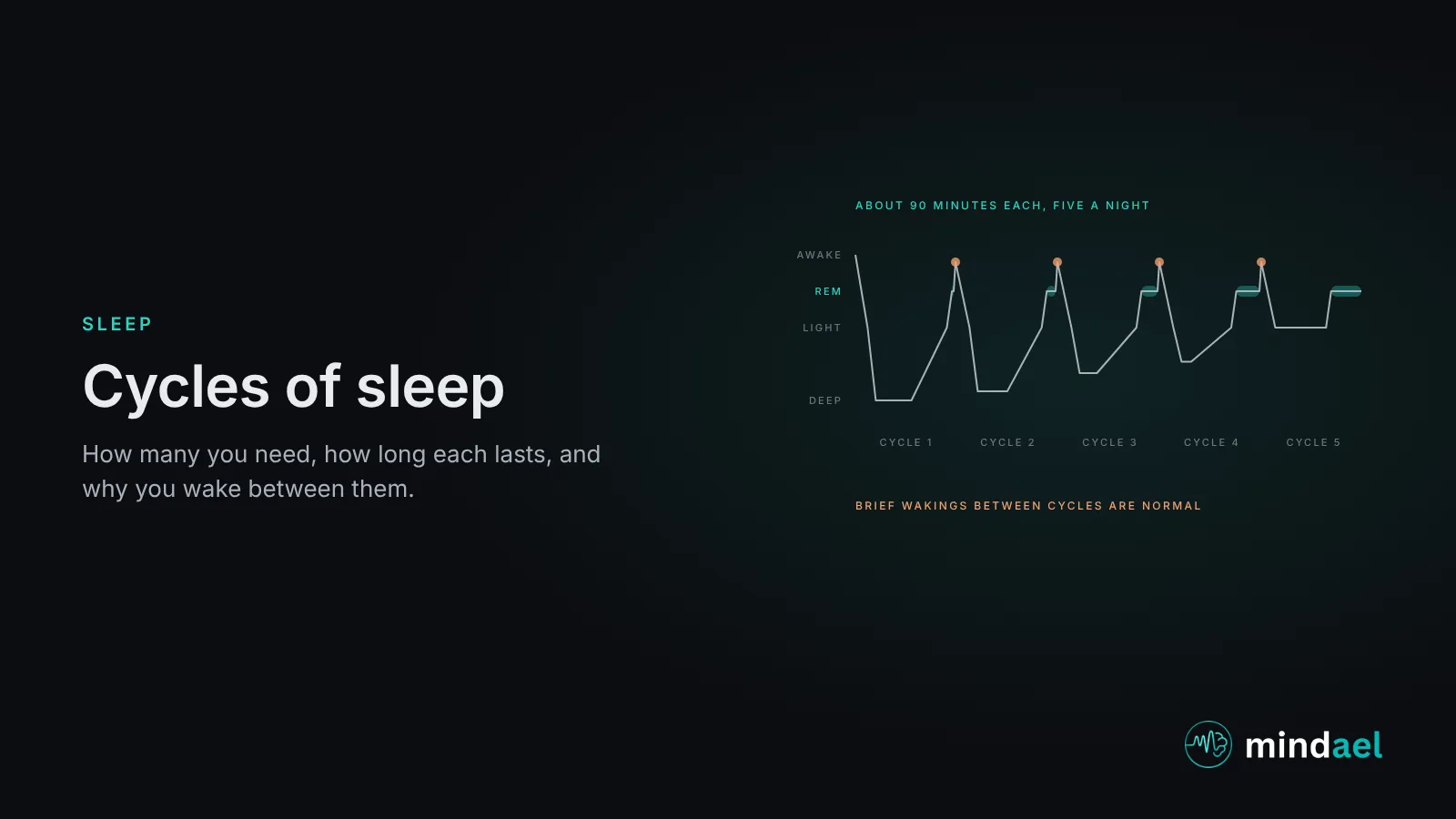
Cycles of sleep are the reason a night is not one long, even state. You move from light sleep into deep sleep, then into REM, and then start again, several times a night. Knowing how the cycles work explains why you sometimes wake at 3 a.m., why some alarms feel brutal and others easy, and why the last hours of the night matter. We make Mindael, a sound app with steady sounds for sleep, free to download on the App Store.
What one cycle is
Each cycle runs through light sleep, deep slow-wave sleep and REM, the stage with most vivid dreams. On average a cycle lasts about 90 minutes, but that is an average: it varies from person to person and from one cycle to the next. The cycles also change across the night in a regular way. Deep sleep is concentrated in the first cycles, and REM gets longer in the later ones (Feinberg and Floyd, 1979).
So the first half of the night is the deep-sleep half, and the second half is the REM half. Our benefits of REM article explains why that second half is worth protecting.
How many cycles: 3, 4, 5 or 6?
- 3 cycles, about 4.5 hours: too short for most adults, and it cuts most of the REM sleep.
- 4 cycles, about 6 hours: short.
- 5 cycles, about 7.5 hours: inside the recommended range.
- 6 cycles, about 9 hours: the upper end of the range.
An expert panel recommended seven to nine hours for adults and seven to eight for older adults (Hirshkowitz et al., 2015). That is about five cycles for most people. Sleep also changes with age: a large meta-analysis found that deep sleep declines and night-time waking increases as people get older (Ohayon et al., 2004).
Waking between cycles is normal
Between cycles, sleep often becomes light enough for a brief awakening. Most people never remember them. They turn into a problem when something catches your attention in that moment, a car, a partner, a thought about tomorrow, and you stay awake.
That is where the room matters. A steady sound such as rain or brown noise that keeps playing all night means there is nothing new to notice when you surface. If you do wake and cannot settle, our can’t sleep at night guide covers what to do.
Timing your alarm
The grogginess after waking, called sleep inertia, is worse when you wake from deep sleep than from light sleep (Tassi and Muzet, 2000). That is the idea behind waking at the end of a cycle: count back in 90-minute steps from your alarm and add about 15 minutes to fall asleep. For a 7:00 alarm, that gives bedtimes around 11:15 or 12:45.
Treat it as a rough guide. Cycle length varies, so you cannot time it to the minute. A fixed wake time, every day, does more for how you feel in the morning than any calculation. The same logic applies in the day: our how to take a nap guide explains why 20 minutes or a full 90 work better than 45.
The short version
A night is four to six cycles of light sleep, deep sleep and REM, about 90 minutes each on average, with deep sleep early and REM late. Waking briefly between cycles is normal. Aim for about five cycles, keep your wake time fixed, and keep the room steady so the awakenings between cycles pass unnoticed. For a sound that plays all night, Mindael is free to download on the App Store, and our sleep sounds guide has the full setup.
A steady room for every cycle.
Mindael has rain and ocean recorded without loops, brown noise generated to spec and a delta beat made in our studio, two at a time, playing all night offline. Free to download, no account. When you surface between cycles, the same sound is there, and nothing new pulls you awake.
- Rain, ocean, brown noise and a delta beat
- Two sounds at once, plays all night offline
- Free to download, no account, works offline
 Free · No account needed · Works offline
Frequently asked questions
How long is one sleep cycle?
About 90 minutes on average, but it varies between people and across the night, often somewhere between 70 and 120 minutes. Treat 90 minutes as a rough guide, not a rule.
How many sleep cycles do you need?
Most adults get four to six a night. Five cycles of about 90 minutes is roughly seven and a half hours, which sits inside the recommended seven to nine hours for adults.
Is 3 sleep cycles enough?
Three cycles is about four and a half hours, well short of what most adults need. It can get you through a single night, but it cuts mostly REM sleep, and doing it often adds up.
Is it normal to wake up between sleep cycles?
Yes. Brief awakenings between cycles are a normal part of sleep, and most people do not remember them. They become a problem only when you stay awake and start thinking, which is where a steady sound and a calm routine help.
Should I time my alarm to my sleep cycles?
It can help a little, since waking from deep sleep feels worse. But cycle length varies, so a fixed wake time and enough time in bed matter more than precise timing.
What are healthy sleep cycles?
Cycles that move through light, deep and REM sleep without being broken up too often, across a full night. Regular hours, little alcohol in the evening and a quiet, dark room support them.
Sources
- Feinberg I, Floyd TC. Systematic trends across the night in human sleep cycles. Psychophysiology, 1979.
- Ohayon MM, Carskadon MA, Guilleminault C, Vitiello MV. Meta-analysis of quantitative sleep parameters from childhood to old age in healthy individuals. Sleep, 2004.
- Hirshkowitz M, et al. National Sleep Foundation's sleep time duration recommendations: methodology and results summary. Sleep Health, 2015.
- Tassi P, Muzet A. Sleep inertia. Sleep Medicine Reviews, 2000.
This article is for general information and is not medical advice. If you regularly wake many times a night, lie awake for long stretches, or feel unrefreshed despite a full night in bed, please talk to a doctor.
This article is part of our sleep guide. Hear the sounds in this article in the Mindael sound library, or see our app comparison checklists.