

Benefits of REM Sleep: Memory, Emotion, Creativity and What the Research Shows
REM sleep, the dream-rich stage that comes in longer stretches toward morning, appears to do several useful jobs. In a brain-imaging study, a night of sleep reduced the emotional brain's reaction to upsetting images seen the day before, and the drop was linked to a marker of calmer brain chemistry during REM. In a nap study, people who reached REM solved more creative word problems afterwards than people who rested quietly or had only non-REM sleep. Reviews of sleep and memory see REM as one part of a larger process, with deep sleep doing much of the consolidation. And in two large studies of middle-aged and older adults, less REM sleep was linked with higher mortality, an association rather than proof of cause. The practical point is simple: REM comes late in the night, so cutting sleep short or drinking late cuts it first.
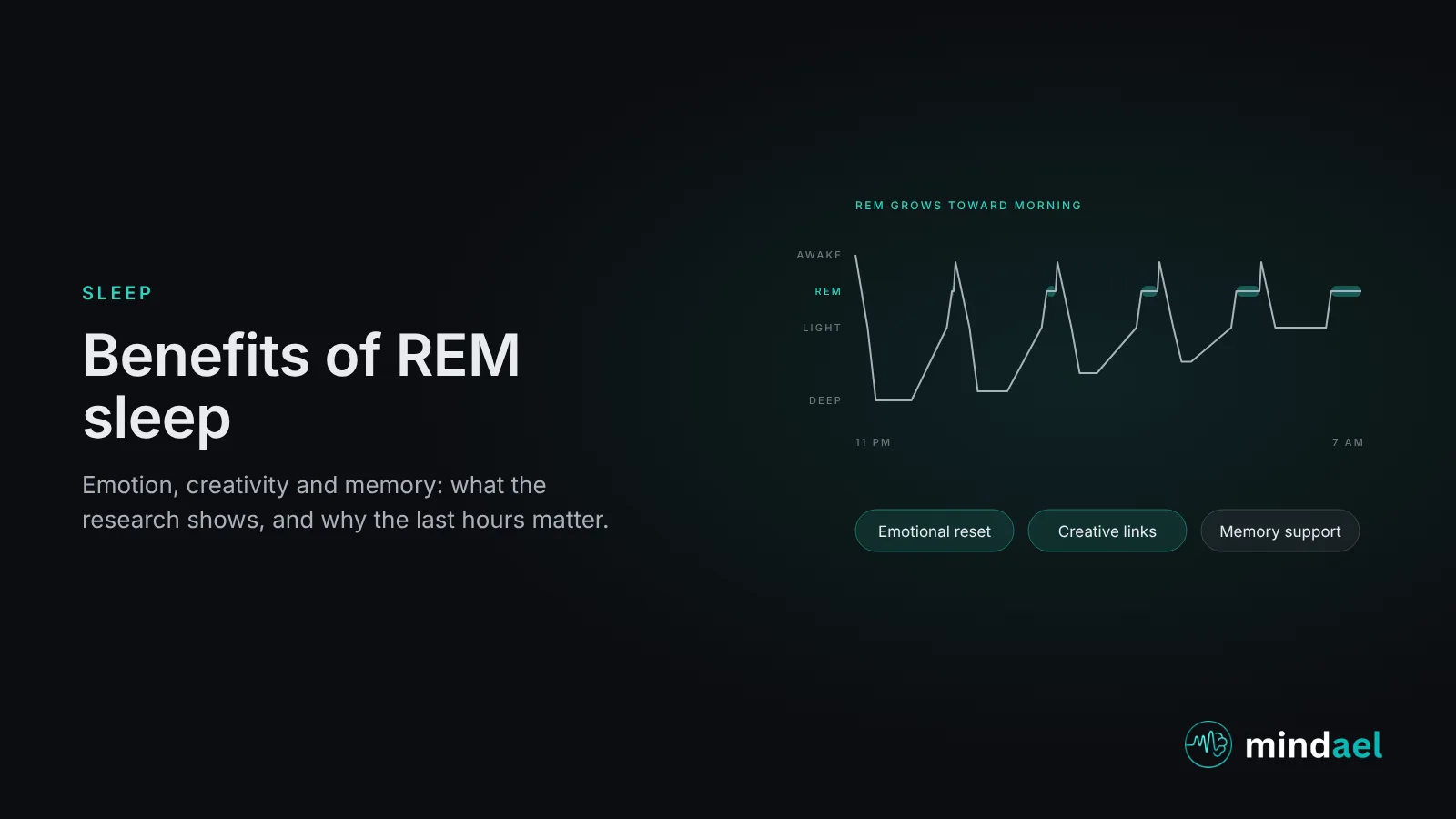
The benefits of REM sleep are easy to overstate and easy to miss. REM is the stage where most vivid dreams happen, and it comes in longer and longer stretches as the night goes on. The research suggests it helps with three things: taking the sting out of emotional memories, linking ideas in new ways, and supporting memory alongside deep sleep. This article covers what the studies show and what it means for your night. We make Mindael, a sound app with steady sounds for sleep, free to download on the App Store.
1. An overnight emotional reset
In a brain-imaging study, people looked at emotional images twice, 12 hours apart. Those who slept in between showed less reaction in the amygdala, the brain’s alarm centre, the second time, and rated the images as less intense. Those who stayed awake showed more. The size of the overnight drop was linked to a marker of calmer brain chemistry during REM (van der Helm et al., 2011).
That fits a common experience: something that felt overwhelming at night often feels more manageable in the morning. Our REM sleep explainer covers why the brain is so active in this stage while the body stays still.
2. Creative links
In a nap study, people saw word problems that needed a creative link, then either rested quietly, napped without reaching REM, or napped with REM. Only the REM group improved on problems they had seen before the nap (Cai et al., 2009). The authors suggested REM helps connect information that was not linked before. “Sleep on it” has some research behind it.
3. Memory, alongside deep sleep
REM is not the whole story for memory. A major review of sleep and memory describes the night as a team effort, with deep slow-wave sleep doing much of the work of consolidating facts and REM contributing, particularly for emotional material (Rasch and Born, 2013). The practical lesson is the same: a full night, not a particular stage, is what supports memory.
4. A marker of health
In two large studies of middle-aged and older adults, people who spent a smaller share of the night in REM had higher mortality over the following years (Leary et al., 2020). This is an association: less REM may reflect poorer health rather than cause it. It is a reason to take REM seriously, not a reason to worry about one bad night.
How to get your REM
Most REM comes in the last third of the night, because each sleep cycle has a little more REM than the one before. So the biggest REM thief is simply a short night: an alarm two hours early can cut your REM far more than your deep sleep. Alcohol in the evening is the other common one.
Keep a regular wake time, give yourself a full night in bed, and keep the early morning quiet: traffic and birds at 5 a.m. land right in the REM-rich hours. A steady sound such as rain or brown noise, playing all night, covers them. Our sleep sounds guide has the full setup.
The short version
REM sleep seems to help emotional memories lose their sting, link ideas creatively and support memory alongside deep sleep, and less of it has been linked with poorer health in later life. It comes late in the night, so protect the last hours: a regular wake time, less evening alcohol, and a quiet room at dawn. For a sound that plays through to morning, Mindael is free to download on the App Store.
Protect the last hours of the night.
Mindael has rain and ocean recorded without loops, brown noise generated to spec and a delta beat made in our studio, two at a time, playing through the night offline. Free to download, no account. A steady sound that covers early-morning noise, when most of your REM sleep happens.
- Rain, ocean, brown noise and a delta beat
- Two sounds at once, plays all night offline
- Free to download, no account, works offline
 Free · No account needed · Works offline
Frequently asked questions
What are the benefits of REM sleep?
Research links REM sleep with taking the sting out of emotional memories, linking ideas for creative problem solving, and supporting some kinds of memory. Less REM sleep has also been linked with higher mortality in older adults, though that is an association, not proof of cause.
How much REM sleep do I need?
Adults typically spend about a fifth to a quarter of the night in REM, roughly 90 to 120 minutes in a full night. You do not need to track it: a regular, full night of sleep gives you the REM your body takes.
Why do I get less REM sleep when I sleep less?
Because most REM comes in the last third of the night. Each sleep cycle has a little more REM than the last, so the final hours before you wake are the REM-rich part. Cutting the night short cuts those first.
Does REM sleep help memory?
It plays a part. Reviews of sleep and memory give deep sleep a central role in consolidating facts, with REM contributing, especially for emotional memories and linking new information to what you already know.
Does REM sleep make you more creative?
In a nap study, people who reached REM did better on creative word problems they had seen before the nap than people who rested quietly or had only non-REM sleep. It is one study, but it fits the idea of 'sleeping on it'.
What reduces REM sleep?
Short nights, alcohol in the evening, some medications, and an irregular schedule. Alcohol tends to suppress REM early in the night and fragment sleep later.
Sources
- van der Helm E, Yao J, Dutt S, Rao V, Saletin JM, Walker MP. REM sleep depotentiates amygdala activity to previous emotional experiences. Current Biology, 2011.
- Cai DJ, Mednick SA, Harrison EM, Kanady JC, Mednick SC. REM, not incubation, improves creativity by priming associative networks. Proceedings of the National Academy of Sciences, 2009.
- Rasch B, Born J. About sleep's role in memory. Physiological Reviews, 2013.
- Leary EB, Watson KT, Ancoli-Israel S, et al. Association of rapid eye movement sleep with mortality in middle-aged and older adults. JAMA Neurology, 2020.
This article is for general information and is not medical advice. If you often wake unrefreshed, act out dreams, or feel very sleepy in the day, please talk to a doctor; these can be signs of a sleep disorder.
This article is part of our sleep guide. Hear the sounds in this article in the Mindael sound library, or see our app comparison checklists.