

Can't Sleep at Night? What to Do Tonight, What to Change This Week, and When to Get Help
If you can't sleep at night, the most useful thing to do in the moment is often the opposite of what feels natural: if you have been awake for about 20 minutes, get up, sit somewhere dim and quiet, and go back to bed only when you feel sleepy, so the bed stays linked with sleep. Before bed, a five minute to-do list for tomorrow helped people fall asleep faster in a lab study, and a steady low sound can cover the noises that keep you alert. In the day, caffeine taken even six hours before bed cut sleep in a home study, and reading on a bright screen in the evening delayed sleep and the body clock compared with a paper book. If poor sleep goes on for three nights a week for three months, the first-line treatment doctors recommend is cognitive behavioural therapy for insomnia, CBT-I, not more effort.
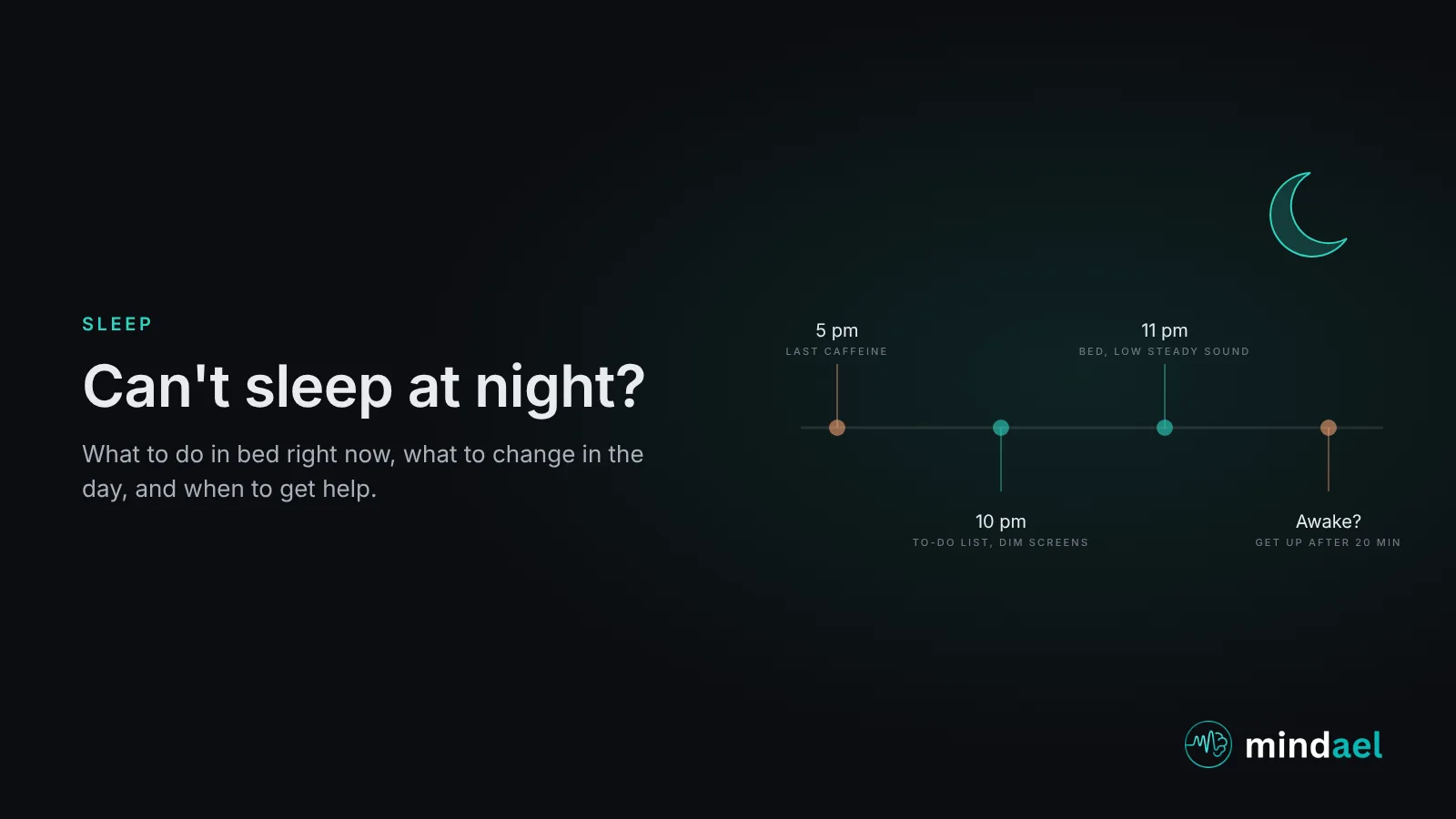
Can’t sleep at night? You are in large company, and the frustrating part is that trying harder usually makes it worse. This article covers what to do in bed right now, what to change in the day, and when it is time to get help. We make Mindael, a sound app for sleep, free to download on the App Store, and we will say where a sound helps and where it does not.
Right now, in bed
If you have been awake about 20 minutes, get up. Sit somewhere dim and quiet with something calm: a paper book, a low sound, slow breathing. Go back to bed when your eyes feel heavy, not when the clock says so. This is stimulus control, one of the core parts of the insomnia treatment doctors recommend first (Qaseem et al., 2016): the bed stays a place for sleep, not for lying awake.
Turn the clock away. Counting the hours left raises the alarm you are trying to calm.
Slow your breathing. A longer breath out than in, for a few minutes, is a simple way to settle. Our deep breathing for sleep guide has three patterns.
Cover the noise. If a car, a neighbour or a creak keeps snapping you back, a steady low sound helps. In a lab study that simulated a bad night, broadband sound cut the time to fall asleep by 38 percent (Messineo et al., 2017). Rain or brown noise, low and across the room, is a good start.
Before bed: get tomorrow out of your head
A lot of sleepless nights are planning sessions in disguise. In a sleep lab study, adults who spent five minutes writing a specific to-do list for the next days fell asleep faster than those who wrote about what they had already finished, and the more specific the list, the faster they fell asleep (Scullin et al., 2018). Keep a notepad by the bed; if something new comes up in the night, write one line and let it go.
In the day: what keeps you awake at night
Caffeine, earlier than you think. In a home study, a strong dose of caffeine taken six hours before bed still cut sleep by about an hour, and people did not notice (Drake et al., 2013). Stop coffee, strong tea and energy drinks six hours before bedtime.
Bright screens late in the evening. People reading on a light-emitting tablet before bed took longer to fall asleep and had a later body clock than when they read a printed book (Chang et al., 2015). Dim the room and the screen for the last hour, or switch to paper.
The same wake time every day, weekends included, and no long late naps. A fixed morning anchors the night. Our how to fall asleep fast guide has the full evening routine.
When it is more than a bad week
If you struggle to sleep on three or more nights a week for three months, that is chronic insomnia, and it is treatable. The first-line treatment is cognitive behavioural therapy for insomnia, CBT-I: a short, structured course that works on sleep timing, the bed-and-wake link and the worry around sleep (Qaseem et al., 2016). Ask a doctor about it. See a doctor too if you snore loudly, stop breathing in your sleep, or if low mood or anxiety is what keeps you awake.
The short version
Awake for 20 minutes? Get up, keep it dim, come back when sleepy. Write tomorrow’s list before bed. No caffeine in the last six hours, dim screens in the last hour, same wake time every day. A low steady sound can cover the noise and give your mind somewhere to rest. If it lasts for months, ask about CBT-I. For rain, ocean and brown noise with a timer that fades, Mindael is free to download on the App Store, and our sleep sounds guide has the full night-time setup.
Something steady for the long night.
Mindael has rain and ocean recorded without loops and brown noise generated to spec, two at a time, with fine volume control and a timer that fades. Free to download, no account, works offline. A low sound for the chair or the bed, the same one every night.
- Rain, ocean and brown noise, studio-made
- Two sounds at once, a timer that fades
- Free to download, no account, works offline
 Free · No account needed · Works offline
Frequently asked questions
What should I do if I can't sleep at night?
If you have been lying awake for about 20 minutes, get up and sit somewhere dim and quiet with something calm, a book on paper or a low sound, and go back to bed when you feel sleepy. Do not check the clock or your phone. Lying in bed trying harder tends to make the bed a place for being awake.
Why can't I sleep even when I'm tired?
Being tired and being able to fall asleep are not the same. Worry, caffeine taken in the afternoon, bright screens in the evening, an irregular wake time or a long nap can all keep the brain alert even when the body is exhausted.
Does writing a to-do list help you sleep?
It can. In a lab study, adults who spent five minutes writing a specific to-do list for the coming days fell asleep faster than those who wrote about what they had already done. It moves tomorrow out of your head and onto paper.
Can sounds help when you can't sleep?
A steady, low sound such as rain, ocean waves or brown noise can cover sudden noises and give a busy mind something neutral to rest on. Keep it quiet, around 45 dB, across the room, with a timer that fades if you only need help falling asleep.
How late can I have coffee?
In one study, a strong dose of caffeine six hours before bed still cut total sleep by about an hour, and people did not notice. A good rule is no coffee, strong tea or energy drinks in the six hours before bedtime.
When should I see a doctor about not sleeping?
If you struggle to fall or stay asleep on three or more nights a week for three months, or poor sleep is affecting your days, see a doctor. The first-line treatment for chronic insomnia is CBT-I, a short course of structured sessions, which works better in the long run than sleeping pills.
Sources
- Qaseem A, Kansagara D, Forciea MA, Cooke M, Denberg TD. Management of chronic insomnia disorder in adults: a clinical practice guideline from the American College of Physicians. Annals of Internal Medicine, 2016.
- Scullin MK, Krueger ML, Ballard HK, Pruett N, Bliwise DL. The effects of bedtime writing on difficulty falling asleep: a polysomnographic study comparing to-do lists and completed activity lists. Journal of Experimental Psychology: General, 2018.
- Drake C, Roehrs T, Shambroom J, Roth T. Caffeine effects on sleep taken 0, 3, or 6 hours before going to bed. Journal of Clinical Sleep Medicine, 2013.
- Chang AM, Aeschbach D, Duffy JF, Czeisler CA. Evening use of light-emitting eReaders negatively affects sleep, circadian timing, and next-morning alertness. Proceedings of the National Academy of Sciences, 2015.
- Messineo L, et al. Broadband sound administration improves sleep onset latency in healthy subjects in a model of transient insomnia. Frontiers in Neurology, 2017.
This article is for general information and is not medical advice. If you struggle to sleep on three or more nights a week for three months, if you snore heavily or stop breathing in your sleep, or if low mood or anxiety keeps you awake, please talk to a doctor.
This article is part of our sleep guide. Hear the sounds in this article in the Mindael sound library, or see our app comparison checklists.