
Deep Breathing for Sleep: 4-7-8 and Other Breathing Techniques That Help You Fall Asleep
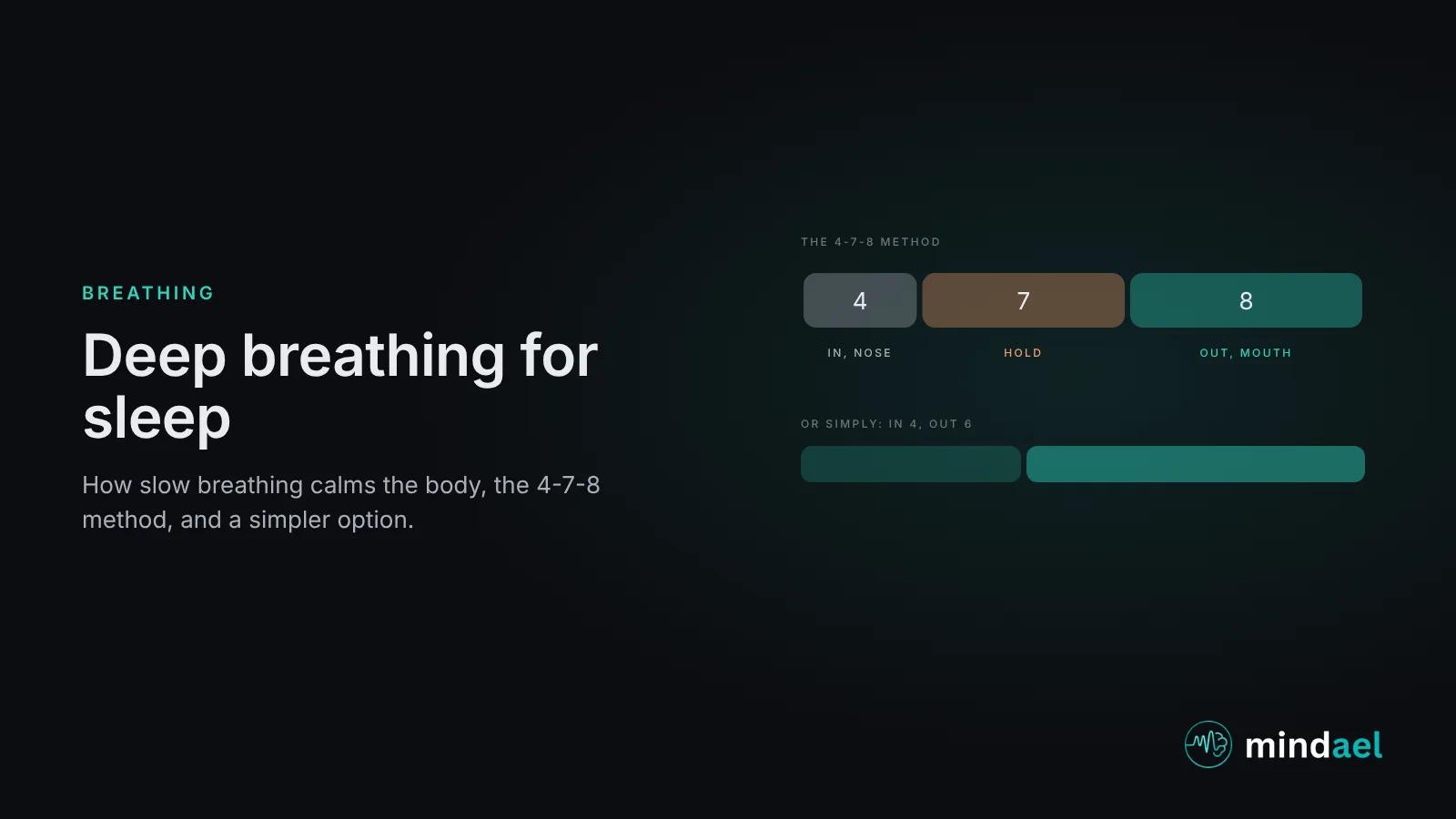
Deep breathing helps sleep by slowing the body down: breathing slowly, around six breaths a minute with a long exhale, raises heart rate variability, a sign the calming side of the nervous system is in charge. A 2022 meta-analysis of 223 studies found this during and after slow breathing, and a systematic review linked slow breathing with lower anxiety and more relaxed brain activity. The 4-7-8 method (in for 4, hold for 7, out for 8) is the best known: in a study of young adults, it improved heart rate variability and blood pressure. If the holds feel uncomfortable, simple slow breathing, four seconds in and six out, works on the same mechanism. Do it in bed for five minutes, belly rising first, with a low steady sound such as rain.
Deep breathing for sleep is one of the simplest things you can do in bed, and one of the few that works on the body directly. You cannot will yourself to sleep, but you can slow your breathing, and a slower body is closer to sleep. This article explains how it works, gives you the 4-7-8 method and a simpler alternative, and the sound to pair them with. Our sounds are in Mindael, free to download on the App Store, and all the breathing patterns we use are in our breathing exercises guide.
How slow breathing calms the body
When you breathe out, your heart rate slows slightly; when you breathe in, it speeds up. A long, slow exhale gives the calming branch of the nervous system more time in charge. A 2022 meta-analysis of 223 studies found that slow breathing raised heart rate variability, a marker of that calming system, during practice, right after it and after weeks of training (Laborde et al., 2022). A systematic review linked slow breathing, around six breaths a minute, with lower anxiety and more relaxed brain activity (Zaccaro et al., 2018). That is the state you want to be in when the light goes off.
The 4-7-8 method, step by step
- Lie on your back, one hand on your belly.
- Breathe out fully through your mouth.
- Breathe in quietly through your nose for a count of 4.
- Hold your breath for a count of 7.
- Breathe out through your mouth for a count of 8, with a soft whoosh.
- Repeat for four rounds. Over a few weeks you can build up to eight.
Count at a pace that suits you; the ratio matters more than the seconds. In a study of young adults, practising 4-7-8 breathing improved heart rate variability and blood pressure, especially in people who were not sleep-deprived (Vierra et al., 2022). The research is small, so we describe it as a helpful pattern, not a cure for insomnia.
A simpler option: slow breathing
If the holds make you feel short of breath, drop them. Breathe in through your nose for about four seconds and out for about six, for five minutes. That gives you the same slow pace and long exhale. Let your belly rise first: in a 2017 trial, eight weeks of diaphragmatic breathing practice lowered cortisol and improved attention and mood in healthy adults (Ma et al., 2017). Our abdominal breathing article shows how to find the belly breath.
Putting it into your night
Same time, same place. In bed, lights off, phone across the room.
Add a low steady sound. Rain or brown noise at a low volume gives your attention somewhere to rest between breaths, so you stop counting seconds and feel the rhythm.
Five minutes, then let go. Do not keep breathing on purpose until you fall asleep. After five or ten minutes, let the breath return to normal and rest.
Give it two weeks. Breathing for sleep works better with practice, like any habit.
If you lie awake for long stretches most nights, breathing alone is unlikely to fix it; our how to fall asleep fast article covers the habits around it, and breathing and exercise covers evenings when you trained. Mindael is where we keep our night sounds, free to download.
Breathe out long. Let the sound hold the room.
Mindael has rain and ocean recorded without loops, brown noise generated to spec and delta beats made in our studio, two at a time. Free to download, no account, works offline. A low steady sound for five slow minutes in bed.
- Rain, ocean, brown noise and delta beats, studio-made
- Two sounds at once, fine volume control
- Free to download, no account, works offline
 Free · No account needed · Works offline
Frequently asked questions
Does deep breathing help you sleep?
It helps many people fall asleep by calming the body. Slow breathing with a long exhale raises heart rate variability, a sign of the body's calming system, and is linked with lower anxiety. It works best as part of a regular bedtime routine.
How do you do the 4-7-8 breathing method for sleep?
Breathe out fully. Breathe in quietly through the nose for a count of 4, hold for 7, then breathe out through the mouth for 8 with a soft whoosh. Repeat for four rounds at first. Count at a pace that feels comfortable, not in strict seconds.
Does the 4-7-8 method really work?
There is some evidence: in a study of young adults, 4-7-8 breathing improved heart rate variability and blood pressure. The research is small, and much of its effect likely comes from the long exhale and slow pace, which simpler slow breathing also gives you.
What if holding my breath feels uncomfortable?
Skip the hold. Breathe in for about four seconds and out for about six, through the nose, for five minutes. That keeps the slow pace and the long exhale, which are the parts that calm the body.
How long should I do breathing exercises before sleep?
Five to ten minutes in bed is enough for most people. Do it every night for a week or two before judging it; like most sleep habits, it works better with practice.
Should I breathe through my nose or mouth for sleep?
Breathe in through the nose. Breathe out through the nose or through pursed lips, whichever lets you make the out-breath long and slow. Let the belly rise first, not the chest.
Sources
- Laborde S, et al. Effects of voluntary slow breathing on heart rate and heart rate variability: a systematic review and a meta-analysis. Neuroscience and Biobehavioral Reviews, 2022.
- Zaccaro A, et al. How breath-control can change your life: a systematic review on psycho-physiological correlates of slow breathing. Frontiers in Human Neuroscience, 2018.
- Vierra J, Boonla O, Prasertsri P. Effects of sleep deprivation and 4-7-8 breathing control on heart rate variability, blood pressure, blood glucose, and endothelial function in healthy young adults. Physiological Reports, 2022.
- Ma X, et al. The effect of diaphragmatic breathing on attention, negative affect and stress in healthy adults. Frontiers in Psychology, 2017.
This article is for general information and is not medical advice. If you have a breathing or heart condition, or you sleep badly most nights for more than a few weeks, please talk to a doctor.
This article is part of our breathing guide. Hear the sounds in this article in the Mindael sound library, or see our app comparison checklists.