
White Noise Device or App: Which to Choose, How Loud, and What the Research Says
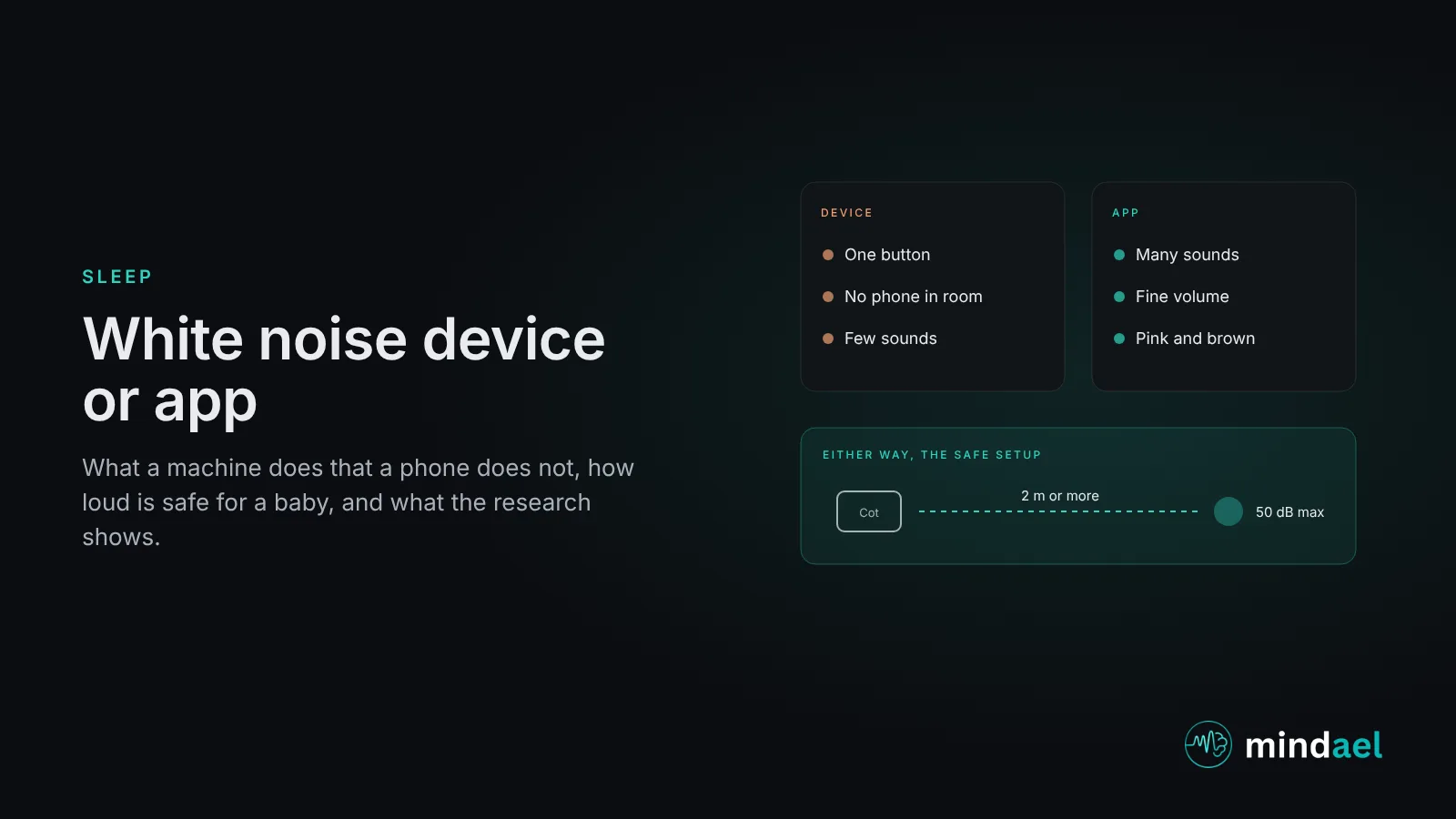
A white noise device and a white noise app do the same job: a steady sound that hides the noises that wake you. The choice comes down to the room. A dedicated machine suits a nursery or a bedroom where you want no phone at night; an app gives you more sounds, finer volume and pink or brown noise when white is too harsh. Whichever you pick, volume matters more than the hardware: in a 2014 study of 14 infant sleep machines, all exceeded the 50 dB nursery limit at 30 cm on maximum volume and three passed 85 dB. Keep any device at least two metres from a cot, never in it, and at the lowest level that works. The research on benefit is encouraging but small: white noise helped most newborns fall asleep in one early trial, and broadband sound shortened time to fall asleep in adults in a lab model of insomnia, while a systematic review rated the overall evidence as weak.
A white noise device is one of the most bought baby products, and many adults sleep next to one too. The question we hear most is whether a dedicated machine is better than a phone app. The honest answer is that the sound is the same job either way, and what matters is how loud it is and where it sits. This article covers what each option does well, the safe volume, and what the research found. Our sounds are in Mindael, free to download on the App Store, and the full baby setup is in our white noise for babies guide.
What a white noise device does
White noise is a steady sound with energy spread across all frequencies, like static or a strong fan. It does not make a room quiet. It raises the background level so that a door, a car or a dog barking changes the sound in the room less, and is less likely to wake you. That is the whole mechanism, and any device that plays a steady sound can do it.
There are three kinds:
Fan-based machines make the sound with a real fan inside a housing. The sound never loops, and you can usually only adjust the tone a little.
Electronic machines play a generated or recorded sound through a speaker. Some offer several sounds, some loop a short recording you can learn to hear.
Apps turn a phone or tablet into an electronic machine, usually with many more sounds, including pink and brown noise, which are softer than white.
Device or app: how to choose
Pick a dedicated device if you want one button, no screen in the room and nothing that can ring at 3 a.m. That is the main case for a machine in a nursery.
Pick an app if you want choice: white noise is harsh for some people, and pink noise, brown noise or rain may suit you or your baby better. Apps also give finer volume steps, which matters for setting a low, safe level. Our white vs pink vs brown noise guide explains the difference.
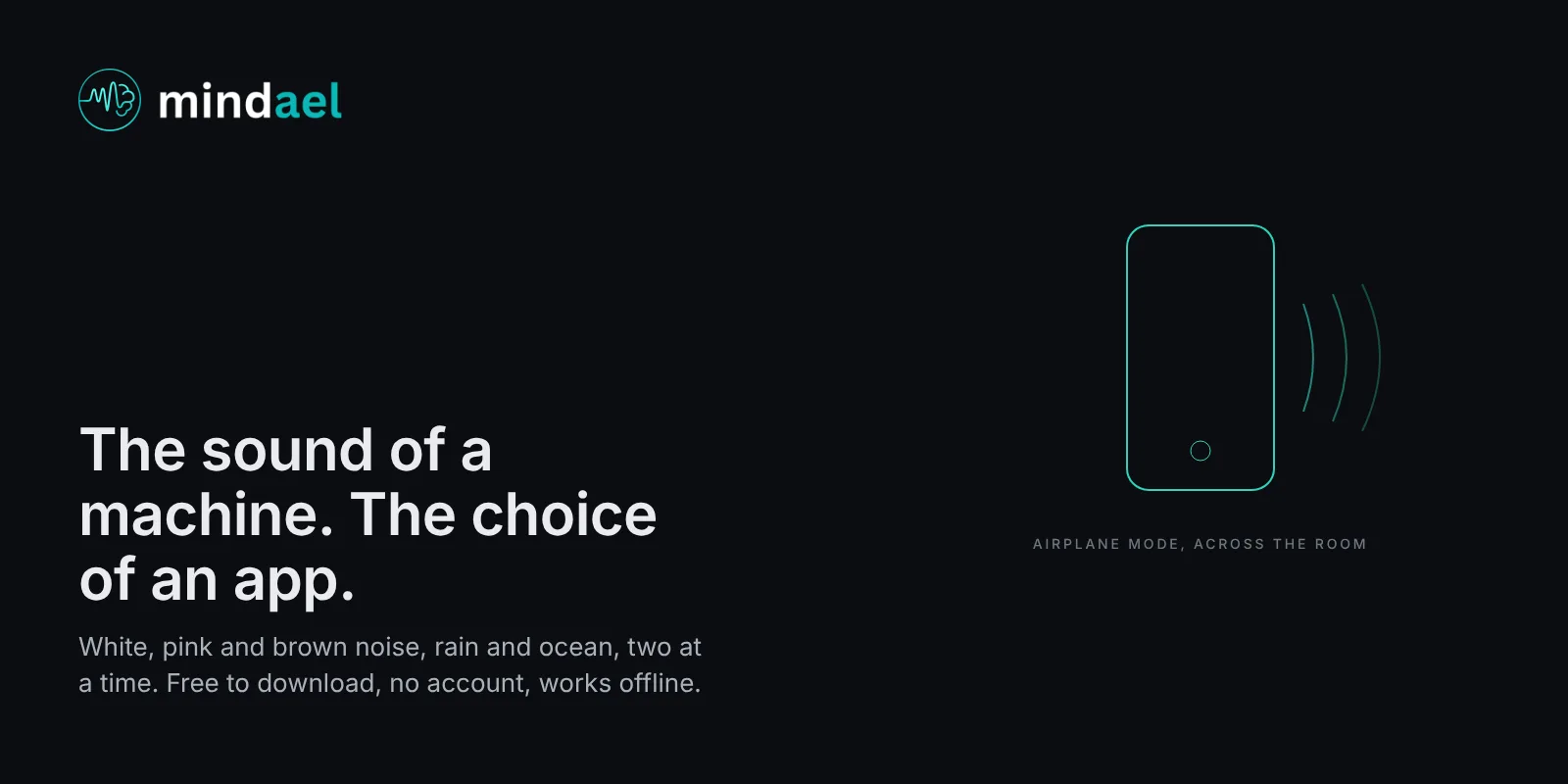
Or do both: an old phone that stays in the bedroom, in airplane mode, with one sound set once, is a white noise device with an app’s choice of sounds. Our best white noise app checklist covers what to look for.
How loud is safe
This matters more than the hardware. In a 2014 study, researchers measured 14 infant sleep machines at maximum volume. All of them exceeded 50 dB, the recommended limit for hospital nurseries, at 30 cm, and three produced more than 85 dB, a level that could exceed adult workplace limits if played for eight hours (Hugh et al., 2014). It was a lab study of the machines, not of babies’ hearing, but the advice that follows is simple:
- Place the device at least two metres from the cot, never in it or on the rail.
- Keep the level at about 50 dB where the baby sleeps, roughly a quiet conversation.
- Use the lowest volume that works, and do not run it at maximum.
The same rule works for adults: a white noise device should sit across the room and be just loud enough to blur the noise outside, not louder.
What the research says it can do
For newborns, the classic study is small. In a randomised trial of 40 babies aged two to seven days, 80 percent fell asleep within five minutes with white noise, against 25 percent who fell asleep on their own in the control group (Spencer et al., 1990).
For adults, a lab study at Harvard sent healthy people to bed earlier than usual to mimic a night of transient insomnia. With broadband sound, they took 38 percent less time to fall asleep than with normal room noise (Messineo et al., 2017).
The wider picture is less certain. A 2021 systematic review of noise as a sleep aid found the overall quality of evidence low, with mixed results (Riedy et al., 2021). We read that as: white noise is a useful tool for noisy rooms and unsettled babies, not a treatment for poor sleep.
Setting it up
Choose the sound first: white noise for a newborn who settles to a hiss, pink or brown noise or rain for everyone else. Place the device across the room. Set the volume once with a sound meter app at the pillow or cot, and leave it. For babies, safe sleep basics always come first; white noise is a settling aid on top of them, which our baby guide covers in full. For adults on a loud street, our sleep sounds guide has the rest of the setup. Mindael is where we keep the steady sounds we use at night, free to download.
The sound of a machine. The choice of an app.
Mindael has white, pink and brown noise generated to spec and rain and ocean recorded without loops, two at a time, with fine volume control. Free to download, no account, works offline, so a phone in airplane mode becomes a quiet white noise device.
- White, pink and brown noise, rain and ocean
- Fine volume control, two sounds at once
- Free to download, no account, works offline
 Free · No account needed · Works offline
Frequently asked questions
Is a white noise machine better than an app?
Not for the sound itself: both play a steady noise. A machine is better if you want no phone in the room and one button to press. An app is better for choice, with pink, brown and natural sounds, and for fine volume control. Both are only as safe as the volume you set.
How loud should a white noise machine be for a baby?
No more than about 50 dB where the baby's head is, roughly a quiet conversation. In a 2014 study, all 14 infant sleep machines tested were louder than that at 30 cm on maximum volume, so keep the machine at least two metres away and well below maximum.
Where should I put a white noise device?
Across the room, at least two metres from the cot, never in the cot or on the rail. Sound gets quieter with distance, so placement is the simplest way to keep the level safe.
Can I use my phone as a white noise device?
Yes. Put it in airplane mode so calls and notifications cannot wake anyone, set the volume once, and place it across the room. An old phone that stays in the bedroom works well as a dedicated device.
Does white noise help adults sleep too?
It can help with falling asleep in noisy places. In a lab study, broadband sound shortened the time healthy adults took to fall asleep by 38 percent in a model of transient insomnia. A systematic review found the overall evidence too weak to call noise a proven sleep aid.
What is the difference between a fan machine and an electronic one?
A fan-based machine makes its sound mechanically, so it never loops, but you can only change the tone a little. An electronic machine plays recorded or generated sounds, sometimes with a short loop you can hear. Apps work like electronic machines with many more sounds.
Sources
- Hugh SC, et al. Infant sleep machines and hazardous sound pressure levels. Pediatrics, 2014.
- Spencer JA, Moran DJ, Lee A, Talbert D. White noise and sleep induction. Archives of Disease in Childhood, 1990.
- Messineo L, et al. Broadband sound administration improves sleep onset latency in healthy subjects in a model of transient insomnia. Frontiers in Neurology, 2017.
- Riedy SM, et al. Noise as a sleep aid: a systematic review. Sleep Medicine Reviews, 2021.
This article is for general information and is not medical advice. White noise does not replace safe sleep practice for babies. If your baby or you sleep badly most nights, please talk to a doctor or health visitor.
This article is part of our baby and child sleep guide. Hear the sounds in this article in the Mindael sound library, or see our app comparison checklists.