
Noise Sleep Machine: Sleeping With One Every Night, Dependence, Hearing, Partners and Travel
Millions of people sleep with a noise machine every night. The research is mixed: a lab study found steady broadband sound cut the time to fall asleep by 38 percent on a simulated bad night, and a review found pink noise studies most often reported better sleep, but two systematic reviews rated the overall evidence as weak. Nightly use is generally fine with three habits: keep the volume low, around 45 dB and across the room, since sound machines can reach hearing-risk levels at close range; choose the softest noise that works, often pink or brown rather than white; and use a fading timer if you only need help falling asleep. Getting used to one is a habit, not an addiction: if you want to stop, lower the volume over a week or two. For a partner who dislikes it, try a softer sound or a pillow speaker; for travel, a phone app gives you the same sound anywhere.
A noise sleep machine is part of the bedtime routine for millions of people: switch it on, lights off, sleep. If you use one every night, sensible questions follow. Does it really help? Are you dependent on it? Is it safe for your ears? What about your partner, and what about travel? This article answers each one. We make Mindael, a sound app that many people use as a noise machine on their phone, free to download on the App Store.
Does it help?
For many people, yes, and the reason is masking. Sudden sounds wake you more than steady ones, so a steady background makes doors, cars and voices stand out less. In a lab study that simulated a bad first night, steady broadband sound cut the time healthy adults took to fall asleep by 38 percent (Messineo et al., 2017).
The wider evidence is honest about its limits. A systematic review of white, pink and mixed noise studies in adults found that pink noise studies most often reported better sleep, but concluded the evidence was not strong (Capezuti et al., 2022). Another review rated the evidence for continuous noise as very low quality and urged caution about volume (Riedy et al., 2021). So the best test is your own: a week with it, a week without, and how you feel in the morning.
Volume and hearing
This is the habit that matters most. Measurements of infant sleep machines found that all of them could exceed recommended nursery limits at maximum volume and close range, and some reached levels linked with hearing risk over long exposure (Hugh et al., 2014). Adults are not immune.
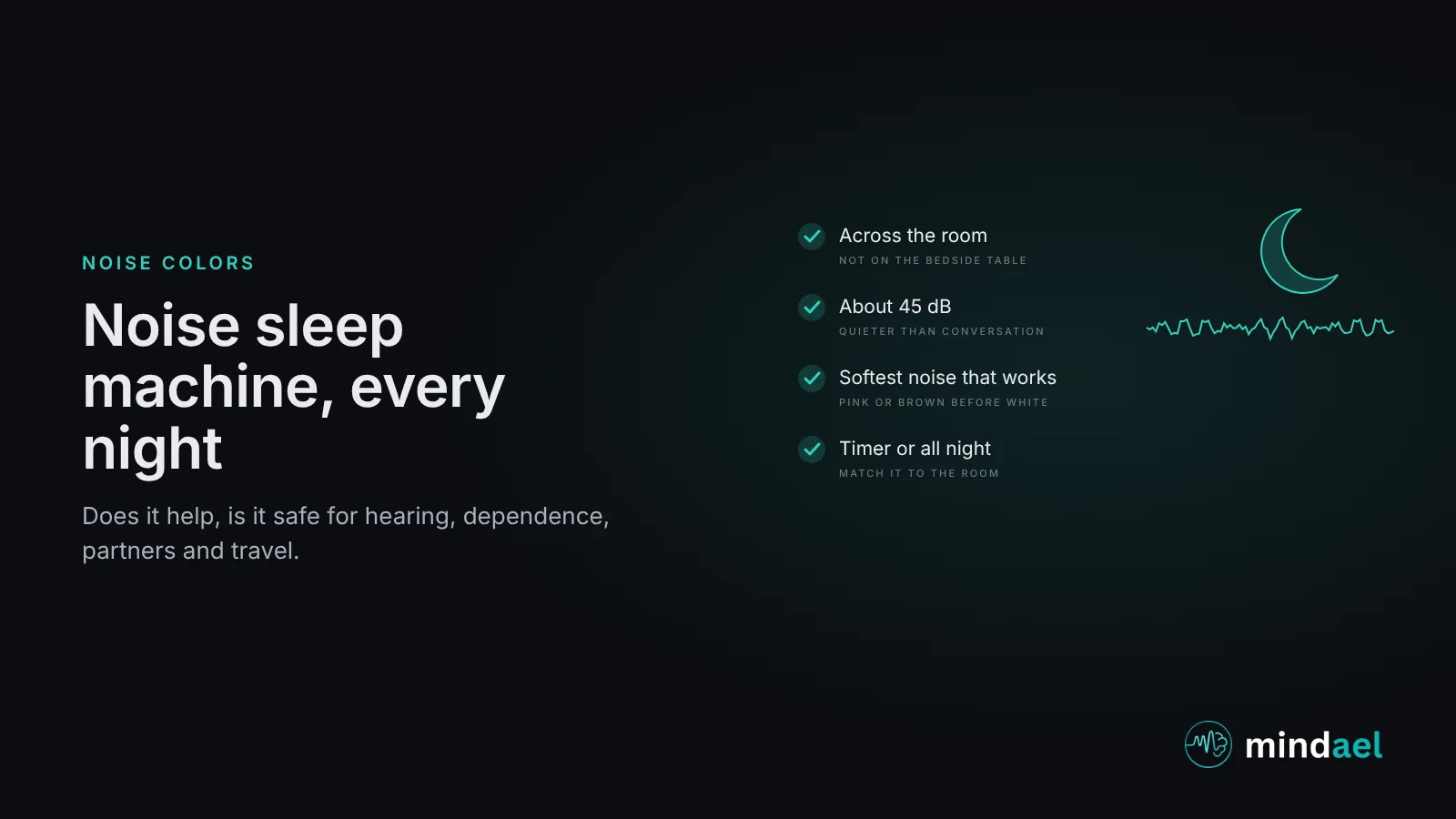
Keep the machine across the room, not on the bedside table, and set it around 45 dB, about the level of a quiet conversation in the next room. If you use earbuds or a sleep headband, keep the volume lower still. If you notice ringing in your ears in the morning, turn it down and see a doctor if it continues.
Choose the softest noise that works
White noise covers the most but can sound harsh over a whole night. Pink noise is softer and still masks voices and traffic; brown noise is the deepest and calmest. Rain and ocean are natural alternatives. Start with the softest one that covers the sounds that bother you. Our sleep noise guide matches each noise to the problem, and our white, pink and brown noise guide explains the difference.
All night or a timer?
If the room is noisy all night, or you wake at 5 a.m. to traffic or neighbours, keep a low sound running until morning so the room does not change halfway through. If you only need help falling asleep, a fading timer of 30 to 45 minutes is gentler and means less sound exposure overall.
Are you dependent on it?
You can get used to a noise machine, the way you get used to a particular pillow or a dark room. A silent room may feel strangely loud at first. That is a habit, not an addiction. If you want to stop, lower the volume a little each night over one to two weeks, or switch to a timer, then turn it off.
Partners, kids and travel
A partner who dislikes it. Try brown noise or rain instead of white, lower the volume and place the machine on your side. A pillow speaker or a sleep headband keeps the sound mostly to you.
Children. The same rules, with distance mattering more: at least two metres from the cot, low volume. Our safe sleep for infants guide covers babies.
Travel. A familiar sound makes hotel rooms and night trains easier. A phone app gives you the same sound anywhere; turn on Do Not Disturb and keep it charging. Our ambient noise machine guide compares machines and apps.
The short version
A noise sleep machine helps many people by masking sudden sounds, though the research is mixed. Use it every night if it helps, but keep it across the room at about 45 dB, choose the softest noise that works, and use a timer if you only need help falling asleep. If you want to stop, taper the volume. For the same sound at home and away, Mindael is free to download on the App Store, and our sleep sounds guide has the full night-time setup.
The same sound, every night, anywhere.
Mindael has white, pink and brown noise generated to spec on the phone and rain and ocean recorded without loops, two at a time, with fine volume control and a timer that fades. Free to download, no account, works offline, at home, in a hotel or on a night train.
- White, pink and brown noise generated to spec
- Fine volume control, a timer that fades
- Free to download, no account, works offline
 Free · No account needed · Works offline
Frequently asked questions
Is it bad to sleep with a noise machine every night?
For most people, no, as long as the volume stays low and the machine is across the room. The evidence that it improves sleep is mixed, and reviewers urge caution about loud, all-night noise, so use the lowest level that covers the sounds that bother you.
Can you become dependent on a white noise machine?
You can get used to it, the way you get used to a pillow or a dark room, and a silent room may feel strange at first. That is a habit, not an addiction. If you want to stop, lower the volume a little each night over one to two weeks.
Can a noise machine damage your hearing?
At high volume and close range, possibly. Measurements of infant sleep machines found that all of them could exceed recommended nursery limits at maximum volume and 30 cm. Keep any machine across the room, at around 45 dB, and avoid earbuds at high volume all night.
What is the best noise for a sleep machine?
Pink noise is a good default; in a review of studies on noise and sleep, pink noise studies most often reported positive results. Brown noise is deeper and softer. White noise masks the most but can sound harsh. Rain and ocean are natural alternatives.
My partner hates the noise machine. What can we do?
Try a softer sound, brown noise or rain instead of white, at a lower level, and place it on your side of the room. A pillow speaker or a sleep headband with thin speakers keeps the sound mostly to you.
Should the noise machine run all night?
If the room is noisy all night or you wake early to traffic or neighbours, yes, at a low level. If you only need help falling asleep, a timer that fades after 30 to 45 minutes is enough.
Sources
- Messineo L, et al. Broadband sound administration improves sleep onset latency in healthy subjects in a model of transient insomnia. Frontiers in Neurology, 2017.
- Capezuti E, et al. Systematic review: auditory stimulation and sleep. Journal of Clinical Sleep Medicine, 2022.
- Riedy SM, Smith MG, Rocha S, Basner M. Noise as a sleep aid: a systematic review. Sleep Medicine Reviews, 2021.
- Hugh SC, et al. Infant sleep machines and hazardous sound pressure levels. Pediatrics, 2014.
This article is for general information and is not medical advice. If you sleep badly most nights for more than a few weeks, snore loudly or stop breathing in your sleep, or notice ringing in the ears or hearing changes, please see a doctor.
This article is part of our sleep guide. Hear the sounds in this article in the Mindael sound library, or see our app comparison checklists.