

Relax Music for Stress: What the Research Says, What to Play and How Long to Listen
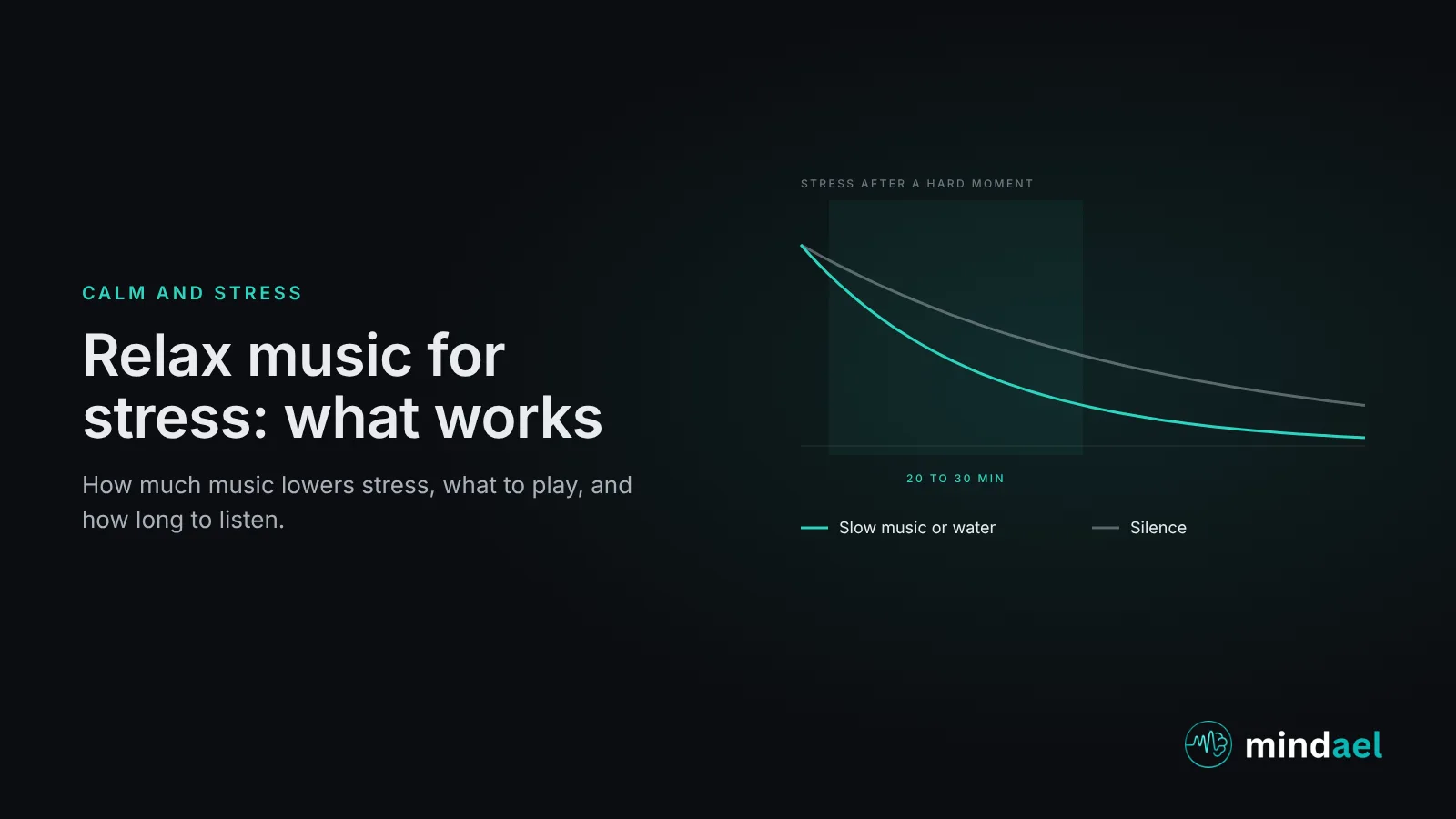
Relaxing music lowers stress for most people. A meta-analysis of 104 randomised trials found music had a small-to-medium effect on the body's stress markers, such as heart rate and cortisol, and a medium effect on how stressed people felt. In daily life, listening to music lowered stress mostly when people chose it in order to relax, which suggests the intention matters as much as the track. What helps is slow, steady music without words: slow tempos lower breathing and heart rate. Natural sounds such as water work too: after a stressful task, people recovered faster with nature sounds than with traffic noise. Twenty to thirty minutes is enough for one session; long 8 or 10 hour tracks are best used as a low background, not as more treatment.
Relax music for stress is one of the most searched kinds of music online, often as 8 or 10 hour videos. The good news is that the research is on its side: music does lower stress, by a modest and reliable amount. This article explains how much, what to play, why the reason you press play matters, and how long to listen. The sounds we suggest are in Mindael, free to download on the App Store.
How much music lowers stress
The best summary is a meta-analysis of 104 randomised trials with nearly 10,000 participants. Music had a small-to-medium effect on physical stress markers such as heart rate, blood pressure and cortisol, and a medium effect on how stressed people said they felt (de Witte et al., 2020). That is not a miracle, but it is real, cheap and has no side effects.
Music also helps you come back down after stress. In a lab study, people who listened to relaxing music before a stressful task recovered faster afterwards, on a nervous-system marker, than people who sat in silence (Thoma et al., 2013).
Why your reason for listening matters
A study that followed people through ordinary days found something useful: listening to music lowered stress, and the effect was strongest when people chose music specifically in order to relax (Linnemann et al., 2015). Music on in the background while you scroll is not the same as sitting down, pressing play and deciding this is the break.
So make it a small ritual: same time, same sound, phone face down, twenty minutes.
What to play
Slow. Tempo does most of the work. In a heart study, slow music lowered breathing and heart rate and fast music raised them; a short silence between pieces relaxed people most of all (Bernardi et al., 2006). Aim for music that feels slower than your breathing. Our stress relief music article adds what music therapy does and why humming along helps.
Without words. Lyrics pull attention into a story. Soft piano, slow strings and ambient pads leave the mind free.
Steady. No big drops, swells or sudden instruments. A track you have to follow is not a track that lets you rest.
Or water. After a stressful task, people recovered faster, on a skin-conductance measure, while hearing nature sounds than while hearing traffic noise (Alvarsson et al., 2010). Rain, a stream or ocean waves are natural stress-relief sounds, and many people put one under soft music. Our nature sounds app checklist covers what to look for in an app.
Something you like. Music you dislike is its own stressor. Try a few for a week and keep the one you stop noticing.
How long: 20 minutes or 8 hours?
Twenty to thirty minutes is a good single session and is in the range many trials used. Long 8 or 10 hour tracks are not a bigger dose. They are useful as a low background for a long work day or a night, because nothing stops or changes. For that use, keep the volume low and choose the steadiest sound you have; our relaxing sleep music article covers the night-time version.
Pair it with your breathing
Music works faster when your breath slows with it. Breathe in for four, out for six, for the first few minutes, or try box breathing if you like a count. When stress spikes into anxiety, our calming music for anxiety guide has a five-minute routine for coming down, and how to calm down covers what to do in the moment. If you are choosing an app for it, our stress management app checklist sorts what helps in the moment from what helps over weeks.
The short version
Relaxing music lowers stress by a modest, real amount. Choose slow, wordless, steady music or water sounds you like, press play with the intention to relax, and give it twenty to thirty minutes with slower breathing. Use long tracks as a quiet background, not as a stronger cure. For a stress-relief sound that stays steady and works offline, Mindael is free to download on the App Store.
Twenty minutes, slower.
Mindael has rain, ocean and a stream recorded without loops, soft drones made in our studio and brown noise generated to spec, two at a time, with fine volume control. Free to download, no account, works offline. Press play with the intention to relax, and give it twenty minutes.
- Rain, stream, ocean and soft drones, studio-made
- Two sounds at once, fine volume control
- Free to download, no account, works offline
 Free · No account needed · Works offline
Frequently asked questions
Does relaxing music really reduce stress?
For most people, yes, by a modest amount. A meta-analysis of 104 randomised trials found music had a small-to-medium effect on physical stress markers such as heart rate, blood pressure and cortisol, and a medium effect on how stressed people said they felt. It is a useful tool, not a cure for a stressful life.
What kind of music is best for stress relief?
Slow, steady music without lyrics: soft piano, slow strings, ambient pads, or a natural sound such as rain or a stream. Tempo matters more than genre, because slower music slows breathing and heart rate. Pick something you like; music you dislike is its own stressor.
How long should I listen to relaxing music for stress?
Twenty to thirty minutes is a good single session and matches what many trials used. You can keep a low sound going longer as background while you work or rest, but a longer track is not a stronger dose.
Are 8 hour or 10 hour relaxing music videos better?
Not as treatment. They are useful as an unbroken background for work or sleep, so nothing changes or stops. For stress relief itself, a focused 20 to 30 minutes does the job. If you play one all night, keep the volume low.
Is piano music good for stress relief?
Soft, slow piano is one of the most popular choices and fits what the research suggests: steady, calm and wordless. Avoid pieces with big jumps in loudness or tempo.
Is music or nature sound better for stress?
Both help, in slightly different ways. Slow music works through tempo and mood; water and rain give a steady, natural background that the brain does not need to follow. Many people find a stream or rain under soft music works best.
Sources
- de Witte M, et al. Effects of music interventions on stress-related outcomes: a systematic review and two meta-analyses. Health Psychology Review, 2020.
- Linnemann A, et al. Music listening as a means of stress reduction in daily life. Psychoneuroendocrinology, 2015.
- Thoma MV, et al. The effect of music on the human stress response. PLOS ONE, 2013.
- Bernardi L, Porta C, Sleight P. Cardiovascular, cerebrovascular, and respiratory changes induced by different types of music in musicians and non-musicians: the importance of silence. Heart, 2006.
- Alvarsson JJ, Wiens S, Nilsson ME. Stress recovery during exposure to nature sound and environmental noise. International Journal of Environmental Research and Public Health, 2010.
This article is for general information and is not medical advice. If stress or anxiety is affecting your sleep, work or relationships most days, or you feel unable to cope, please talk to a doctor or a mental health professional.
This article is part of our anxiety, stress and panic guide. Hear the sounds in this article in the Mindael sound library, or see our app comparison checklists.