
Box Breathing Technique: How to Do It, What It Does, and How It Compares With 4-7-8, Pursed Lip and Other Methods
Box breathing is four equal steps: breathe in for four counts, hold for four, breathe out for four, hold for four, and repeat for a few minutes. It slows your breathing to around four breaths a minute and gives the mind a simple count to hold on to, which is why it is popular before stressful tasks. In a randomised trial, five minutes a day of box breathing improved mood and lowered anxiety over a month, though an exhale-focused pattern, cyclic sighing, did slightly better. Reviews of slow breathing link it with higher heart rate variability and lower anxiety. If the holds feel uncomfortable, shorten them or switch to plain slow breathing with a longer exhale. Other techniques suit other jobs: 4-7-8 for sleep, pursed lip breathing for breathlessness, diaphragmatic breathing as a foundation.
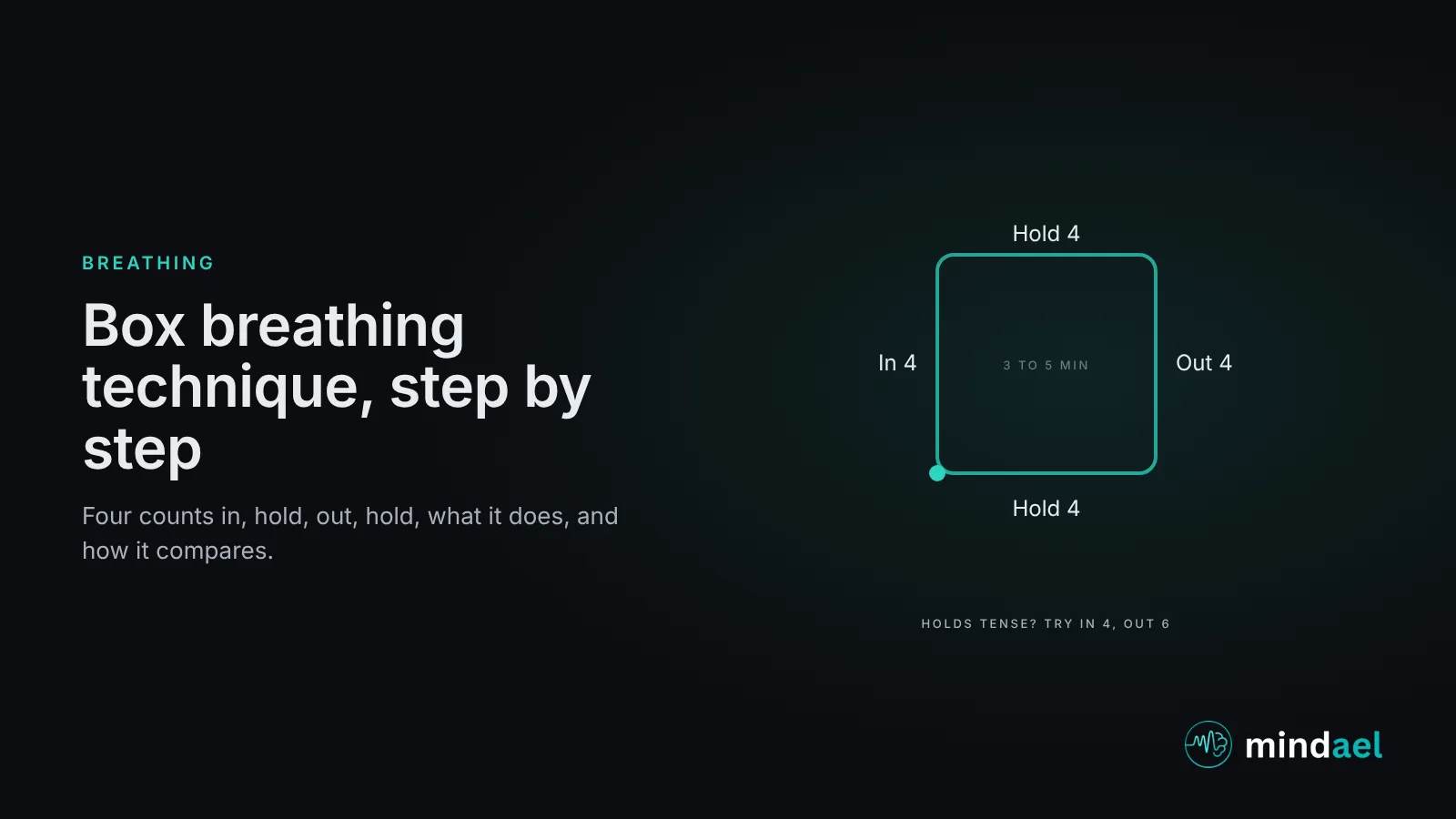
The box breathing technique is one of the simplest breathing exercises there is: four equal steps, four counts each, drawn as the sides of a square. It is popular before exams, presentations and hard conversations because it is easy to remember under pressure. This article explains how to do it, what it does, what the research shows and how it compares with other breathing techniques. The steady sound we suggest under the count is in Mindael, free to download on the App Store.
How to do box breathing
- Sit upright, shoulders loose, and breathe out fully.
- In through the nose for a count of four.
- Hold for four.
- Out slowly through the mouth or nose for four.
- Hold for four.
- Repeat for three to five minutes.
If four counts feels long, start at three; if it feels easy, try five. Keep the breath quiet and low in the belly rather than lifting the chest. When you finish, breathe normally for a minute before you stand up.
What it does
Each box takes about sixteen seconds, so you breathe roughly four times a minute instead of the usual twelve to sixteen. Slow breathing like this has been studied a lot. A systematic review found it was linked with higher heart rate variability, more relaxed brain activity and lower anxiety (Zaccaro et al., 2018), and a meta-analysis of 223 studies confirmed the rise in heart rate variability during and after slow breathing (Laborde et al., 2022). Higher heart rate variability is a sign that the calming side of the nervous system is in charge. Slow breathing also changes how the lungs, heart and blood pressure work together (Russo et al., 2017).
The count matters too. Under stress, attention runs ahead to what might go wrong. A count of four gives it something small and certain to do.
What the research shows
Box breathing was one of the patterns tested in a month-long randomised trial. People practised five minutes a day of box breathing, cyclic sighing (a double inhale and a long exhale), cyclic hyperventilation or mindfulness meditation. All the breathing groups improved in mood and anxiety, and cyclic sighing did slightly better than box breathing, especially for lowering resting breathing rate (Balban et al., 2023).
The lesson is practical: box breathing works, and a longer exhale may work a little better. If the holds make you tense, try four in, six out. Our breathing exercises guide explains when to use each pattern.
Box breathing and other techniques
4-7-8 breathing. In for 4, hold for 7, out for 8. The long hold and longer exhale make it a wind-down pattern, mostly used at bedtime. Our deep breathing for sleep article walks through it.
Diaphragmatic breathing. Breathing low into the belly rather than the chest. It is the foundation for all the others, and in a study of healthy adults it lowered stress and improved attention over eight weeks (Ma et al., 2017). Our abdominal breathing article explains how, and our calm breathing guide has gentler patterns with no holds.
Pursed lip breathing. In through the nose, out slowly through lips pursed as if blowing on soup. It is taught mainly to people with lung conditions to ease breathlessness, and is a gentle way to lengthen the exhale for anyone.
Wim Hof style breathing. Rounds of deep, fast breaths followed by a long hold. It is energising rather than calming, and because it can cause fainting it should never be done in water, while driving or standing.
Buteyko breathing. Reduced, nasal breathing, used mostly by people with asthma alongside medical care. It is a specialist method rather than a quick calming tool.
When to use box breathing
Before something you are nervous about: a meeting, an exam, a call. In a short break between tasks, with brown noise low in the background so the count is the only thing you follow. And when your thoughts are racing and you need something simple to hold. For a sudden spike of anxiety, two physiological sighs are faster; our how to calm nerves article has the steps.
The short version
Four in, four hold, four out, four hold, for three to five minutes. It slows your breathing, gives your mind a count to hold and improved mood in a month-long trial, although a longer exhale did slightly better. Shorten the holds if they make you tense, use 4-7-8 for sleep and keep a steady, low sound under the count. For that sound, Mindael is free to download on the App Store.
Four sides. One steady sound.
Mindael has brown noise generated to spec, rain recorded without loops and soft drones made in our studio, two at a time, with fine volume control. Free to download, no account, works offline. A steady sound under the count, so the box is the only thing you follow.
- Brown noise, rain and soft drones, studio-made
- Two sounds at once, fine volume control
- Free to download, no account, works offline
 Free · No account needed · Works offline
Frequently asked questions
How do you do the box breathing technique?
Sit upright and breathe out fully. Breathe in through your nose for four counts, hold for four, breathe out slowly for four, hold for four. That is one box. Repeat for three to five minutes. If four counts is too long, start with three.
What does box breathing do?
It slows your breathing to around four breaths a minute and gives your attention a simple count to follow. Slow breathing is linked with higher heart rate variability, a sign the calming side of the nervous system is active, and with lower anxiety. In a month-long trial, five minutes a day of box breathing improved mood.
Is box breathing better than 4-7-8?
They suit different moments. Box breathing is even and alert, good before a task or a hard conversation. 4-7-8 has a long hold and a longer exhale and is used mostly to wind down for sleep. In one trial, an exhale-focused pattern beat box breathing slightly for mood, so a longer exhale may matter more than the holds.
Why is it called box breathing?
Because the four equal steps, in, hold, out, hold, are often drawn as the four sides of a square. It is also called square breathing or four-square breathing.
Is box breathing safe?
For most people, yes. Holding the breath can feel uncomfortable, especially with anxiety, so shorten or skip the holds if they make you tense. If you have a heart or lung condition or are pregnant, ask a doctor before practising long breath holds.
What about Wim Hof or Buteyko breathing?
They are different techniques. Wim Hof style breathing uses rounds of deep, fast breaths followed by holds, and should never be practised in water, while driving or standing up, because it can cause fainting. Buteyko focuses on reduced, nasal breathing and is mostly used by people with asthma. Neither is a calming technique in the way box breathing is.
Sources
- Balban MY, et al. Brief structured respiration practices enhance mood and reduce physiological arousal. Cell Reports Medicine, 2023.
- Zaccaro A, et al. How breath-control can change your life: a systematic review on psycho-physiological correlates of slow breathing. Frontiers in Human Neuroscience, 2018.
- Laborde S, et al. Effects of voluntary slow breathing on heart rate and heart rate variability: a systematic review and a meta-analysis. Neuroscience and Biobehavioral Reviews, 2022.
- Russo MA, Santarelli DM, O'Rourke D. The physiological effects of slow breathing in the healthy human. Breathe, 2017.
- Ma X, et al. The effect of diaphragmatic breathing on attention, negative affect and stress in healthy adults. Frontiers in Psychology, 2017.
This article is for general information and is not medical advice. Stop if you feel dizzy or breathless. If you have a heart or lung condition, are pregnant, or have panic attacks that breathing makes worse, please talk to a doctor before practising breath holds.
This article is part of our breathing guide. Hear the sounds in this article in the Mindael sound library, or see our app comparison checklists.