

Calm Breathing: Three Breathing Exercises to Calm Down, What the Research Shows, and When to Stop
Calm breathing means breathing more slowly than usual, with a breath out that is as long as or longer than the breath in. It is one of the few calming tools with consistent research behind it: a meta-analysis of randomised trials found breathwork reduced stress, anxiety and low mood by a small to moderate amount, and a review of slow-breathing studies found that breathing at about six breaths a minute raised heart rate variability, a marker of a calmer nervous system. Three exercises cover most situations: a longer exhale (in for 4, out for 6) for a few minutes, the double-inhale sigh, which in a trial lifted mood more than mindfulness meditation with five minutes a day, and slow belly breathing for a longer practice. Breathe gently, never forcefully, and stop if you feel dizzy or more anxious.
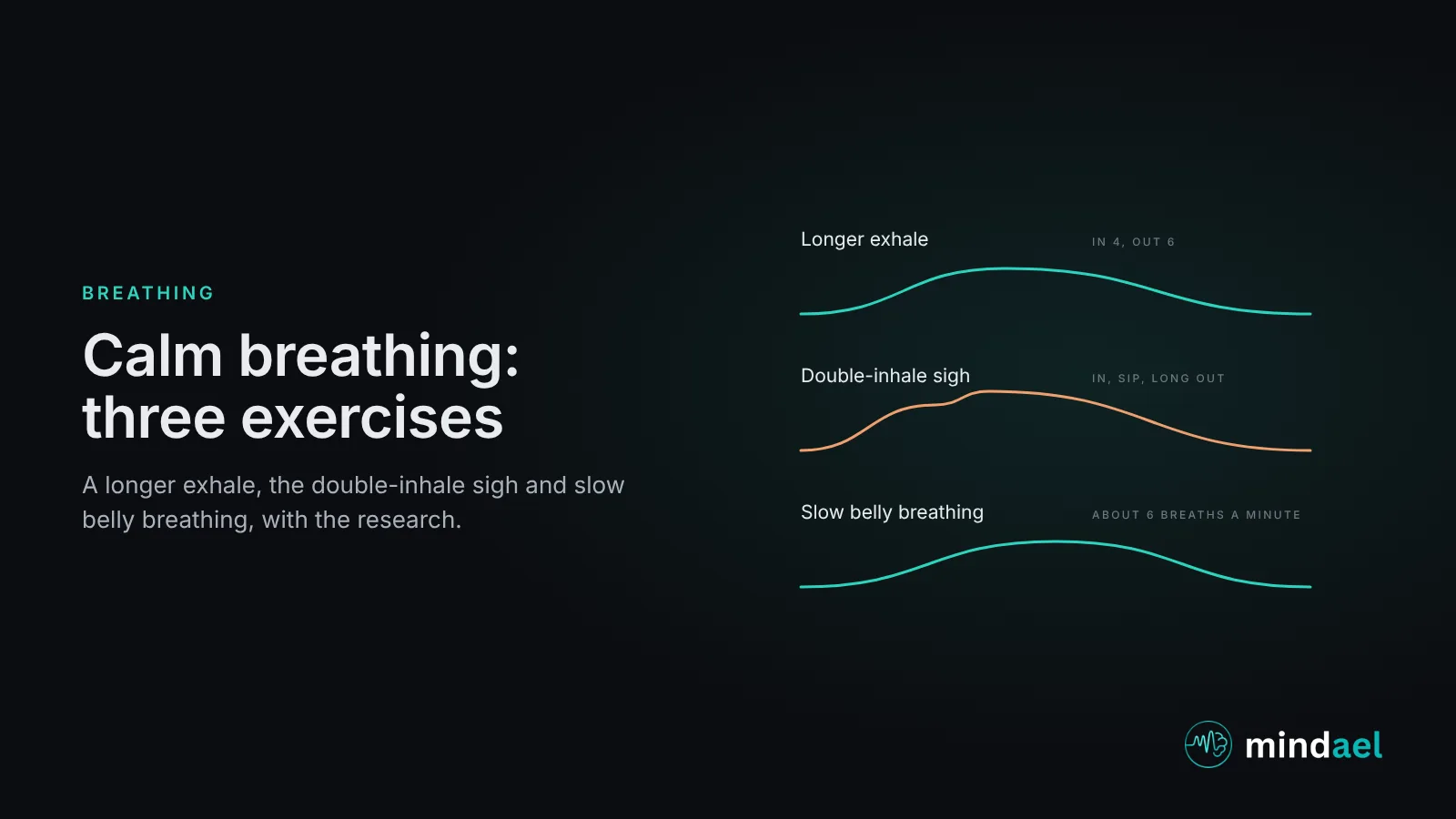
Calm breathing is the simplest calming tool you carry: breathe more slowly, and let the breath out be longer than the breath in. It is not a trick of willpower; slow breathing changes how the heart and nervous system behave within minutes. This article gives three exercises for different moments, what the research shows and when to stop. We make Mindael, a sound app with steady sounds to breathe along with, free to download on the App Store.
Why slow breathing calms you
Stress speeds the breath up and moves it into the chest. Slowing it down, to about six breaths a minute, works in the other direction. A review of slow-breathing studies linked it with higher heart rate variability and more activity in the calming branch of the nervous system, along with less anxiety and more relaxation (Zaccaro et al., 2018). A meta-analysis confirmed that voluntary slow breathing raises heart rate variability during the practice itself (Laborde et al., 2022).
How much does it help with how you feel? A meta-analysis of randomised trials found breathwork lowered stress, anxiety and low mood by a small to moderate amount (Fincham et al., 2023). That is real, and it is honest: a tool, not a cure.
Three exercises for three moments
1. The longer exhale, for most situations. Breathe in through the nose for 4, out through the nose or pursed lips for 6. No holds. Three to five minutes. If 4 and 6 feel long, try 3 and 5; the ratio matters more than the numbers.
2. The double-inhale sigh, for a fast reset. Breathe in through the nose, take a second short sip of air on top, then let it out slowly through the mouth. One to three sighs take the edge off within a minute. In a month-long trial, five minutes a day of this cyclic sighing lifted mood and lowered breathing rate more than mindfulness meditation did (Balban et al., 2023).
3. Slow belly breathing, for a longer practice. One hand on the chest, one on the belly; let the lower hand rise first. Aim for around six breaths a minute for ten minutes. In an eight-week study, people who practised diaphragmatic breathing showed lower stress hormone levels and better attention than a control group (Ma et al., 2017). Our abdominal breathing guide goes deeper.
If you like a fixed rhythm with holds, box breathing is the next step. For bedtime, our deep breathing for sleep guide adapts these for lying down.
Make it easier with a steady sound
Counting can feel like a task. A steady, low sound, ocean waves, rain or brown noise, gives attention somewhere neutral to rest and covers the room. Ocean waves have a natural rise and fall that many people breathe along with. Keep it quiet enough to hear your breath.
When to stop
Breathe gently. Breathing too deep or too fast can make you light-headed or tingly; if that happens, breathe smaller and let the next breath come on its own. For some anxious people, focusing on the breath makes the anxiety louder. If that is you, keep your eyes open and put your attention on a sound instead. If you have frequent panic attacks, a heart or lung condition, or are pregnant, talk to a doctor first. Our anxiety guide covers other calming tools.
The short version
Breathe out longer than you breathe in, at about six breaths a minute. Use the double-inhale sigh for a fast reset, the 4 and 6 exhale for a few minutes, belly breathing for a longer practice. Breathe gently and stop if you feel dizzy. For steady sounds to breathe with, Mindael is free to download on the App Store, and our breathing guide has the full setup.
A steady sound to breathe with.
Mindael has rain and ocean recorded without loops, brown noise generated to spec and soft drones made in our studio, two at a time, with fine volume control. Free to download, no account, works offline. Something steady to rest your attention on while the breath slows.
- Rain, ocean, brown noise and soft drones
- Two sounds at once, fine volume control
- Free to download, no account, works offline
 Free · No account needed · Works offline
Frequently asked questions
What is calm breathing?
Breathing slowly and gently, usually through the nose, with an exhale as long as or longer than the inhale. Around six breaths a minute is the pace most studies use. It is the opposite of the fast, shallow chest breathing that comes with stress.
What is the fastest breathing exercise to calm down?
The double-inhale sigh: breathe in through the nose, take a second short sip of air on top, then breathe out slowly through the mouth. One to three of these can take the edge off within a minute. Five minutes a day of it lifted mood in a month-long trial.
Do breathing exercises help with anxiety?
They can help with the body side of it. A meta-analysis of randomised trials found breathwork reduced anxiety and stress by a small to moderate amount. They are a useful tool, not a replacement for treatment if anxiety is frequent or severe.
How long should I do calm breathing for?
One to three breaths for a quick reset, three to five minutes to settle properly. Daily practice of about five minutes makes it easier to use when you actually need it.
Why does breathing slowly make me feel worse?
Usually because you are breathing too deeply or forcing the count, which can cause light-headedness, or because focusing on the breath makes some anxious people more aware of it. Breathe smaller and softer, open your eyes, focus on a sound, and stop if you feel dizzy.
Is calm breathing the same as box breathing?
They are close relatives. Box breathing adds two breath holds, four counts each. Calm breathing without holds is gentler and easier for beginners and for people who find holding the breath uncomfortable.
Sources
- Fincham GW, Strauss C, Montero-Marin J, Cavanagh K. Effect of breathwork on stress and mental health: a meta-analysis of randomised-controlled trials. Scientific Reports, 2023.
- Balban MY, et al. Brief structured respiration practices enhance mood and reduce physiological arousal. Cell Reports Medicine, 2023.
- Laborde S, et al. Effects of voluntary slow breathing on heart rate and heart rate variability: a systematic review and a meta-analysis. Neuroscience and Biobehavioral Reviews, 2022.
- Zaccaro A, et al. How breath-control can change your life: a systematic review on psycho-physiological correlates of slow breathing. Frontiers in Human Neuroscience, 2018.
- Ma X, et al. The effect of diaphragmatic breathing on attention, negative affect and stress in healthy adults. Frontiers in Psychology, 2017.
This article is for general information and is not medical advice. Breathe gently and stop if you feel dizzy, tingly or more anxious. If you have a heart or lung condition, are pregnant, or have frequent panic attacks, please talk to a doctor.
This article is part of our breathing guide. Hear the sounds in this article in the Mindael sound library, or see our app comparison checklists.