

Breathing Meditation: Watching the Breath vs Changing It, With Three Techniques to Try
Breathing meditation comes in two kinds. In the first, you watch the breath without changing it and come back each time your mind wanders; in the second, breathwork, you deliberately change the breath, slowing it or giving it a shape. Both have research behind them. After 15 minutes of focused breathing, people reacted less strongly to upsetting pictures than people who let their minds wander. Breath counting, a simple watching technique, was linked with less mind wandering and better mood, and four weeks of practice improved mindfulness. Changing the breath also works: in a month-long trial, five minutes a day of breathing exercises improved mood about as well as or better than five minutes of watching the breath, with exhale-focused breathing doing best. Slow, deep breathing from the belly lowered stress markers in another trial. Start with breath counting for five minutes, add a slow exhale when you are tense, and keep a steady sound underneath.
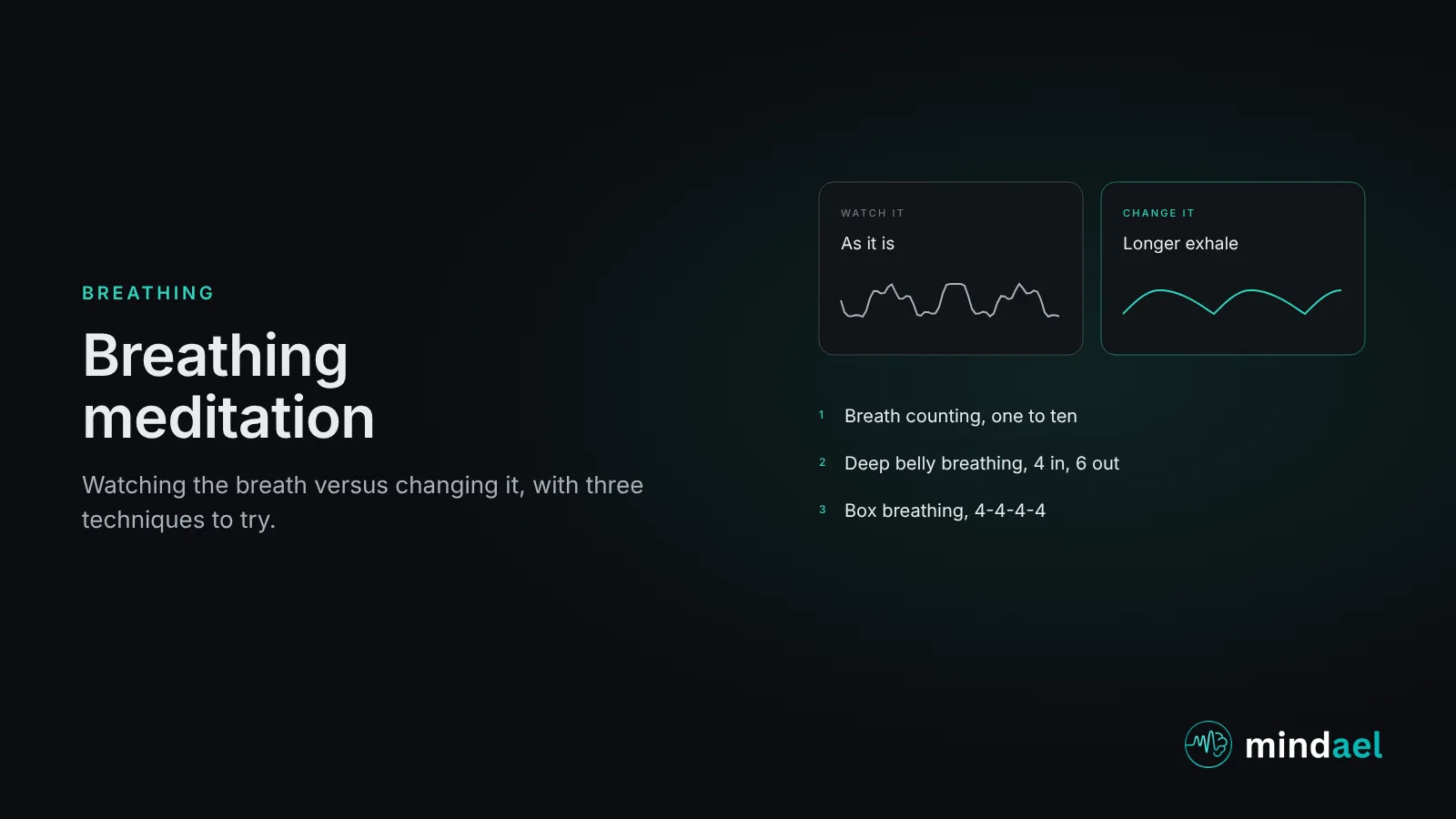
Breathing meditation uses the breath as the anchor for attention, and it comes in two kinds that are easy to confuse. In one, you watch the breath as it is and come back to it each time your mind wanders. In the other, you change the breath on purpose: slower, deeper, with a shape. Both have research behind them, and they work well together. This article explains the difference and gives three techniques to try. We make Mindael, a sound app many people breathe and meditate with, free to download on the App Store.
Watching the breath
This is the classic form: sit comfortably, feel the breath where it is easiest to notice, at the nose, chest or belly, and when your mind wanders, notice it and come back. Nothing to change, nothing to achieve.
It does more than it seems. In an experiment, people who spent 15 minutes on a recorded focused-breathing exercise reacted less strongly to upsetting pictures afterwards than people who let their minds wander or worried (Arch and Craske, 2006). Our how to meditate properly article covers what to do when the mind keeps wandering.
Changing the breath
Breathwork shapes the breath deliberately. In a month-long trial, five minutes a day of breathing exercises improved mood and lowered anxiety about as well as or better than five minutes of watching the breath, and exhale-focused breathing, with a long, slow out-breath, did best (Balban et al., 2023). In another trial, eight weeks of slow, deep belly breathing improved attention and lowered a stress hormone (Ma et al., 2017).
The two kinds are not rivals. Watching trains attention; shaping calms the body. Many sessions start with a few slow breaths and then let the breath go back to normal while you watch it.
Three techniques to try
1. Breath counting (watching). Breathe normally. Count each out-breath, one to ten, then start again at one. If you lose count or go past ten, start over without fuss. Skill at breath counting was linked with less mind wandering and better mood, and four weeks of practice improved mindfulness compared with other training (Levinson et al., 2014).
2. Deep belly breathing (changing). One hand on the belly. In through the nose for four, letting the belly rise; out for six, slow and easy. Five minutes. Our calm breathing guide has variations, and deep breathing for sleep has the bedtime version.
3. Box breathing (changing). In for four, hold for four, out for four, hold for four. A steady, square rhythm that suits busy minds. The box breathing article explains when to use it.
Setting it up
Five minutes, same time each day. Sit or lie comfortably, phone face down. A steady, low sound such as ocean waves or rain covers the room; ocean gives an easy pace to breathe with. If you prefer a voice, our guided meditation guide covers free guided audio. The breathing guide has all four patterns in one place.
The short version
Breathing meditation either watches the breath or changes it, and both help: watching trains attention and emotional calm, slow exhale-focused breathing lifts mood and settles the body. Start with five minutes of breath counting, add slow belly breathing when you are tense, and keep a steady sound underneath. For ocean, rain and soft drones to breathe with, Mindael is free to download on the App Store.
Something steady to breathe with.
Mindael has rain and ocean recorded without loops, soft drones and a 6 Hz theta beat made in our studio, two at a time, so the room goes quiet and the breath has a backdrop. Free to download, no account, works offline. Ocean waves are an easy pace to breathe with: in on the rise, out on the fall.
- Rain, ocean, soft drones and a theta beat
- Two sounds at once, no voice over the breath
- Free to download, no account, works offline
 Free · No account needed · Works offline
Frequently asked questions
What is breathing meditation?
A meditation that uses the breath as its anchor. You either watch the breath as it is and return to it when your mind wanders, or deliberately slow and shape it. Both are simple to start and need no equipment.
What are the best meditation breathing techniques?
For beginners: breath counting (count out-breaths from one to ten, then start again), slow deep belly breathing with a longer exhale, and box breathing (in, hold, out, hold for four counts each). Pick one and practise it daily for a few weeks.
Is deep breathing the same as meditation?
Not quite. Deep breathing changes the breath on purpose; breath meditation can simply watch it. They overlap, and in a month-long trial both helped mood, with exhale-focused breathing slightly ahead.
How long should a breathing meditation be?
Five minutes a day is enough to start. Trials used sessions of five to fifteen minutes. Consistency over weeks matters more than length.
Can breathing meditation help with anxiety?
It can help you feel calmer in the moment and reduce stress over time. If anxiety is frequent or severe, a doctor or therapist is the right next step; breathing is a support, not a treatment.
Should I meditate to music or silence?
Either works. A steady, low sound without words, such as rain or a soft drone, can cover distracting noise and give attention a backdrop. Avoid music with lyrics or sudden changes.
Sources
- Arch JJ, Craske MG. Mechanisms of mindfulness: emotion regulation following a focused breathing induction. Behaviour Research and Therapy, 2006.
- Levinson DB, Stoll EL, Kindy SD, Merry HL, Davidson RJ. A mind you can count on: validating breath counting as a behavioral measure of mindfulness. Frontiers in Psychology, 2014.
- Balban MY, et al. Brief structured respiration practices enhance mood and reduce physiological arousal. Cell Reports Medicine, 2023.
- Ma X, et al. The effect of diaphragmatic breathing on attention, negative affect and stress in healthy adults. Frontiers in Psychology, 2017.
This article is for general information and is not medical advice. If breathing exercises make you dizzy, stop and breathe normally. If you have a heart or lung condition, or anxiety that is frequent or severe, please talk to a doctor.
This article is part of our breathing guide. Hear the sounds in this article in the Mindael sound library, or see our app comparison checklists.