

Guided Meditation: What It Is, Whether a Voice Helps, and How to Start for Free
Guided meditation is meditation with a voice that tells you where to put your attention: the breath, the body, an image, or a phrase. For beginners it removes the hardest part, knowing what to do when the mind wanders. The research on meditation programs is modest but real: a large review found small to moderate reductions in anxiety, depression and pain. In a randomised study of people who had never meditated, 13 minutes of guided meditation a day for eight weeks improved mood, attention and memory compared with listening to podcasts; four weeks was not enough. Guided imagery, a guided session built around a calm scene, raised feelings of relaxation in a comparison study. Start with ten to fifteen minutes a day of free guided audio, the same time each day, and keep a steady, low sound underneath if your room is noisy.
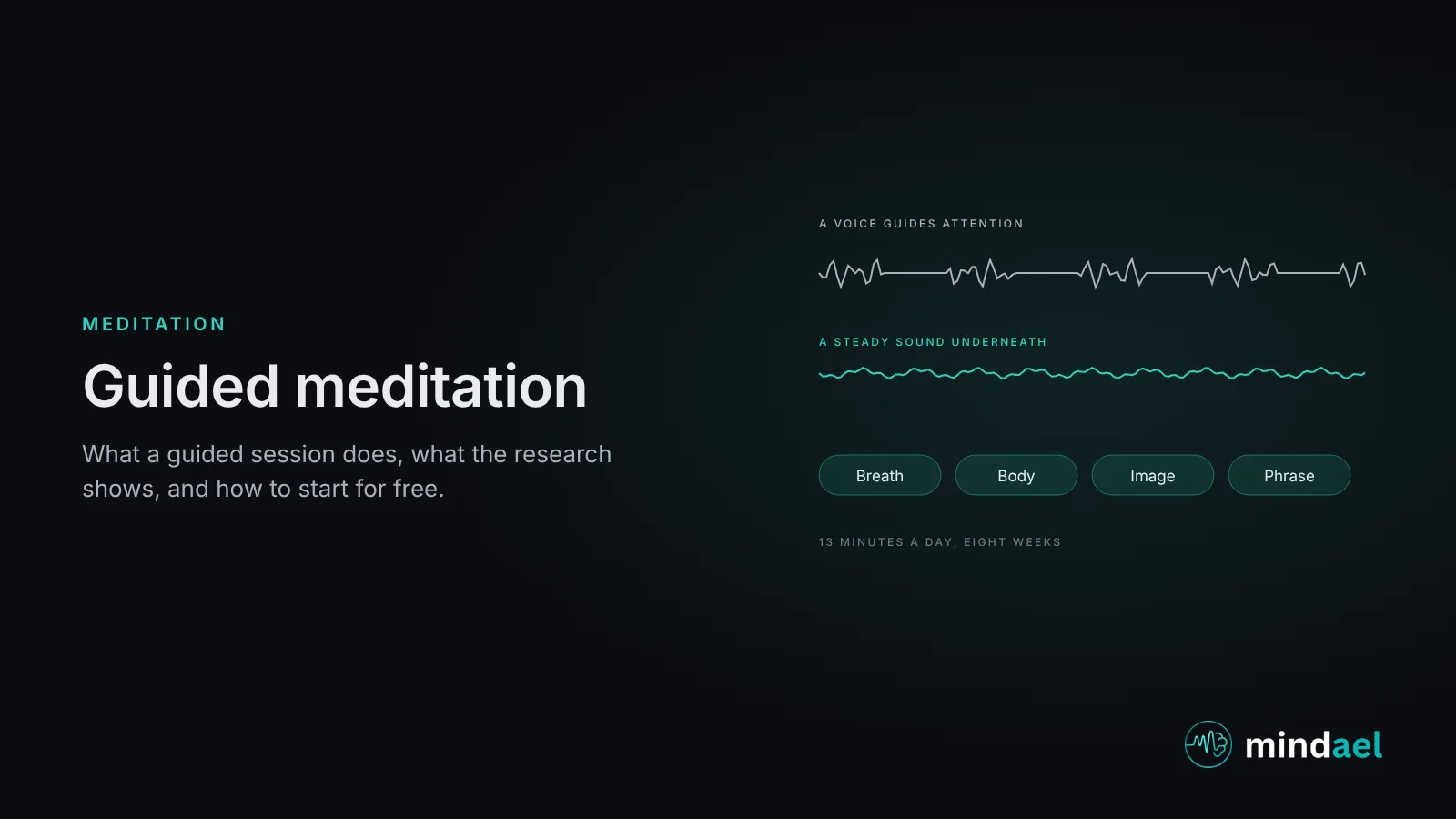
Guided meditation is meditation with a voice that tells you where to put your attention, and for most beginners it is the easiest way in. The hardest part of meditating alone is not sitting still; it is knowing what to do when your mind wanders for the tenth time. A good guide answers that, gently, every time. This article covers what guided meditation is, what the research shows, and how to start with free audio. We make Mindael, a sound app many people play under a guided session, free to download on the App Store.
What a guided session does
A guide gives your attention a place to rest and brings it back when it drifts. Most sessions use one of four anchors: the breath, sensations in the body, a calm scene, or a short phrase. The voice sets the pace, names the wandering without judging it, and ends the session so you do not have to watch the clock.
Recorded sessions vary from three minutes to an hour. For a beginner, ten to fifteen minutes is the sweet spot: long enough to settle, short enough to do every day. Our how to start meditation guide covers posture and timing.
What the research shows
A large review of meditation programs found small to moderate reductions in anxiety, depression and pain, with no evidence of harm, though meditation was not better than other active treatments such as exercise (Goyal et al., 2014).
Short and daily works. In a randomised study, people who had never meditated listened to a 13 minute guided meditation every day for eight weeks; compared with people who listened to podcasts, they had better mood, attention and memory, and less anxiety under a stress test. At four weeks the differences were not yet there (Basso et al., 2019). Guided programs on a phone count too: in a randomised trial, a short mindfulness course in an app improved stress, mood and irritability compared with an audiobook (Economides et al., 2018).
Guided imagery
Guided imagery is a session built around a scene: a beach at dusk, a forest path, a warm room with rain on the window. The guide describes it in enough detail that you can picture it. In a comparison study, guided imagery raised feelings of relaxation, alongside deep breathing and progressive muscle relaxation (Toussaint et al., 2021). It suits people who find the breath too dull to hold attention.
How to start, for free
- Pick one voice. Free guided audio is published by universities, health services and on most podcast and video platforms. Choose one teacher you like and stay with them for a few weeks.
- Same time, same place. After the first coffee or before bed. The habit matters more than the length.
- Ten to fifteen minutes. The research above used 13 minutes a day; it took eight weeks to show.
- Keep the room steady. If traffic or voices break in, put a low sound such as rain under the guide, quieter than the voice.
- Try a session without a voice. Once you know the steps, sit with just the sound. Our breathing meditation guide is a good first unguided session.
The short version
Guided meditation is the easiest way to start: a voice gives your attention somewhere to rest and brings it back. Ten to fifteen minutes a day of free guided audio, for at least eight weeks, is what the research supports. Mindael has no narration, but for a steady sound under any guided session, Mindael is free to download on the App Store, and our meditation sounds guide has three sessions to try.
A steady floor under any voice.
Mindael has rain and ocean recorded without loops, soft drones, singing bowl tones and a 6 Hz theta beat made in our studio, two at a time. There is no narration: play your favourite guided session on top, or sit with the sound alone once you know the steps. Free to download, no account, works offline.
- Rain, ocean, drones, bowls and a theta beat
- No narration, pairs with any guided audio
- Free to download, no account, works offline
 Free · No account needed · Works offline
Frequently asked questions
What is guided meditation?
Meditation led by a voice, live or recorded, that tells you where to rest your attention: the breath, sensations in the body, a calm scene, or a phrase. It is the easiest way to start, because the voice brings you back when your mind wanders.
Is guided meditation good for beginners?
Yes. In a randomised study of people who had never meditated, a 13 minute guided session each day for eight weeks improved mood, attention and memory compared with a podcast. The benefits showed up at eight weeks, not four, so consistency matters.
What is guided imagery meditation?
A guided session built around a calm scene, such as a beach or a forest, described in detail so you can picture it. In a comparison study, guided imagery raised feelings of relaxation, alongside deep breathing and muscle relaxation.
Where can I find free guided meditation?
Many universities, health services and public libraries publish free guided audio, and there are free sessions on most podcast and video platforms. Pick one teacher whose voice you like and stay with them for a few weeks.
Does Mindael have guided meditations?
No. Mindael is a sound app with no narration. Many people play a free guided recording and keep a Mindael sound such as rain or a drone underneath it, or meditate to the sound alone once they know the steps.
Guided or unguided meditation: which is better?
Neither is better in general. Guided is easier to start with; unguided, with just a sound or silence, gives you more space once you know the steps. Many people switch between them.
Sources
- Goyal M, Singh S, Sibinga EMS, et al. Meditation programs for psychological stress and well-being: a systematic review and meta-analysis. JAMA Internal Medicine, 2014.
- Basso JC, McHale A, Ende V, Oberlin DJ, Suzuki WA. Brief, daily meditation enhances attention, memory, mood, and emotional regulation in non-experienced meditators. Behavioural Brain Research, 2019.
- Economides M, Martman J, Bell MJ, Sanderson B. Improvements in stress, affect, and irritability following brief use of a mindfulness-based smartphone app: a randomized controlled trial. Mindfulness, 2018.
- Toussaint L, Nguyen QA, Roettger C, et al. Effectiveness of progressive muscle relaxation, deep breathing, and guided imagery in promoting psychological and physiological states of relaxation. Evidence-Based Complementary and Alternative Medicine, 2021.
This article is for general information and is not medical advice. Meditation is not a treatment for anxiety, depression or other conditions. If you are struggling, please talk to a doctor or therapist.
This article is part of our meditation guide. Hear the sounds in this article in the Mindael sound library, or see our app comparison checklists.