

5 Minute Meditation: A Short Practice That Works, What Research Shows, and How to Do It
A 5 minute meditation is long enough to matter. In a lab study, just eight minutes of mindful breathing reduced mind-wandering on an attention task compared with relaxing or reading, and four 20-minute sessions over four days improved attention in beginners. Effects build with practice: beginners who meditated 13 minutes a day for eight weeks improved attention, memory and mood, while four weeks was not enough. So start with five minutes every day, at the same time, focusing on the breath and returning each time your mind wanders, and move to 10 or 15 minutes when five feels easy. A steady sound such as rain or ocean waves makes it easier to start and to stay.
A 5 minute meditation is the easiest way to start meditating, and the research says it is not just a warm-up. Short sessions changed attention in the lab, and a daily habit of a few minutes is what builds the longer-term effects. This article gives you a simple five-minute practice, explains what short sessions can do, and when to go longer. The sounds we sit with are in Mindael, free to download on the App Store, and our meditation sounds guide covers the rest.
A 5 minute meditation you can do now
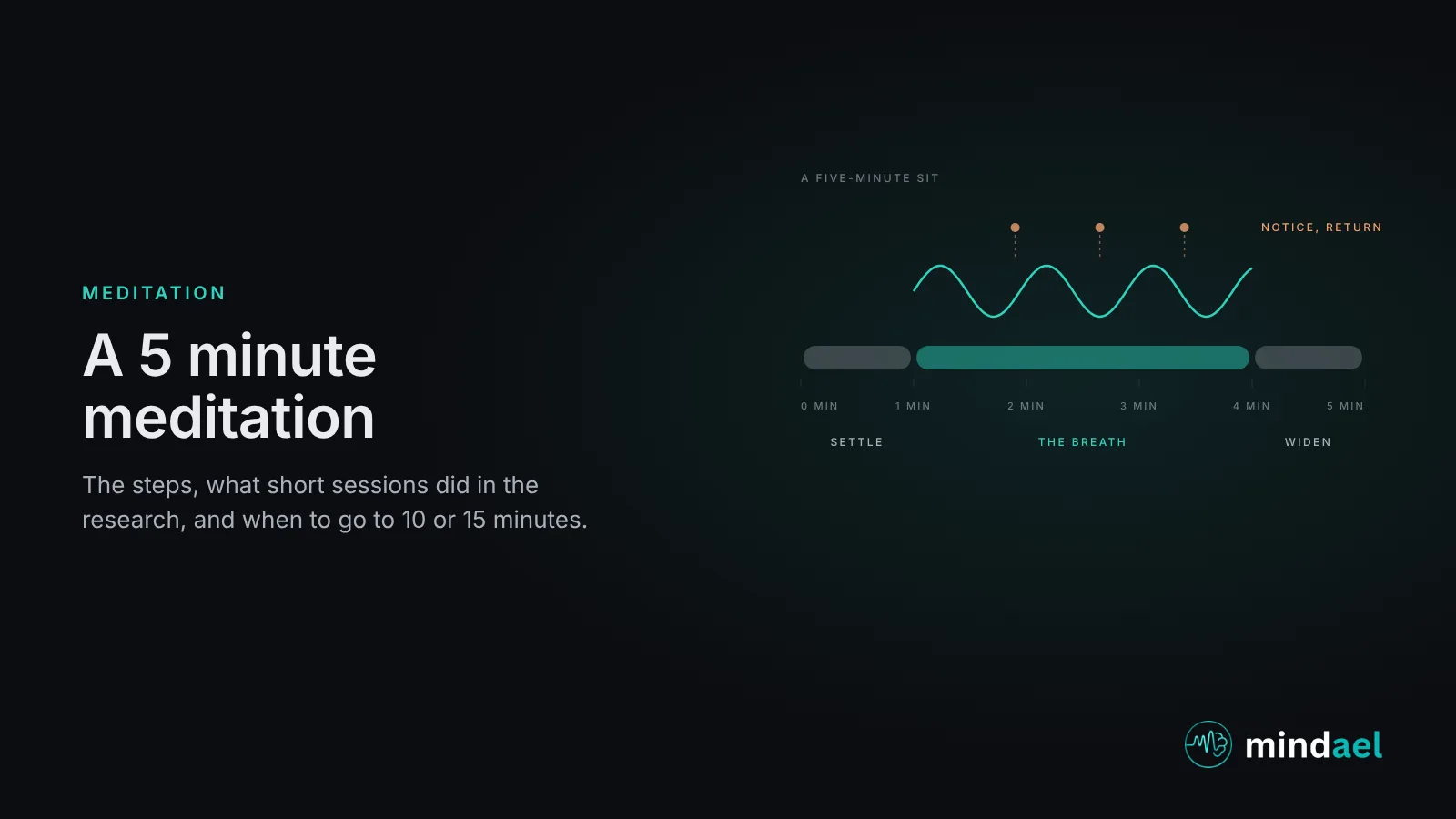
Minute 1: settle. Sit on a chair or cushion with your back upright but not stiff. Close your eyes or lower your gaze. Take three slow breaths, longer out than in, then let the breath find its own pace.
Minutes 2 to 4: the breath. Rest your attention where you feel the breath most clearly: the nose, the chest or the belly. Feel each breath in and each breath out. When you notice your mind has wandered to a plan, a memory or a worry, note it lightly, “thinking”, and come back to the next breath.
Minute 5: widen. Let go of the breath and notice the whole body, then the sounds in the room. Open your eyes slowly before you stand.
That is it. The noticing and returning in the middle is the whole skill, and every return counts.
What short sessions can do
The mind wanders a lot: in a large study that sampled people’s thoughts during the day, they were thinking about something other than what they were doing almost half the time, and they were less happy when they were (Killingsworth and Gilbert, 2010). Meditation trains the return.
Short sessions show effects quickly. In one experiment, eight minutes of mindful breathing reduced mind-wandering on a sustained attention task compared with relaxing or reading for the same time (Mrazek et al., 2012). In another, beginners who did four 20-minute sessions of mindfulness training over four days improved on attention tests, while a group who listened to an audiobook did not (Zeidan et al., 2010).
Why every day matters more than how long
The effects build with regular practice. In a study of beginners, 13 minutes of guided meditation a day for eight weeks reduced negative mood and improved attention, working memory and recognition memory, while the same practice for four weeks did not yet show those changes (Basso et al., 2019). That is why we suggest starting with five minutes you will actually do every day, rather than a long session you skip.
When to go to 10 or 15 minutes
Once five minutes feels easy, add a few minutes at a time. Ten minutes gives the mind more time to settle after the first busy stretch, and 15 to 20 minutes is where many regular meditators land. If you are new, our how to start meditation guide covers the first weeks, and how to meditate properly goes deeper into technique. For a short session at night, meditation for sleep has a version to do in bed.
The sound to sit with
A steady sound with nothing to follow helps in two ways: it covers the noise around you, and it becomes a cue that the session has started. Rain and ocean waves are the simplest choices; a soft theta beat under rain suits a longer sit with earbuds. Keep it low, and use the same sound every time. Mindael is where we keep the sounds we meditate with, free to download.

Five minutes, the same sound, every day.
Mindael has rain and ocean recorded without loops, soft drones and theta beats made in our studio, two at a time. Free to download, no account, works offline. Press play, close your eyes, come back to the breath.
- Rain, ocean, drones and theta beats, studio-made
- Two sounds at once, fine volume control
- Free to download, no account, works offline
 Free · No account needed · Works offline
Frequently asked questions
Is a 5 minute meditation enough?
It is enough to start and to feel a difference in the moment. In a lab study, eight minutes of mindful breathing reduced mind-wandering straight away. Longer-term benefits for attention, memory and mood showed up in beginners who practised about 13 minutes a day for eight weeks, so five minutes is a good first step to build on.
How do you do a 5 minute meditation?
Sit comfortably, set a timer for five minutes and close your eyes or lower your gaze. Take one minute to settle, then rest your attention on the breath at the nose or belly. When your mind wanders, notice it and come back. In the last minute, widen your attention to the room, then open your eyes.
What if my mind keeps wandering?
That is normal and it is the practice. Each time you notice you have drifted and come back, you train the skill. A session where you came back twenty times is not a failed session.
Is 10 minutes of meditation better than 5?
Usually, once five minutes feels easy. Longer sessions give the mind more time to settle. But a daily five minutes beats an occasional twenty, because regular practice is what builds the effect.
When is the best time to do a 5 minute meditation?
Whenever you will do it every day. Many people pick the morning before the phone, a break in the afternoon, or before sleep. Tying it to something you already do, such as after the first coffee, makes the habit stick.
Can I meditate with music?
Yes, if the sound is steady and has no words: rain, ocean waves or a soft drone. A sound with a melody or lyrics gives the mind something to follow instead of the breath. Keep it low.
Sources
- Mrazek MD, Smallwood J, Schooler JW. Mindfulness and mind-wandering: finding convergence through opposing constructs. Emotion, 2012.
- Zeidan F, et al. Mindfulness meditation improves cognition: evidence of brief mental training. Consciousness and Cognition, 2010.
- Basso JC, et al. Brief, daily meditation enhances attention, memory, mood, and emotional regulation in non-experienced meditators. Behavioural Brain Research, 2019.
- Killingsworth MA, Gilbert DT. A wandering mind is an unhappy mind. Science, 2010.
This article is part of our meditation guide. Hear the sounds in this article in the Mindael sound library, or see our app comparison checklists.