

Meditation for Anxiety: What the Research Shows, a 10-Minute Practice, and When to Get More Help
Meditation helps anxiety for many people, by a moderate amount. A meta-analysis of 39 studies found mindfulness-based therapy reduced anxiety with a moderate effect, larger in people with anxiety disorders. A review of 47 trials found mindfulness programs gave moderate improvements in anxiety. In a 2023 trial of adults with anxiety disorders, an eight-week mindfulness course worked about as well as a common anxiety medicine. Even four days of brief training lowered anxiety in a brain-imaging study. Start small: ten minutes a day, attention on the breath or a steady sound, noticing worried thoughts and returning without arguing with them. Meditation is not risk-free: some people feel more anxious at first. Keep sessions short, eyes open if needed, and see a professional if anxiety is severe.
Meditation for anxiety is one of the most searched practices for a reason: it is free, it can be done anywhere, and the research behind it is better than for most self-help. It is also not magic, and for some people it makes anxiety louder at first. This article explains how well it works, gives a simple ten-minute practice, and covers what to do when it does not feel calming. The steady sounds we suggest are in Mindael, free to download on the App Store.
How well meditation works for anxiety
The evidence points the same way across several large reviews. A meta-analysis of 39 studies found that mindfulness-based therapy reduced anxiety with a moderate effect, and the effect was larger in people with diagnosed anxiety disorders (Hofmann et al., 2010). A review of 47 randomised trials found mindfulness meditation programs gave moderate improvements in anxiety, depression and pain (Goyal et al., 2014).
The most striking result came in 2023. Adults with anxiety disorders were randomised to an eight-week mindfulness course or to escitalopram, a common anxiety medicine. After eight weeks, anxiety had dropped by a similar amount in both groups (Hoge et al., 2023). That does not mean anyone should swap medication for meditation on their own; it does mean meditation is a serious option to discuss.
You do not need months to feel something. In a brain-imaging study, people with no meditation experience had four short training sessions, and meditation lowered their anxiety in every session they were scanned (Zeidan et al., 2014).
Why it helps
Anxiety lives in the future: what might happen, what you should have said, what could go wrong. Meditation trains one skill: noticing that you have drifted into those thoughts and bringing attention back to something happening now, the breath, a sound, the feeling of your feet. You are not trying to stop the thoughts. You are practising not following each one. Over weeks, that makes it easier to step back from a worry in daily life, too.
A 10-minute meditation for anxiety
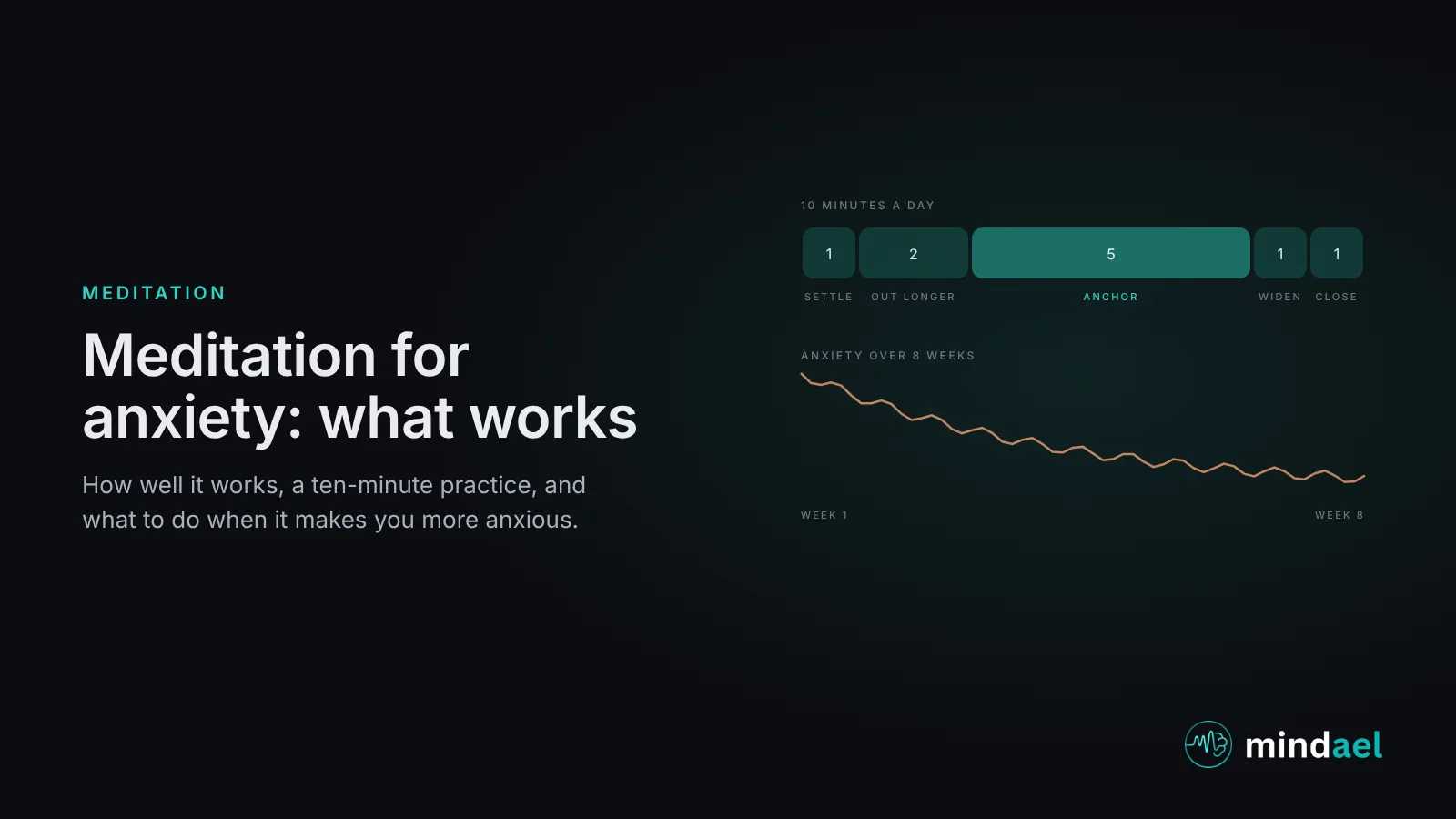
- Settle (1 minute). Sit with your back supported. Eyes closed or resting on the floor. Put on a low, steady sound, rain or brown noise.
- Breathe out longer (2 minutes). In for four, out for six, through the nose. Do not force it.
- Pick an anchor (5 minutes). Let the breath return to normal and rest attention on it, or on the sound. When a worry arrives, name it quietly, “planning” or “worrying”, and come back. The coming back is the exercise, not a failure.
- Widen (1 minute). Notice the whole room: sounds, the chair, the air.
- Close (1 minute). Open your eyes, move your hands, and notice one thing you will do next.
Do it at the same time each day, with the same sound, so it becomes a habit. Our 5-minute meditation is a shorter version for busy days, and how to start meditation covers the basics.
When meditation makes anxiety worse
This happens, and it is worth knowing in advance. A systematic review of 83 studies found that unwanted effects were reported in a minority of meditators, and anxiety was the most common one (Farias et al., 2020). Sitting still can make you notice your heartbeat or breath, and for some anxious people that itself feels alarming.
If that is you, change the practice rather than pushing through:
- Keep sessions short, three to five minutes.
- Keep your eyes open, gaze resting on a point.
- Use an outside anchor, a steady sound rather than the breath.
- Try moving meditation, slow walking or gentle stretching.
- Stop if it keeps getting worse, and talk to a professional.
For a spike of anxiety, a breathing exercise is often faster than meditation; our how to calm nerves article and box breathing guide have the steps.
Sound as an anchor
The breath is the classic anchor, but anxious people sometimes find it too close to the body’s alarm signals. A steady external sound is a gentler place for attention: rain, ocean or a soft drone that does not change. Our meditation sounds guide explains how to pick one, and our calming music for anxiety guide covers the rest of a calming routine.
The short version
Meditation lowers anxiety by a moderate amount for many people, and in one trial an eight-week course matched a common medicine. Start with ten minutes a day: settle, lengthen the exhale, rest on an anchor and come back without arguing. If it makes you more anxious, go shorter, open your eyes or use a sound as the anchor, and get help if anxiety is severe. For a steady sound to come back to, Mindael is free to download on the App Store.
Something steady to come back to.
Mindael has rain and ocean recorded without loops, soft drones and an alpha beat made in our studio, and brown noise generated to spec, two at a time. Free to download, no account, works offline. A steady sound to rest anxious attention on, ten minutes a day.
- Rain, ocean, soft drones and alpha beats, studio-made
- Two sounds at once, fine volume control
- Free to download, no account, works offline
 Free · No account needed · Works offline
Frequently asked questions
Does meditation help with anxiety?
For many people, yes, by a moderate amount. Meta-analyses found mindfulness-based programs reduced anxiety with moderate effects, and in a 2023 trial an eight-week mindfulness course worked about as well as a common anxiety medicine for adults with anxiety disorders. It is one tool among several, not a guaranteed fix.
What type of meditation is best for anxiety?
Mindfulness meditation has the most research: attention on the breath, a sound or the body, noticing thoughts and coming back. Guided meditation is a good start because a voice keeps you on track. Some people find loving-kindness or body scan practices easier on anxious days.
How long should I meditate for anxiety?
Start with five to ten minutes a day. The trials used longer programs, often eight weeks with daily home practice, but a short practice you keep is better than a long one you skip. Increase slowly if it feels useful.
Why does meditation sometimes make my anxiety worse?
Sitting still with your thoughts can bring worries forward, and some people notice their heartbeat or breath more, which can feel alarming. A review found anxiety was the most commonly reported unwanted effect. Shorter sessions, eyes open, moving meditation or a steady external sound to focus on usually help. Stop if it keeps getting worse.
Can meditation replace anxiety medication or therapy?
Do not stop a prescribed treatment on your own. In one trial, mindfulness training worked about as well as medication for some adults with anxiety disorders, but that was a structured course, and the right choice depends on the person. Talk to your doctor.
Is guided meditation for anxiety better than silent?
For beginners, often yes. A voice or a steady sound gives anxious attention something to follow. As practice grows, many people move to silent sessions or a single steady sound.
Sources
- Hofmann SG, Sawyer AT, Witt AA, Oh D. The effect of mindfulness-based therapy on anxiety and depression: a meta-analytic review. Journal of Consulting and Clinical Psychology, 2010.
- Goyal M, et al. Meditation programs for psychological stress and well-being: a systematic review and meta-analysis. JAMA Internal Medicine, 2014.
- Hoge EA, et al. Mindfulness-based stress reduction vs escitalopram for the treatment of adults with anxiety disorders: a randomized clinical trial. JAMA Psychiatry, 2023.
- Zeidan F, et al. Neural correlates of mindfulness meditation-related anxiety relief. Social Cognitive and Affective Neuroscience, 2014.
- Farias M, et al. Adverse events in meditation practices and meditation-based therapies: a systematic review. Acta Psychiatrica Scandinavica, 2020.
This article is for general information and is not medical advice. If anxiety stops you from working, sleeping or seeing people, if you have panic attacks, or if you have thoughts of harming yourself, please talk to a doctor or a mental health professional. Do not stop prescribed treatment without medical advice.
This article is part of our meditation guide. Hear the sounds in this article in the Mindael sound library, or see our app comparison checklists.