
Mindfulness-Based Stress Reduction: What MBSR Is, What the Research Shows, and How to Practise at Home
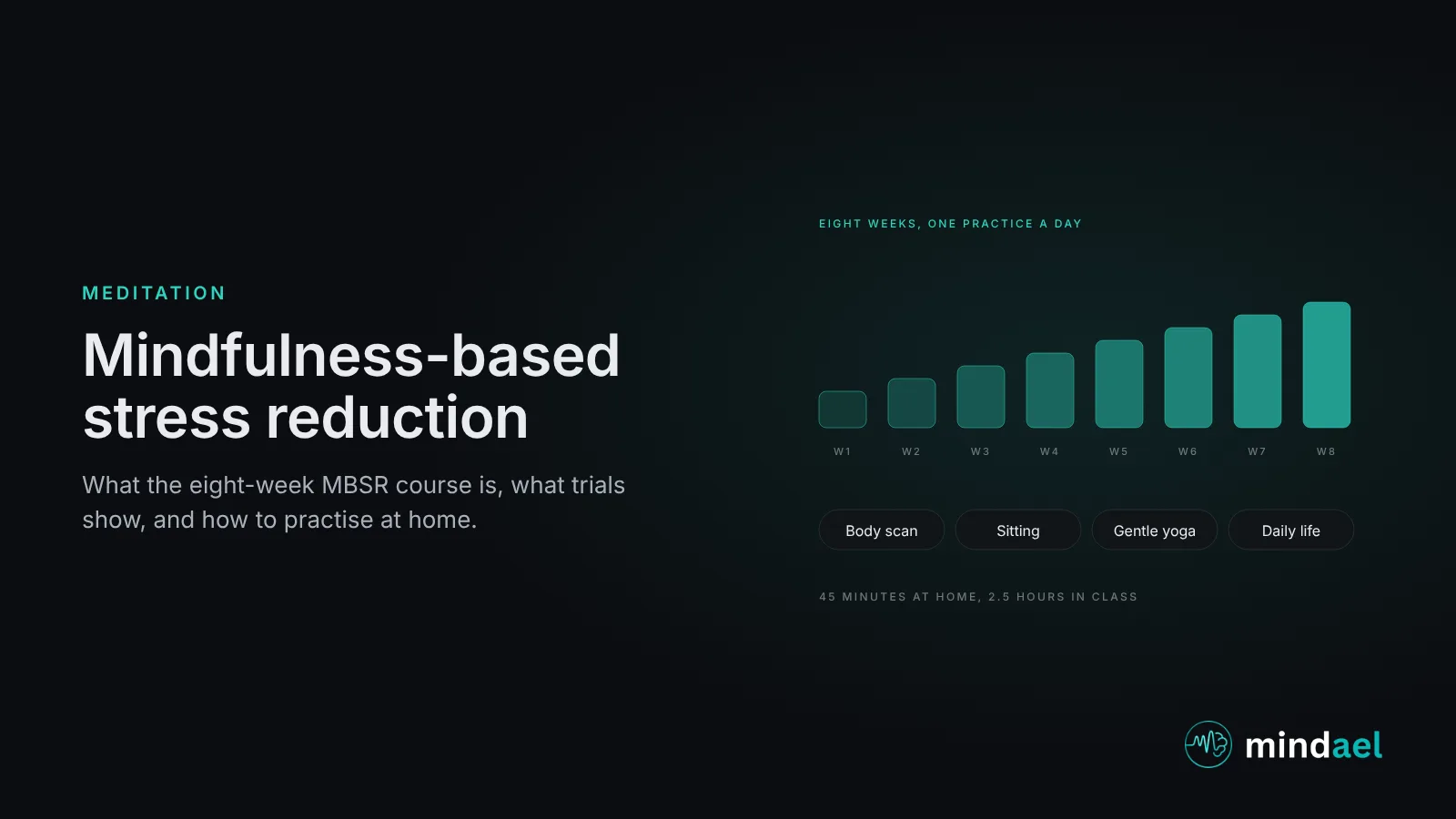
Mindfulness-based stress reduction, or MBSR, is an eight-week group course built around a few practices: a body scan, sitting meditation on the breath, gentle mindful movement, and bringing attention to everyday activities, with about 45 minutes of home practice a day. It is one of the most studied mindfulness programs. In healthy adults, a meta-analysis of 29 studies found moderate reductions in stress, anxiety and depression and better quality of life. In a randomised trial with adults who had anxiety disorders, MBSR reduced anxiety about as much as a common medication, with far fewer side effects. Online mindfulness programs also lowered stress, with more sessions linked to larger effects. You can start the core practices at home, but the full course, ideally with a trained teacher, is what the research tested. If anxiety or stress is severe, MBSR is something to discuss with a doctor, not a replacement for care.
Mindfulness-based stress reduction, usually called MBSR, is an eight-week course that teaches mindfulness as a practical skill for stress. It started in a hospital clinic in the late 1970s and is now one of the most studied mindfulness programs in the world. This article explains what the course involves, what the research shows, and how to start its core practices at home. We make Mindael, a sound app many people use under their daily practice, free to download on the App Store.
What the course involves
MBSR runs as a weekly group class for eight weeks, with a longer day-long session near the end. Four practices make up most of it:
- The body scan. Lying down, moving attention slowly through the body. Our yoga nidra sleep guide has a bedtime version.
- Sitting meditation. Attention on the breath, then on sounds, thoughts and feelings as they come and go. The breathing meditation guide covers the first step.
- Mindful movement. Gentle stretches done slowly, with attention on the body.
- Everyday mindfulness. Bringing the same attention to ordinary moments: eating, walking, washing up.
The standard course asks for about 45 minutes of home practice a day. That is the part that makes the difference, and the part most people find hardest.
What the research shows
For healthy adults under stress, a meta-analysis of 29 studies found MBSR had moderate effects on stress, anxiety, depression and distress, and improved quality of life (Khoury et al., 2015). A broader review of meditation programs found smaller but real reductions in anxiety and depression (Goyal et al., 2014).
The most striking result came from a randomised trial with 276 adults who had anxiety disorders. After eight weeks, MBSR reduced anxiety about as much as a widely used anti-anxiety medication, and far fewer people in the MBSR group reported side effects (Hoge et al., 2023). That does not mean anyone should swap medication for a course on their own; it means MBSR is a serious option to discuss with a doctor.
Online programs count too. A meta-analysis of 15 randomised trials found online mindfulness programs had small effects on anxiety and depression and a larger effect on stress, and programs with more sessions did better (Spijkerman et al., 2016).
Starting at home
You do not need to wait for a course to begin:
- Week 1 and 2: a 15 to 20 minute body scan each day, lying down.
- Week 3 and 4: add 10 minutes of sitting with the breath.
- Week 5 onward: alternate the two, and pick one everyday activity to do mindfully, such as the first cup of coffee.
Same time each day, phone face down. If the room is noisy, a low, steady sound such as rain covers it without pulling your attention. If you like a voice to lead you, our guided meditation guide covers free guided audio. When you are ready for more, look for a trained MBSR teacher; many run the course online.
The short version
MBSR is an eight-week course of body scan, sitting meditation, mindful movement and everyday mindfulness, with daily home practice. It moderately reduced stress and anxiety in healthy adults, and in people with anxiety disorders it worked about as well as a common medication in one trial. Start with a daily body scan at home and look for a teacher when you can. For a steady sound under your practice, Mindael is free to download on the App Store, and our meditation sounds guide has more sessions.
A quiet room for your daily practice.
Mindael has rain and ocean recorded without loops, soft drones and singing bowl tones made in our studio, two at a time. There is no course or narration: it is the steady sound under your body scan or sitting practice. Free to download, no account, works offline.
- Rain, ocean, drones and singing bowls
- Two sounds at once, no voice over your practice
- Free to download, no account, works offline
 Free · No account needed · Works offline
Frequently asked questions
What is mindfulness-based stress reduction?
An eight-week group course developed in the late 1970s that teaches mindfulness through a body scan, sitting meditation, gentle movement and attention to daily life. Classes are weekly, with a day-long session and daily home practice.
Does MBSR really reduce stress?
In healthy adults, a meta-analysis of 29 studies found moderate reductions in stress, anxiety and depression. In people with anxiety disorders, a randomised trial found MBSR reduced anxiety about as much as a common medication.
Is MBSR a form of therapy?
It is a structured training course rather than psychotherapy, though it is used in hospitals and clinics. Mindfulness-based cognitive therapy, MBCT, is a related program built for preventing depression relapse.
Can I do MBSR on my own?
You can practise its core exercises at home, and online mindfulness programs lowered stress in trials. The full course with a trained teacher is what most research tested, and many teachers now run it online.
How much do I need to practise?
The standard course asks for about 45 minutes a day. If that is too much, start with 10 to 15 minutes. In online programs, more sessions were linked with larger reductions in stress.
Is mindfulness for stress safe for everyone?
For most people, yes. A few people find that sitting with difficult feelings brings them up strongly. If you have trauma, severe anxiety or depression, talk to a doctor or a trained teacher before starting.
Sources
- Khoury B, Sharma M, Rush SE, Fournier C. Mindfulness-based stress reduction for healthy individuals: a meta-analysis. Journal of Psychosomatic Research, 2015.
- Hoge EA, Bui E, Mete M, Dutton MA, Baker AW, Simon NM. Mindfulness-based stress reduction vs escitalopram for the treatment of adults with anxiety disorders: a randomized clinical trial. JAMA Psychiatry, 2023.
- Spijkerman MPJ, Pots WTM, Bohlmeijer ET. Effectiveness of online mindfulness-based interventions in improving mental health: a review and meta-analysis of randomised controlled trials. Clinical Psychology Review, 2016.
- Goyal M, Singh S, Sibinga EMS, et al. Meditation programs for psychological stress and well-being: a systematic review and meta-analysis. JAMA Internal Medicine, 2014.
This article is for general information and is not medical advice. Mindfulness is not a substitute for professional care. If stress, anxiety or low mood is severe or lasting, please talk to a doctor; do not stop any medication without medical advice.
This article is part of our meditation guide. Hear the sounds in this article in the Mindael sound library, or see our app comparison checklists.