
Stress Meditation: Three Short Practices for a Stressful Day, and What They Do in the Body
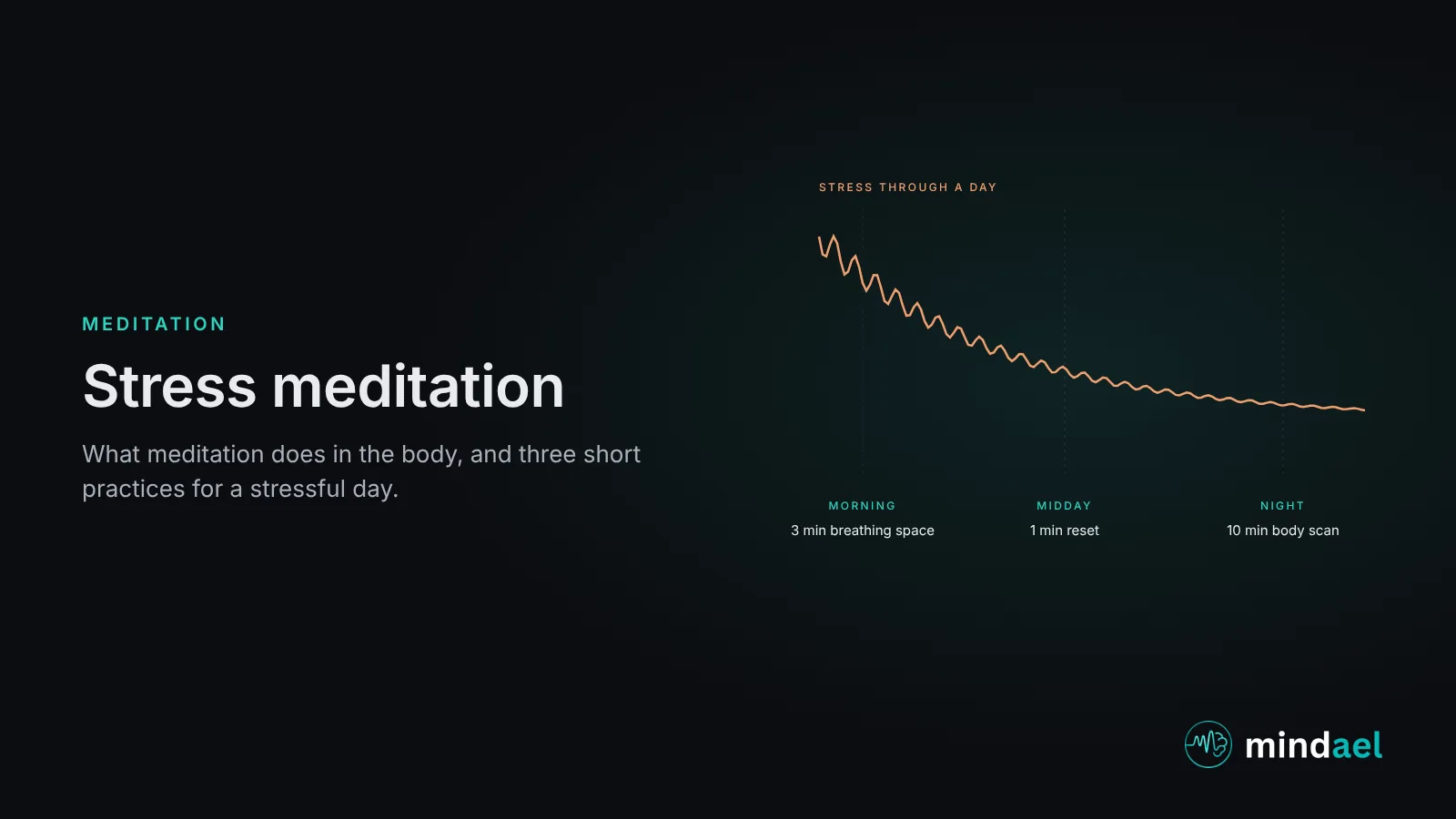
Stress meditation is any short meditation used to bring the body down from a stress response: slowing the breath, noticing tension, and letting thoughts pass instead of chasing them. The research is encouraging but honest. A meta-analysis of 45 randomised trials found meditation lowered cortisol, blood pressure, heart rate and markers of inflammation compared with active control groups. A review in JAMA Internal Medicine found meditation programs gave small to moderate reductions in anxiety and depression. Brief practice counts: four 20-minute sessions reduced anxiety and fatigue in beginners, and three days of 25-minute practice lowered how stressed people felt during a stressful speech task, though their cortisol did not fall at first. A useful plan is three short practices: a three-minute breathing space in the morning, a one-minute reset in the middle of the day, and a ten-minute body scan at night. If stress is severe or lasting, talk to a doctor.
Stress meditation is any short meditation you use to bring your body down from a stress response: slowing the breath, noticing where tension sits, and letting worried thoughts pass instead of following them. You do not need a retreat or an hour a day. This guide covers what meditation does to stress in the body, what the research does and does not show, and three short practices for a real day. We make Mindael, a sound app many people use under their practice, free to download on the App Store.
What stress does, and where meditation fits
Stress is the body getting ready to act: faster heart, shallower breath, tighter muscles, more cortisol. That is useful for a deadline and tiring when it never switches off. Meditation works from the other side. Slow breathing and steady attention send the opposite signal, and with practice it becomes easier to notice the stress response early and let it settle.
What the research shows
- The body. A meta-analysis of 45 randomised trials compared meditation with active control groups and found it lowered cortisol, C-reactive protein, blood pressure, heart rate and triglycerides (Pascoe et al., 2017).
- The mind. A review in JAMA Internal Medicine found meditation programs gave small to moderate reductions in anxiety, depression and pain (Goyal et al., 2014).
- Short practice counts. Beginners who did four 20-minute sessions reported less anxiety and fatigue than people who listened to an audiobook (Zeidan et al., 2010).
- An honest catch. After three days of 25-minute practice, people felt less stressed during a stressful speech task, but their cortisol was slightly higher, not lower (Creswell et al., 2014). Early practice can take effort; the body tends to catch up with time.
For the structured eight-week version, see our guide to mindfulness-based stress reduction.
Three short practices for a stressful day
Morning: a three-minute breathing space
- Minute one. Sit, close your eyes, and notice what is here: thoughts, feelings, body sensations. Do not fix anything.
- Minute two. Narrow attention to the breath at the belly. Count each out-breath up to ten, then start again.
- Minute three. Widen attention to the whole body sitting, then open your eyes.
Midday: a one-minute reset
Before a meeting or after a hard message, breathe in for four counts and out for six, five or six times. A longer out-breath is the quickest way to slow the body down. Our calm breathing guide has more patterns.
Night: a ten-minute body scan
Lying down, move attention slowly from the feet to the head, pausing wherever there is tension and letting it soften on the out-breath. If thoughts about tomorrow come up, note “planning” and return to the body. A low, steady sound such as rain can cover noise from the street or the house. If stress keeps you awake, our sleep music for anxiety guide covers a full wind-down.
Making it stick
Tie each practice to something you already do: the first coffee, opening the laptop, brushing your teeth. Keep the bar low enough that you never skip it, and lengthen sessions only when they feel easy. If silence feels loud, some people prefer music for stress relief or a guided meditation at first.
The short version
Stress meditation is short, practical meditation that brings the body down from a stress response. In trials, meditation lowered cortisol, blood pressure and heart rate, and reduced anxiety, though the first days can feel effortful. Try three minutes in the morning, one minute at midday and ten minutes at night. For a calm sound under your practice, Mindael is free to download on the App Store, and our meditation sounds guide has more.
A steady sound for a stressful day.
Mindael has rain and ocean recorded without loops, soft drones and singing bowl tones made in our studio, mixed two at a time. No narration: just a calm floor under your own practice, whether it lasts one minute or twenty. Free to download, no account, works offline.
- Rain, ocean, drones and singing bowls
- Two sounds at once, no voice over your practice
- Free to download, no account, works offline
 Free · No account needed · Works offline
Frequently asked questions
Does meditation really lower stress?
Yes, modestly. A meta-analysis of 45 randomised trials found meditation lowered cortisol, blood pressure and heart rate compared with active control groups, and a large review found small to moderate drops in anxiety and depression.
How long should a stress meditation be?
Short sessions help. Four 20-minute sessions reduced anxiety in beginners, and even a one-minute reset in the middle of a hard day is worth doing. Ten to twenty minutes a day is a good target once it becomes a habit.
What is the best meditation for stress?
The one you will actually do. Breath-focused practice is the easiest start; a body scan helps when stress shows up as tension; and slow breathing with a longer exhale is the fastest way to calm the body in the moment.
Can meditation make stress worse at first?
Sometimes. In one study, beginners felt less stressed after three days of practice, but their cortisol was slightly higher during a stress test, possibly because they were actively coping. Give it a few weeks before judging.
Should I use music for stress meditation?
If silence feels loud, yes. A low, steady sound such as rain or a soft drone can cover distractions without pulling attention. Avoid music with lyrics or big changes.
When should I see a doctor about stress?
If stress affects your sleep, eating, work or relationships for more than a few weeks, or comes with panic, low mood or thoughts of self-harm, talk to a doctor. Meditation supports care; it does not replace it.
Sources
- Pascoe MC, Thompson DR, Jenkins ZM, Ski CF. Mindfulness mediates the physiological markers of stress: systematic review and meta-analysis. Journal of Psychiatric Research, 2017.
- Goyal M, Singh S, Sibinga EMS, et al. Meditation programs for psychological stress and well-being: a systematic review and meta-analysis. JAMA Internal Medicine, 2014.
- Zeidan F, Johnson SK, Diamond BJ, David Z, Goolkasian P. Mindfulness meditation improves cognition: evidence of brief mental training. Consciousness and Cognition, 2010.
- Creswell JD, Pacilio LE, Lindsay EK, Brown KW. Brief mindfulness meditation training alters psychological and neuroendocrine responses to social evaluative stress. Psychoneuroendocrinology, 2014.
This article is for general information and is not medical advice. Meditation is not a substitute for professional care. If stress, anxiety or low mood is severe or lasting, please talk to a doctor.
This article is part of our meditation guide. Hear the sounds in this article in the Mindael sound library, or see our app comparison checklists.