
Sleep Music for Anxiety: Why Anxious Nights Are Different, What to Play, and a Wind-Down That Helps
On anxious nights the problem is usually not the body but the mind: worry and planning keep you alert long after you are tired. Music helps on two fronts. A Cochrane review of 13 trials found listening to music likely improves how adults with insomnia symptoms rate their sleep, and meta-analyses of music for stress found it lowered both physical and felt stress. In a survey of people who use music to sleep, the reasons they gave included relaxation, blocking out noise and quieting their thoughts. Music works best alongside one more step: in a sleep lab study, writing a specific to-do list for the next few days before bed helped people fall asleep faster. So for an anxious night, write the list, then play 30 to 45 minutes of slow, soft, wordless music at a low volume, breathe slowly with it, and let a steady sound take over when the music ends. If anxiety keeps you awake most nights, talk to a doctor.
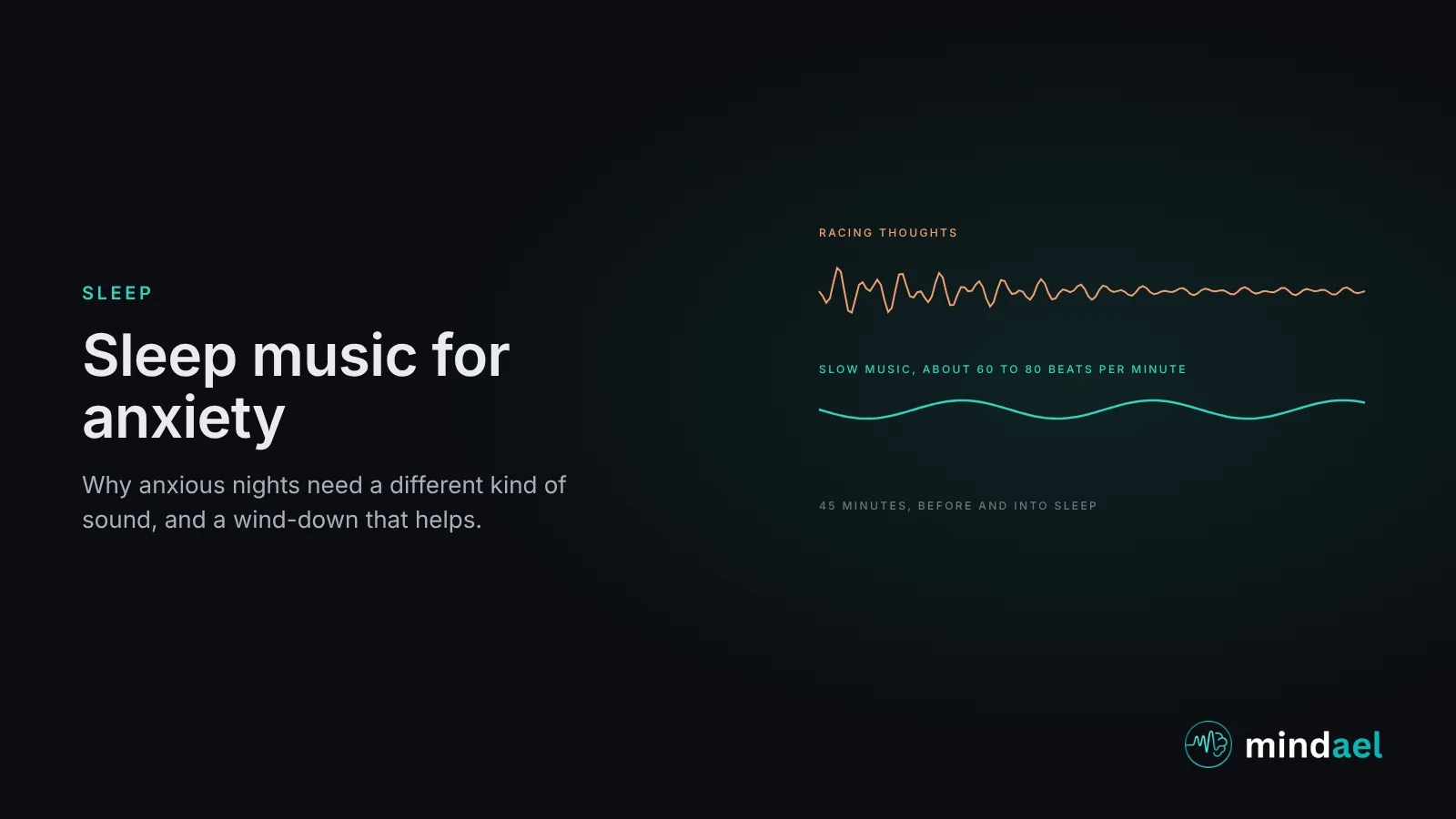
Sleep music for anxiety is a different job from ordinary sleep music. On anxious nights you are usually tired enough; the problem is a mind that keeps running through tomorrow, last week and everything in between. Music can help by giving that mind something calm to follow, but it works best with one more step before the lights go out. This article covers what the research shows and gives a simple routine. We make Mindael, a sound app many people use on restless nights, free to download on the App Store.
Why anxious nights are different
During the day, work, people and noise keep worries in the background. In a dark, quiet bedroom they move to the front. The body may be ready to sleep while the mind stays alert, planning and checking. That is why lying still in silence often makes it worse: it gives the worries the whole stage.
What music does
Music helps with both halves of the problem. For sleep, a Cochrane review of 13 trials found that listening to music likely improves how adults with insomnia symptoms rate their sleep (Jespersen et al., 2022). For stress, meta-analyses found music lowered both physical signs of stress, such as heart rate, and how stressed people felt (de Witte et al., 2020).
People who use music to sleep say the same in their own words. In a survey, their reasons included relaxation, blocking out noise and, importantly for anxious nights, quieting their thoughts (Trahan et al., 2018). Our calm music for sleep article covers what the tracks people choose have in common.
The step before the music
Music works better when the worries have somewhere else to go. In a sleep lab study, people who spent five minutes writing a specific to-do list for the coming days fell asleep faster than people who wrote about tasks they had already finished (Scullin et al., 2018). Writing the list tells the mind it does not have to hold everything until morning.
What to play
- Slow and soft. Music that feels slower than your breathing.
- No lyrics. Words give a busy mind something to grab.
- No surprises. Avoid tracks that build, drop or change suddenly.
- Something you find calm. Your own taste matters more than a label.
- Low volume. Just loud enough to follow, with the phone away from the pillow.
A 30 minute anxious-night routine
- Write tomorrow’s list (5 minutes). Specific tasks, on paper, by the bed.
- Lights low, music on (30 to 45 minutes). Slow, wordless, quiet.
- Breathe with it. In for four, out for six, for the first few minutes. Our calm breathing guide has more.
- Let a steady sound take over. When the music ends, rain or brown noise through the night means there is no sudden silence if you wake.
- If you are still awake after 20 minutes, get up for a few minutes and come back. Our can’t sleep at night guide covers what to do then.
The short version
Anxious nights are a busy mind in a tired body. Write tomorrow’s list, then play 30 to 45 minutes of slow, soft, wordless music at a low volume, breathe slowly with it, and let a steady sound carry the rest of the night. If anxiety keeps you awake most nights, talk to a doctor. For soft drones, rain and brown noise with a timer that fades, Mindael is free to download on the App Store, and our anxiety sounds guide has more.
Something kind to listen to at 1 a.m.
Mindael has soft drones made in our studio, rain and ocean recorded without loops and brown noise generated to spec, two at a time, with a timer that fades. Free to download, no account, works offline. Something calm to follow while you fall asleep, and something steady for the rest of the night.
- Soft drones, rain, ocean and brown noise
- Two sounds at once, a timer that fades
- Free to download, no account, works offline
 Free · No account needed · Works offline
Frequently asked questions
Does music help with anxiety at night?
It can. Music lowered physical and felt stress in meta-analyses, and a Cochrane review found music likely improves sleep for adults with insomnia symptoms. People who use it say it relaxes them, blocks noise and quiets their thoughts.
What is the best sleep music for anxiety?
Slow, soft, steady music without lyrics or sudden changes, the kind you find calm, not just music labelled for sleep. Instrumental piano, ambient drones and acoustic pieces are common choices.
Are sleep sounds better than music for anxiety?
They do different jobs. Music gives an anxious mind something pleasant to follow; a steady sound like rain or brown noise covers noises through the night. Many people use music to fall asleep and a steady sound after.
How long should I play sleep music?
Thirty to forty-five minutes is enough for most people to fall asleep. If you wake in the night, a steady sound that keeps playing works better than music that stops.
Why does my anxiety get worse at night?
With the day's distractions gone, worries have the stage. Lying in a dark, quiet room gives the mind nothing else to do. Writing tomorrow's tasks down before bed and giving attention a calm sound to follow both help.
When should I see a doctor about anxiety and sleep?
If anxiety keeps you awake most nights for weeks, affects your day, or comes with panic attacks, talk to a doctor. Insomnia and anxiety both have effective treatments.
Sources
- Jespersen KV, et al. Music for insomnia in adults. Cochrane Database of Systematic Reviews, 2022.
- de Witte M, et al. Effects of music interventions on stress-related outcomes: a systematic review and two meta-analyses. Health Psychology Review, 2020.
- Trahan T, Durrant SJ, Müllensiefen D, Williamson VJ. The music that helps people sleep and the reasons they believe it works: a mixed methods analysis of online survey reports. PLOS ONE, 2018.
- Scullin MK, Krueger ML, Ballard HK, Pruett N, Bliwise DL. The effects of bedtime writing on difficulty falling asleep: a polysomnographic study comparing to-do lists and completed activity lists. Journal of Experimental Psychology: General, 2018.
This article is for general information and is not medical advice. Music is a helpful tool, not a treatment for anxiety disorders or insomnia. If anxiety keeps you awake most nights, or comes with panic attacks, please talk to a doctor.
This article is part of our anxiety, stress and panic guide. Hear the sounds in this article in the Mindael sound library, or see our app comparison checklists.