

Stress Relief Music: Music Therapy, Listening at Home, and Five Tactics That Make It Work
Music lowers stress, and there are two ways to use it. Music therapy, run by a trained therapist, had a medium-to-large effect on stress-related outcomes in a meta-analysis of 47 studies. Music on your own also helps: across more than a hundred studies, music interventions lowered physical and mental signs of stress. How you use it matters. In daily life, music lowered stress most when people chose it on purpose to relax. Singing and listening seem to do different things: in a choir study, singing lifted mood while listening was linked with lower cortisol. So pick calm music yourself, give it ten to twenty minutes as a real break, slow your breathing to it, hum or sing along when you can, and use the same music each time so it becomes a cue. For lasting or severe stress, a music therapist or doctor is the right next step.
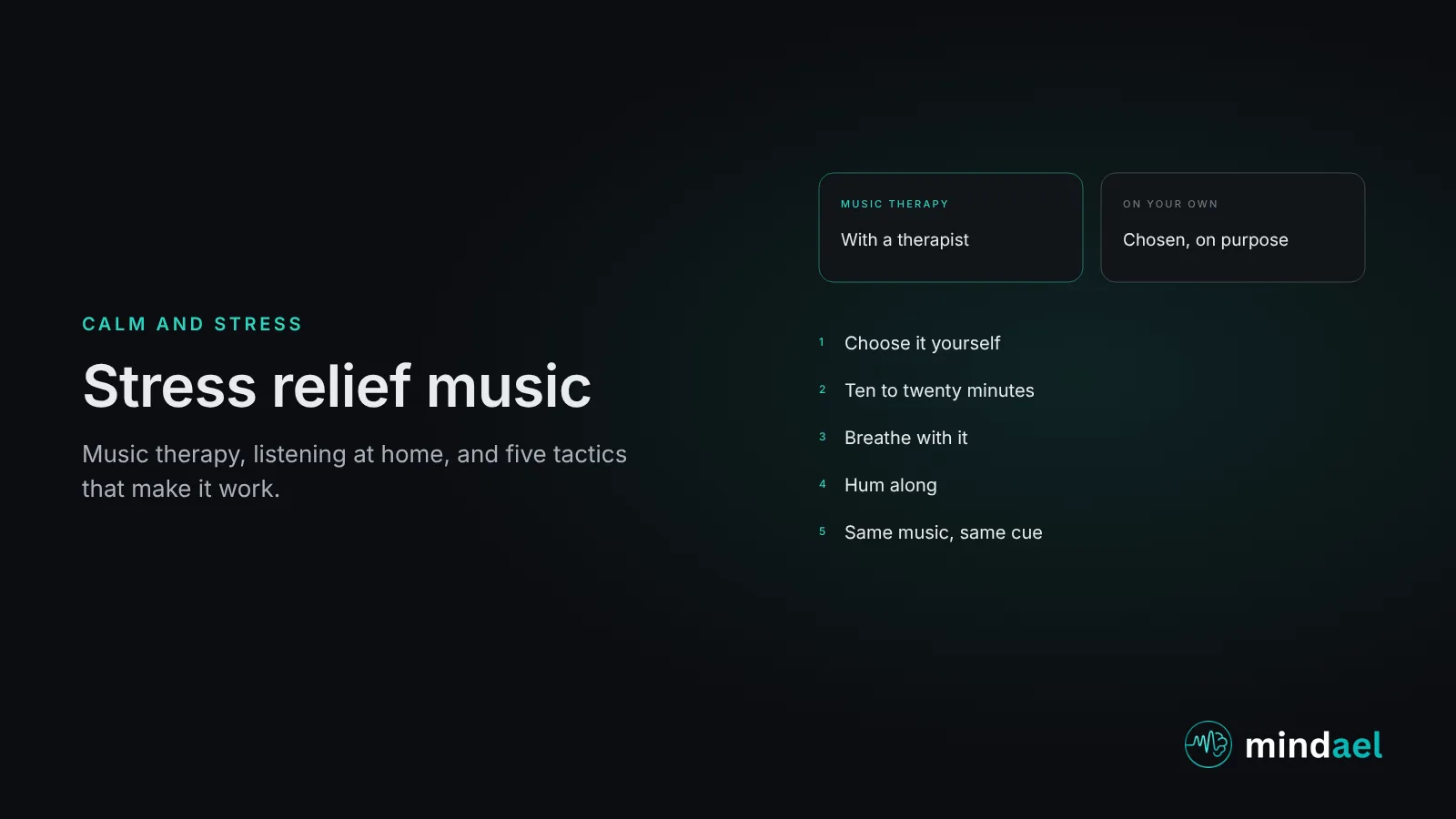
Stress relief music works, and the research now says something more useful than that: how you use it changes how much it helps. There is music therapy, run by a trained therapist, and there is music you put on yourself, and they are not the same. This article covers what each does and five tactics that make everyday listening work harder. We make Mindael, a sound app many people use for a calm break in the day, free to download on the App Store.
Music therapy and music on your own
Music therapy means sessions with a trained music therapist, who may use listening, singing, playing or writing music toward a goal. A meta-analysis of 47 studies found it had a medium-to-large effect on stress-related outcomes (de Witte et al., 2022).
Music on your own helps too, more modestly. Across more than a hundred studies, music interventions lowered both physical signs of stress, such as heart rate and stress hormones, and how stressed people felt (de Witte et al., 2020). Our relax music for stress article goes into what to play and for how long.
Five tactics that make it work
1. Choose it yourself, on purpose. In a study that followed people through ordinary days, music lowered stress most when they chose it specifically in order to relax (Linnemann et al., 2015). Background music while you scroll is not the same as deciding this is the break.
2. Give it ten to twenty minutes. Sit or lie down, phone face down, and let one or a few calm tracks play through. Slow, steady music without sudden changes works for most people; leave out lyrics if your mind is busy.
3. Breathe with it. Let the out-breath be longer than the in-breath, in for four, out for six. Slow breathing on its own is linked with more activity in the calming branch of the nervous system (Zaccaro et al., 2018), and music gives it a pace. Our calm breathing guide has more patterns.
4. Hum or sing along. In a choir study, singing lifted people’s mood, while listening was linked with lower cortisol (Kreutz et al., 2004). Humming quietly along to a calm song gives you a little of both.
5. Use the same music as a cue. Same playlist, same sound underneath, same time of day. Over a few weeks, pressing play starts to signal the break on its own. Many people put rain or ocean waves under the music for a steadier bed of sound.
Other stress relief tactics that pair with music
A short walk with music, a few minutes of stretching, or a body scan lying down all combine well with a calm track. Our how to calm down guide covers what to do in a tense moment, and the anxiety sounds guide has the sounds people use most.
The short version
Music lowers stress, music therapy most of all. On your own, choose calm music on purpose, give it ten to twenty minutes, breathe slowly with it, hum along, and use the same music each time as a cue. For a steady sound to put under your music, Mindael is free to download on the App Store.

Twenty minutes that are yours.
Mindael has rain and ocean recorded without loops and soft drones and tones made in our studio, two at a time, so you can put a steady sound under the music you love. Free to download, no account, works offline. The same sound each time, until pressing play is the cue to let go.
- Rain, ocean, soft drones and tones
- Two sounds at once, the same cue every time
- Free to download, no account, works offline
 Free · No account needed · Works offline
Frequently asked questions
Does music really relieve stress?
Yes, on average. Meta-analyses found music interventions lowered physical and mental signs of stress, and music therapy with a trained therapist had a medium-to-large effect. It is not a cure for chronic stress, but it is a real, low-cost tool.
What is music therapy for stress relief?
Sessions with a trained music therapist who uses listening, singing, playing or writing music toward a goal, such as lowering stress. It is different from listening on your own, and in studies its effects were larger.
What kind of song is best for stress relief?
One you like and find calm: slow, steady, without sudden changes, often without lyrics if you need to think. Your own choice matters more than any list, because music lowered stress most when people picked it themselves to relax.
How long should I listen to music for stress relief?
Ten to twenty minutes as a real break is a good start. Many studies used sessions of about that length. Background music while you keep working is not the same.
Is singing better than listening for stress?
They seem to do different things. In a choir study, singing lifted mood and listening was linked with lower cortisol. Humming or singing along to calm music combines the two.
Can music replace therapy for anxiety or stress?
No. It is a helpful daily tool. If stress or anxiety lasts, affects sleep or work, or feels unmanageable, please talk to a doctor or therapist.
Sources
- de Witte M, Pinho AS, Stams GJ, Moonen X, Bos AER, van Hooren S. Music therapy for stress reduction: a systematic review and meta-analysis. Health Psychology Review, 2022.
- de Witte M, et al. Effects of music interventions on stress-related outcomes: a systematic review and two meta-analyses. Health Psychology Review, 2020.
- Linnemann A, et al. Music listening as a means of stress reduction in daily life. Psychoneuroendocrinology, 2015.
- Kreutz G, Bongard S, Rohrmann S, Hodapp V, Grebe D. Effects of choir singing or listening on secretory immunoglobulin A, cortisol, and emotional state. Journal of Behavioral Medicine, 2004.
- Zaccaro A, et al. How breath-control can change your life: a systematic review on psycho-physiological correlates of slow breathing. Frontiers in Human Neuroscience, 2018.
This article is for general information and is not medical advice. Music is a helpful tool for everyday stress, not a substitute for professional care. If stress or anxiety lasts, disrupts sleep or work, or feels overwhelming, please talk to a doctor, therapist or music therapist.
This article is part of our anxiety, stress and panic guide. Hear the sounds in this article in the Mindael sound library, or see our app comparison checklists.