
Yoga Nidra Sleep Meditation: A Bedtime Body Scan Script and What the Research Supports
Yoga nidra for sleep is the same guided body scan people use for daytime rest, with one change: there is no return at the end, so you let yourself drift off. The script takes about 15 minutes lying in bed: settle, a slow breath with a long exhale, a body scan from the feet up, a short count of breaths, and then nothing. The research on yoga nidra itself is still early, with small studies and case reports. The stronger evidence comes from mindfulness meditation, which includes the body scan: a meta-analysis of 18 randomised trials found it improved sleep quality compared with nonspecific controls, and in a trial with older adults who slept poorly, a mindfulness course improved sleep more than sleep hygiene education. Use it most nights at the same time, with a steady, low sound that keeps playing after you fall asleep.
Yoga nidra sleep meditation is a body scan done in bed, at the end of the day, with no step to wake you up afterwards. It is the night-time version of the practice many people use for a midday reset, and its job is different: not to rest and return, but to let the body settle until sleep arrives. This article gives a 15 minute bedtime script and is honest about what the research supports. We make Mindael, a sound app with steady sounds for sleep, free to download on the App Store.
Daytime NSDR or bedtime nidra?
The steps are almost the same. In the day, NSDR ends with a return: deeper breaths, moving the fingers, sitting up. At night, you leave that out. Yoga nidra comes from a traditional practice of guided deep relaxation, and a review traced its modern uses, including sleep (Pandi-Perumal et al., 2022). Our body scan guide explains how the practices relate.
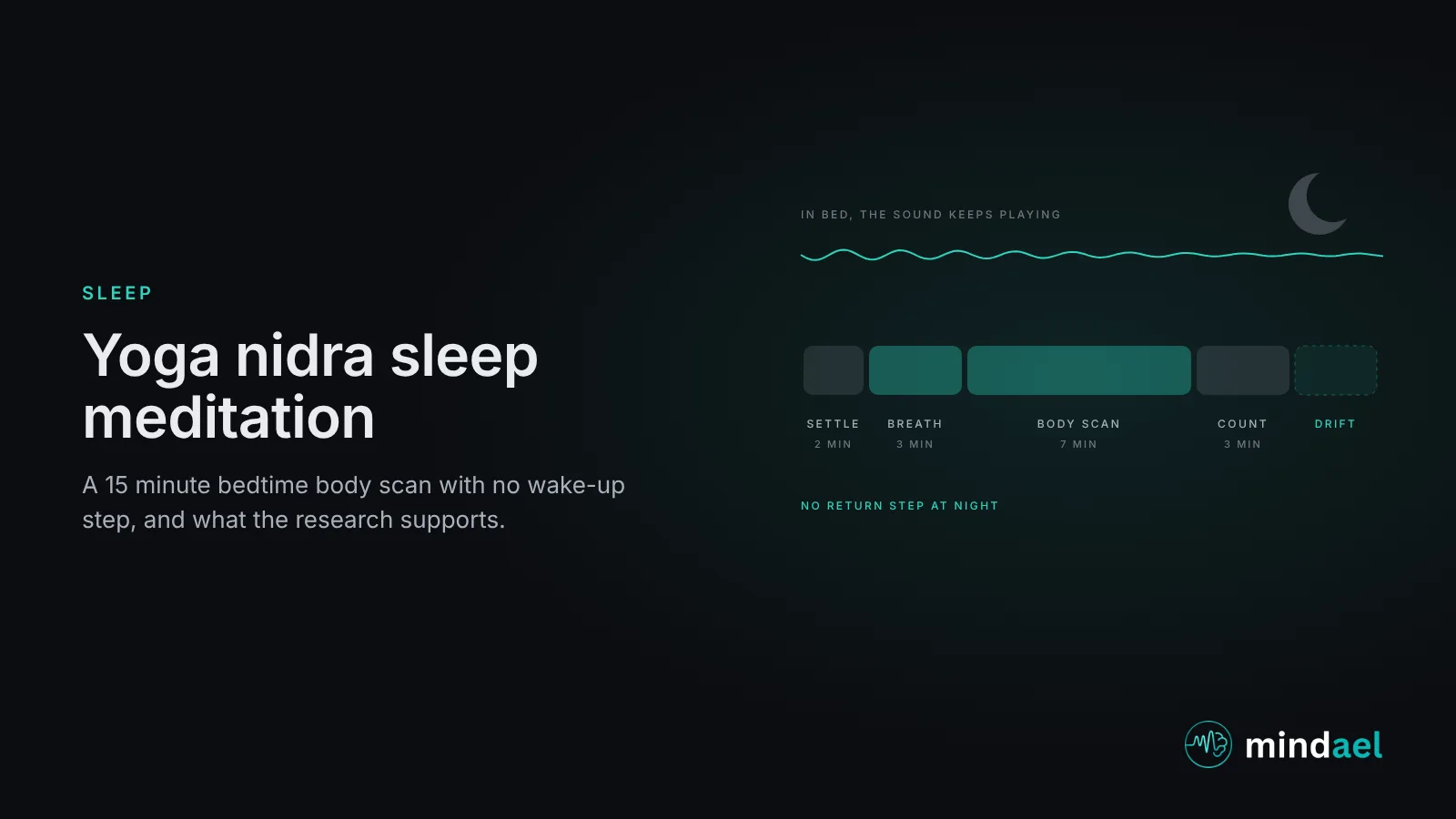
A 15 minute bedtime script
- Settle (2 minutes). Lights off, on your back or side, whatever you sleep in. Let the mattress take your weight. Start a steady sound at a low volume.
- Slow the breath (3 minutes). In through the nose for four, out for six. Let each out-breath be longer and softer than the last.
- Scan the body (7 minutes). Toes, soles, ankles, calves, knees, thighs, hips, belly, chest, hands, arms, shoulders, neck, jaw, eyes, forehead. At each place, notice it and let it get heavy. If your mind wanders, come back to the last place you remember.
- Count the breaths (3 minutes). Count each out-breath from ten down to one. If you lose count, start again at ten. There is no prize for reaching one.
- Drift. No return. Stay still and let the sound run.
If you are still awake, repeat the scan more slowly. Our deep breathing for sleep guide has more breath patterns, and meditation for sleep has a shorter version for busy minds.
What the research supports
Research on yoga nidra for sleep is early. A published case report described improved sleep in a person with chronic insomnia after practising it (Datta et al., 2017); a single case is encouraging, not proof. A small brain-imaging study found increased dopamine release during yoga nidra, which shows the state is different from simply lying still (Kjaer et al., 2002).
The stronger evidence comes from mindfulness meditation, which uses the body scan as a core exercise. A meta-analysis of 18 randomised trials found mindfulness meditation improved sleep quality compared with nonspecific active controls, while noting that more research is needed (Rusch et al., 2019). In a randomised trial with older adults who slept poorly, a six-week mindfulness course improved sleep quality more than a sleep hygiene education course (Black et al., 2015).
Making it work night after night
Same time, same sound, most nights. A steady sound such as rain, ocean waves or brown noise gives attention somewhere to land when the scan ends, and covers small noises in the house. Keep it low, around the level of a quiet conversation or softer, and let it keep playing or fade slowly rather than stop. If you lie awake for a long time, get up for a few minutes and come back; our can’t sleep at night guide covers what to do then.
The short version
Bedtime yoga nidra is a body scan with no wake-up step: settle, slow the breath, scan from the feet up, count down ten breaths, then drift. The evidence from mindfulness meditation is promising; yoga nidra itself needs more study. For rain, ocean and brown noise that keep playing after you fall asleep, Mindael is free to download on the App Store, and our sleep sounds guide has the full night setup.
Lie back. The sound keeps going.
Mindael has rain and ocean recorded without loops, brown noise generated to spec and a delta beat made in our studio, two at a time, with a timer that fades slowly. Free to download, no account, works offline. A steady sound for the scan, and for after it.
- Rain, ocean, brown noise and a delta beat
- Two sounds at once, a timer that fades
- Free to download, no account, works offline
 Free · No account needed · Works offline
Frequently asked questions
What is yoga nidra sleep meditation?
A guided practice lying down that moves attention slowly through the body while the breath slows. At bedtime it is done in bed, with no step to wake up at the end, so you can fall asleep during or after it.
Is a body scan meditation good for sleep?
It is one of the core parts of mindfulness meditation, and a meta-analysis of 18 randomised trials found mindfulness meditation improved sleep quality. Studies of the body scan alone for sleep are fewer, so treat it as promising rather than proven.
What is the difference between yoga nidra and NSDR?
NSDR is a modern, secular name for the core of yoga nidra, usually used in the day to rest while staying awake. Bedtime yoga nidra uses the same steps but leaves out the return, so sleep can come.
How long should yoga nidra for sleep be?
Ten to twenty minutes. Fifteen is a good start. If you are still awake at the end, keep breathing slowly with the sound and let it run.
Is it okay to fall asleep during yoga nidra?
At bedtime, yes, that is the point. In the day, if you keep falling asleep during NSDR, you may need more sleep at night.
What sound should I use for yoga nidra at night?
A guided voice while you learn it, then a steady, low sound such as rain, ocean or brown noise, set to keep playing or to fade slowly. Avoid music with sudden changes.
Sources
- Rusch HL, Rosario M, Levison LM, et al. The effect of mindfulness meditation on sleep quality: a systematic review and meta-analysis of randomized controlled trials. Annals of the New York Academy of Sciences, 2019.
- Black DS, O'Reilly GA, Olmstead R, Breen EC, Irwin MR. Mindfulness meditation and improvement in sleep quality and daytime impairment among older adults with sleep disturbances: a randomized clinical trial. JAMA Internal Medicine, 2015.
- Pandi-Perumal SR, et al. The origin and clinical relevance of yoga nidra. Sleep and Vigilance, 2022.
- Datta K, Tripathi M, Mallick HN. Yoga nidra: an innovative approach for management of chronic insomnia, a case report. Sleep Science and Practice, 2017.
- Kjaer TW, et al. Increased dopamine tone during meditation-induced change of consciousness. Cognitive Brain Research, 2002.
This article is for general information and is not medical advice. If you regularly take more than 30 minutes to fall asleep, wake often, or feel unrefreshed most days, please talk to a doctor; ongoing insomnia has effective treatments.
This article is part of our body scan, nsdr and yoga nidra guide. Hear the sounds in this article in the Mindael sound library, or see our app comparison checklists.