

NSDR Meditation: What Non-Sleep Deep Rest Is, a 10 Minute Script, and What the Research Supports
NSDR, non-sleep deep rest, is a name for practices that put you in a deeply relaxed state while you stay awake: lying still, slow breathing and a guided scan of the body, much like yoga nidra. It is not a replacement for sleep, and the research on NSDR under that name is thin; the evidence comes from neighbouring practices. A brain-imaging study of yoga nidra found increased dopamine release during the practice. Slow breathing shifts the nervous system toward rest. Ten minutes of quiet rest after learning improved how much people remembered a week later, compared with a simple game. And a short nap of 5 to 15 minutes gave near-immediate benefits for alertness. Use NSDR for 10 to 20 minutes in the early afternoon or after study, lying down with a steady sound, when a nap would leave you groggy or there is no time for one.
NSDR meditation, short for non-sleep deep rest, is a way to rest deeply in the middle of the day without falling asleep. You lie down, slow your breathing and move your attention slowly through your body for 10 to 20 minutes. It has become popular as a midday reset, and it is a modern name for something much older. This article explains what it is, gives a simple 10 minute script, and is honest about what the research supports. We make Mindael, a sound app with steady sounds for rest, free to download on the App Store.
What NSDR is, and where it comes from
NSDR is a secular label for the core of yoga nidra, a traditional practice of guided deep relaxation lying down. Yoga nidra usually adds an intention and visualisations; NSDR keeps the essentials: stillness, slow breathing and a body scan. A review traced yoga nidra from its traditional roots to its modern clinical uses, including sleep (Pandi-Perumal et al., 2022). Our body scan meditation guide covers how the three practices relate.
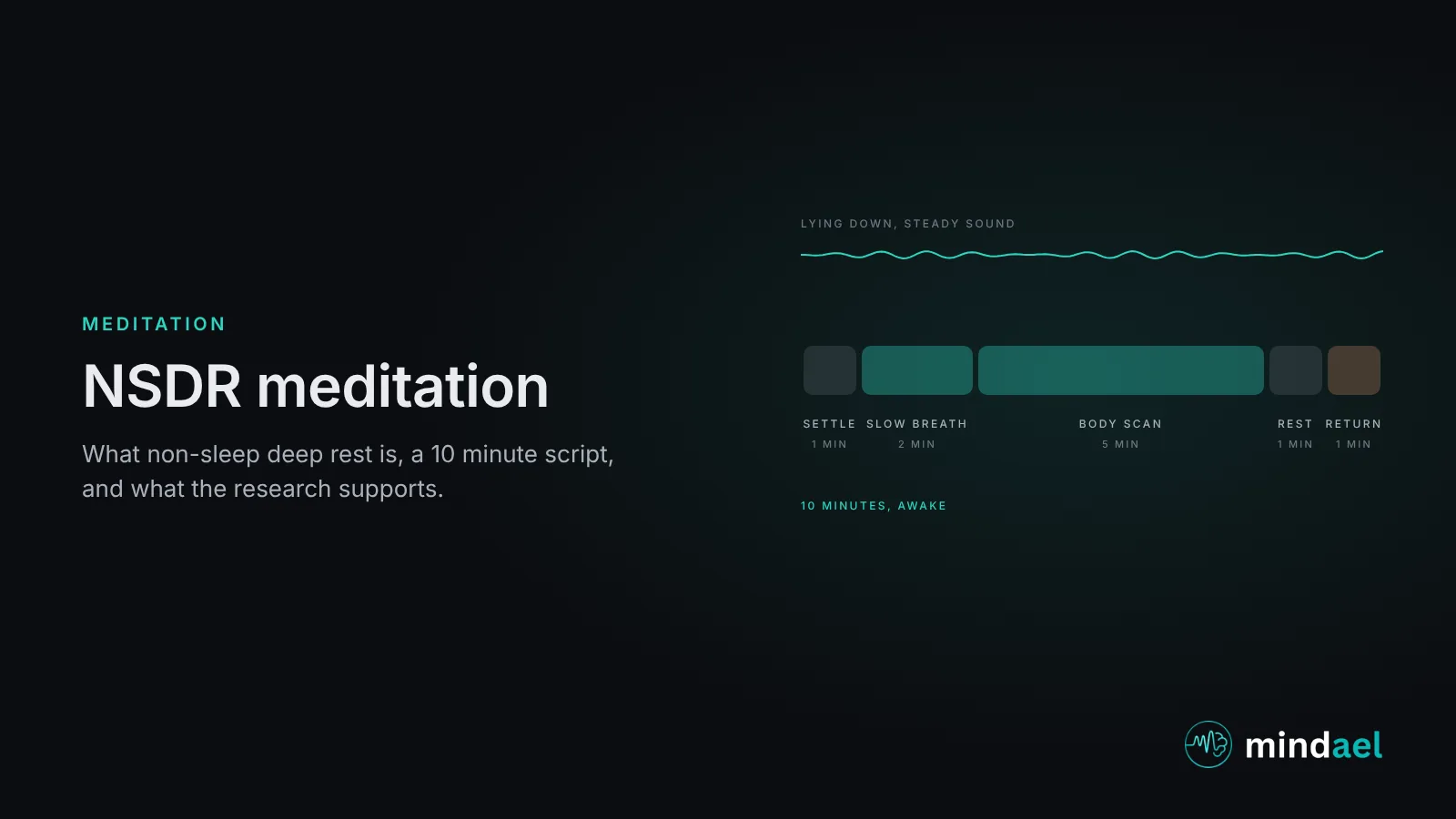
A 10 minute NSDR script
- Settle (1 minute). Lie on your back, arms by your sides, eyes closed. Let the floor take your weight.
- Slow the breath (2 minutes). In through the nose for four, out for six. Let the breath out be long and easy.
- Scan the body (5 minutes). Move attention slowly from the toes to the feet, calves, knees, thighs, hips, belly, chest, hands, arms, shoulders, neck and face. At each place, notice and let it soften. No need to change anything.
- Rest (1 minute). Feel the whole body at once, heavy and still.
- Return (1 minute). Deepen the breath, move your fingers and toes, open your eyes, sit up slowly.
For 20 minutes, slow every step down. A steady, low sound such as brown noise, rain or ocean waves covers the room and gives attention somewhere to rest.
What the research supports
The research on NSDR under that name is thin, so the honest picture comes from its parts.
Deep relaxation changes the brain. In a brain-imaging study, experienced practitioners showed increased dopamine release during yoga nidra compared with ordinary rest (Kjaer et al., 2002). It was a small study, but it shows the state is different from just lying still.
Slow breathing calms the body. A review of slow-breathing studies linked it with more activity in the calming branch of the nervous system and less anxiety (Zaccaro et al., 2018).
Quiet rest helps memory. People who rested quietly with eyes closed for 10 minutes after hearing a story remembered more of it a week later than people who played a simple game instead (Dewar et al., 2012). NSDR after a study block is a reasonable use.
NSDR or a nap?
A short nap of 5 to 15 minutes gives an almost immediate boost in alertness that lasts one to three hours; naps longer than 30 minutes can leave you groggy for a while before they help (Lovato and Lack, 2010). NSDR keeps you awake, so there is no grogginess, and it works without a bed. If you can nap, our how to take a nap guide has the timing. If you cannot, or have a meeting in twenty minutes, use NSDR. For the bedtime version with no wake-up step, see our yoga nidra sleep meditation guide.
NSDR does not replace sleep. If you need it every afternoon just to function, look at your nights first.
The short version
NSDR is deep, guided rest while awake: lie down, slow the breath, scan the body, rest, return. The evidence comes from yoga nidra, slow breathing and quiet rest, and it is promising rather than proven. Use 10 to 20 minutes in the early afternoon or after studying, with a steady sound. For rain, ocean and brown noise with a timer that fades, Mindael is free to download on the App Store, and our meditation guide has more practices.
Lie down. Let the sound hold the room.
Mindael has rain and ocean recorded without loops, brown noise generated to spec and soft drones made in our studio, two at a time, with a timer that fades. Free to download, no account, works offline. A steady sound for ten quiet minutes in the middle of the day.
- Rain, ocean, brown noise and soft drones
- Two sounds at once, a timer that fades
- Free to download, no account, works offline
 Free · No account needed · Works offline
Frequently asked questions
What is NSDR meditation?
NSDR stands for non-sleep deep rest. It is a guided practice, usually 10 to 20 minutes lying down, that combines slow breathing and a body scan to bring you into deep relaxation while staying awake. It is closely related to yoga nidra.
Is NSDR the same as yoga nidra?
Close relatives. Yoga nidra is the older, traditional practice and often includes an intention and visualisations. NSDR is a modern, secular name for the core of it: lying still, slowing the breath and moving attention through the body.
Can NSDR replace sleep?
No. It can help you feel more rested and alert in the afternoon, but nothing replaces a full night's sleep. If you need NSDR every day to function, look at your nights first.
Is NSDR better than a nap?
They do different things. A short nap of 5 to 15 minutes gives a quick boost in alertness. A longer nap can leave you groggy for a while. NSDR keeps you awake, so there is no grogginess, and it suits people who cannot nap or have no bed nearby.
When is the best time to do NSDR?
Early afternoon, when energy dips, after a block of studying or learning, or in the evening to wind down. Avoid doing it right before an important task if you tend to drift into sleep.
What should I listen to during NSDR?
A guided voice if you are new to it, or a steady, low sound such as rain, ocean or brown noise once you know the steps. Keep it quiet and without sudden changes.
Sources
- Kjaer TW, et al. Increased dopamine tone during meditation-induced change of consciousness. Cognitive Brain Research, 2002.
- Pandi-Perumal SR, et al. The origin and clinical relevance of yoga nidra. Sleep and Vigilance, 2022.
- Dewar M, Alber J, Butler C, Cowan N, Della Sala S. Brief wakeful resting boosts new memories over the long term. Psychological Science, 2012.
- Lovato N, Lack L. The effects of napping on cognitive functioning. Progress in Brain Research, 2010.
- Zaccaro A, et al. How breath-control can change your life: a systematic review on psycho-physiological correlates of slow breathing. Frontiers in Human Neuroscience, 2018.
This article is for general information and is not medical advice. NSDR is not a replacement for sleep. If you feel exhausted most days despite a full night in bed, or fall asleep during the day without meaning to, please talk to a doctor.
This article is part of our body scan, nsdr and yoga nidra guide. Hear the sounds in this article in the Mindael sound library, or see our app comparison checklists.