

Breathwork: What It Is, How to Do It, Slow vs Fast Styles, and What the Research Shows
Breathwork is any practice that changes your breathing on purpose to change how you feel. It covers two quite different families. Slow breathwork, at around six breaths a minute with a longer out-breath, calms the body: a systematic review linked it to higher heart rate variability and lower anxiety. Fast or intense breathwork, with rapid deep breaths and breath holds, energises and can bring strong sensations, and carries more risk. A meta-analysis of randomised trials found breathwork lowered stress, anxiety and depressive symptoms modestly compared with no treatment. In a month-long trial, five minutes a day of cyclic sighing, a double inhale and long exhale, improved mood and lowered breathing rate slightly more than mindfulness meditation. To start, sit, breathe in through the nose for four and out for six, for five minutes a day. Avoid intense breathwork if you are pregnant, have epilepsy, heart or lung conditions or a history of panic, and never practise it in water or while driving.
Breathwork is any practice that changes your breathing on purpose to change how you feel. The word covers a wide range, from a gentle four-in, six-out breath at your desk to intense sessions of rapid breathing and long holds. This guide explains the two main families, what the research shows, a five-minute practice to start with, and who should be careful. We make Mindael, a sound app with guided breathing, free to download on the App Store.
Two families of breathwork
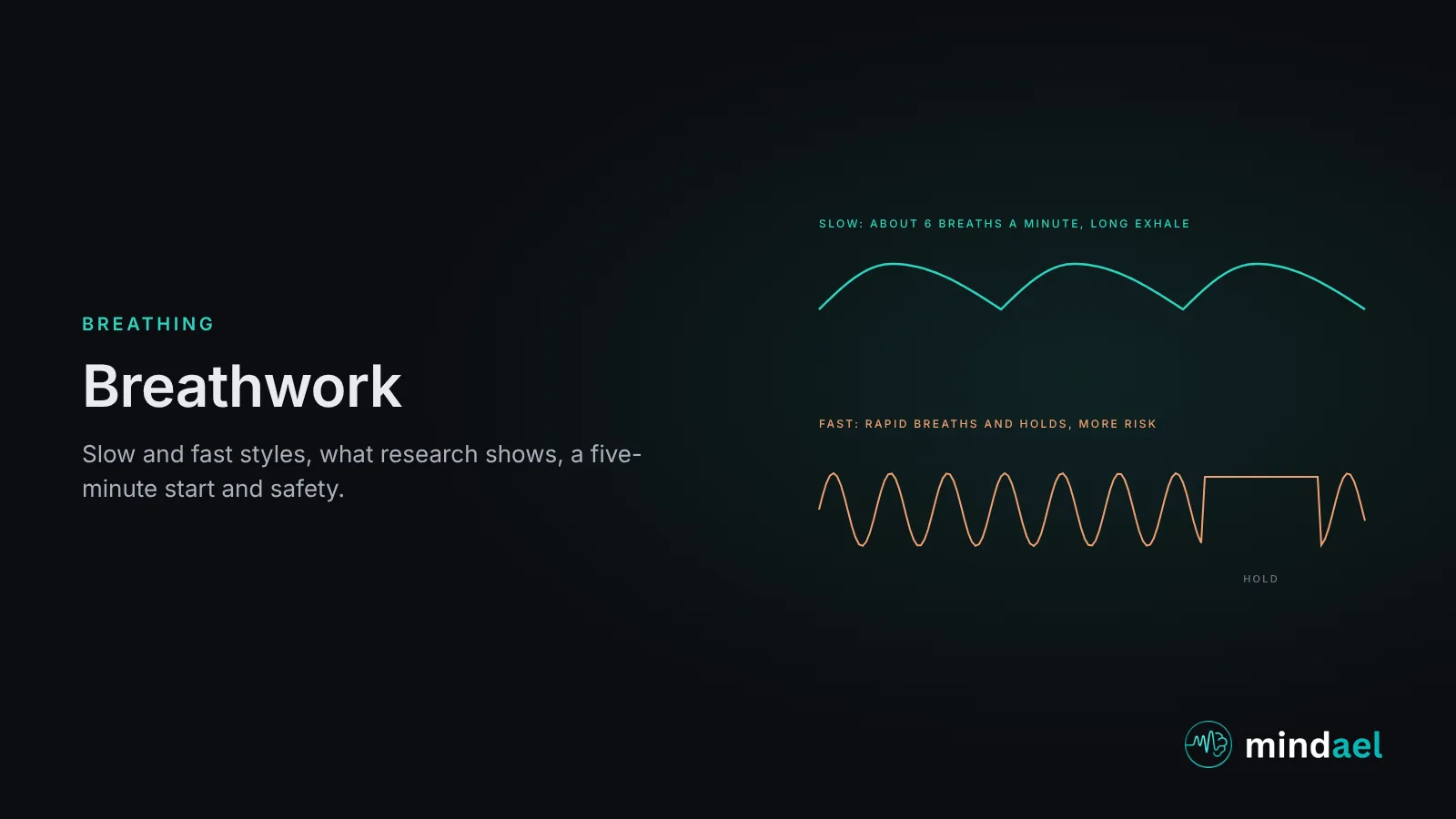
Slow breathwork brings breathing down to around six breaths a minute, usually with a longer out-breath than in-breath. It calms the body. A systematic review linked slow breathing to higher heart rate variability, more relaxed brain activity and lower anxiety (Zaccaro et al., 2018). Box breathing, calm breathing, 4-7-8 and belly breathing all belong here.
Fast or intense breathwork uses rapid, deep breaths, often followed by breath holds. It energises, and it can bring tingling, light-headedness, cramping in the hands and strong emotions, mainly because fast breathing lowers carbon dioxide in the blood. Some people find it powerful; it also carries more risk and is best learned with an experienced teacher.
What the research shows
A meta-analysis of randomised trials found that breathwork lowered stress compared with no treatment, with similar modest improvements in anxiety and depressive symptoms (Fincham et al., 2023). The effects were modest, and the strongest evidence is for slow, gentle styles.
A month-long trial compared five minutes a day of cyclic sighing, box breathing, cyclic hyperventilation and mindfulness meditation. All improved mood and anxiety; cyclic sighing, a double inhale through the nose and a long exhale through the mouth, did slightly better than mindfulness meditation for mood and lowered resting breathing rate the most (Balban et al., 2023).
How to do breathwork: a five-minute start
- Sit upright with your shoulders relaxed and one hand on your belly.
- Breathe in through the nose for four, letting the belly rise first.
- Breathe out slowly for six, through the nose or pursed lips.
- Repeat for five minutes, about six breaths a minute.
- Try cyclic sighing once this feels easy: two short inhales through the nose, then a long, slow exhale through the mouth.
A steady sound such as ocean waves gives the breath a rhythm to follow. For an evening version, see deep breathing for sleep, and for a seated practice, the breathing meditation guide.
Safety
Slow breathing is safe for almost everyone. Intense breathwork is different. Avoid it if you are pregnant or have epilepsy, heart disease, high blood pressure, a lung condition or a history of panic attacks, and talk to a doctor first if unsure. Never practise breath holds in water, in the bath or while driving. Stop if you feel dizzy, numb or panicky, and breathe normally until it passes.
The short version
Breathwork means changing your breathing on purpose. Slow styles at around six breaths a minute calm the body and have the best evidence; fast styles energise but carry more risk. Start with five minutes a day of four in, six out, then try cyclic sighing. For guided breathing with a steady sound underneath, Mindael is free to download on the App Store, and our breathing guide has more patterns.
Something steady to breathe with.
Mindael guides 4-7-8 and slow six-a-minute breathing on screen, with rain, ocean or brown noise underneath so the count becomes a feeling. Free to download, no account, works offline.
- 4-7-8 and six-a-minute breathing on screen
- Rain, ocean or brown noise underneath
- Free to download, no account, works offline
 Free · No account needed · Works offline
Frequently asked questions
What is breathwork?
Any practice that changes your breathing on purpose to change how you feel. It includes slow, calming patterns like box breathing and cyclic sighing, and faster, more intense styles with rapid breaths and breath holds.
How do you do breathwork?
Start simple: sit upright, breathe in through the nose for a count of four and out for six, for five minutes. Keep it gentle. Once that feels easy, try box breathing or cyclic sighing.
Does breathwork really work?
For stress, modestly and reliably. A meta-analysis of randomised trials found breathwork lowered stress, anxiety and depressive symptoms compared with no treatment, and slow breathing is linked to higher heart rate variability and calmer mood.
What is the difference between slow and fast breathwork?
Slow breathwork, about six breaths a minute with a long exhale, calms the body. Fast breathwork uses rapid deep breaths and holds; it energises and can cause tingling, light-headedness and strong emotions, and carries more risk.
Is breathwork safe?
Slow breathing is safe for almost everyone. Intense breathwork is not for people who are pregnant or have epilepsy, heart or lung conditions, high blood pressure or a history of panic. Never practise breath holds in water or while driving.
Can I learn breathwork from videos?
Yes, many people start with videos or apps. Choose slow, gentle sessions first, and stop if you feel dizzy, numb or panicky.
Sources
- Zaccaro A, et al. How breath-control can change your life: a systematic review on psycho-physiological correlates of slow breathing. Frontiers in Human Neuroscience, 2018.
- Fincham GW, Strauss C, Montero-Marin J, Cavanagh K. Effect of breathwork on stress and mental health: a meta-analysis of randomised-controlled trials. Scientific Reports, 2023.
- Balban MY, et al. Brief structured respiration practices enhance mood and reduce physiological arousal. Cell Reports Medicine, 2023.
This article is for general information and is not medical advice. Stop any breathing practice that makes you dizzy, numb or panicky. If you are pregnant or have a heart, lung or seizure condition, talk to a doctor before trying intense breathwork.
This article is part of our breathing guide. Hear the sounds in this article in the Mindael sound library, or see our app comparison checklists.