

Should You Listen to Music While Studying? What Helps, What Hurts, and the Best Music to Pick
Listening to music while studying helps in some ways and hurts in others. The cost comes mainly from words: in a reading study, comprehension was best in quiet and with instrumental music, and worst with music that had lyrics, even when people liked the songs. A meta-analysis of background music found small harms for reading and memory tasks overall. The benefit comes from mood: music you enjoy can lift energy and mood before or between study sessions, which is why it can help you start and keep going. So the best music to listen to while studying is instrumental, familiar, steady and fairly quiet, saved for routine tasks, with silence or a steady noise for hard reading and memorising. Use music with lyrics in breaks, not during them.
Listening to music while studying is one of the most common habits and one of the most argued about. The research gives a clear answer once you separate two things: what music does to your mood, and what words in music do to reading and memory. This guide covers both, the best music to listen to while studying, and when silence wins. We make Mindael, a sound app with words-free focus sounds, free to download on the App Store.
What hurts: words
The biggest cost comes from lyrics. Your brain processes speech automatically, so words in a song compete with the words on the page. In a study of reading comprehension, people scored best in quiet and with instrumental music, and worst with music that had lyrics. Liking the songs did not help: favourite lyrical music hurt comprehension as much as disliked music (Perham and Currie, 2014).
A meta-analysis of background music in adults found the overall effect was close to zero, but with small harms for reading and memory tasks and small benefits for mood and some physical tasks (Kämpfe et al., 2011). Music is not neutral during study; it depends on what you are doing.
What helps: mood
The upside of music is mostly emotional. The famous “Mozart effect”, the claim that classical music makes you smarter, turned out to be about mood: music that lifted people’s mood and energy helped them on a spatial task, and the effect disappeared once mood and arousal were accounted for (Thompson et al., 2001). That is still useful. If music helps you sit down and start, or keeps a long session from feeling grim, it is doing a job.
The best music to listen to while studying
- Instrumental. No vocals, or vocals in a language you do not understand at a very low level.
- Familiar. Music you know well pulls less attention than something new.
- Steady. No big jumps in volume or tempo. Ambient, soft piano, slow classical and lo-fi without vocals all fit.
- Quiet. Low enough that you could ignore it.
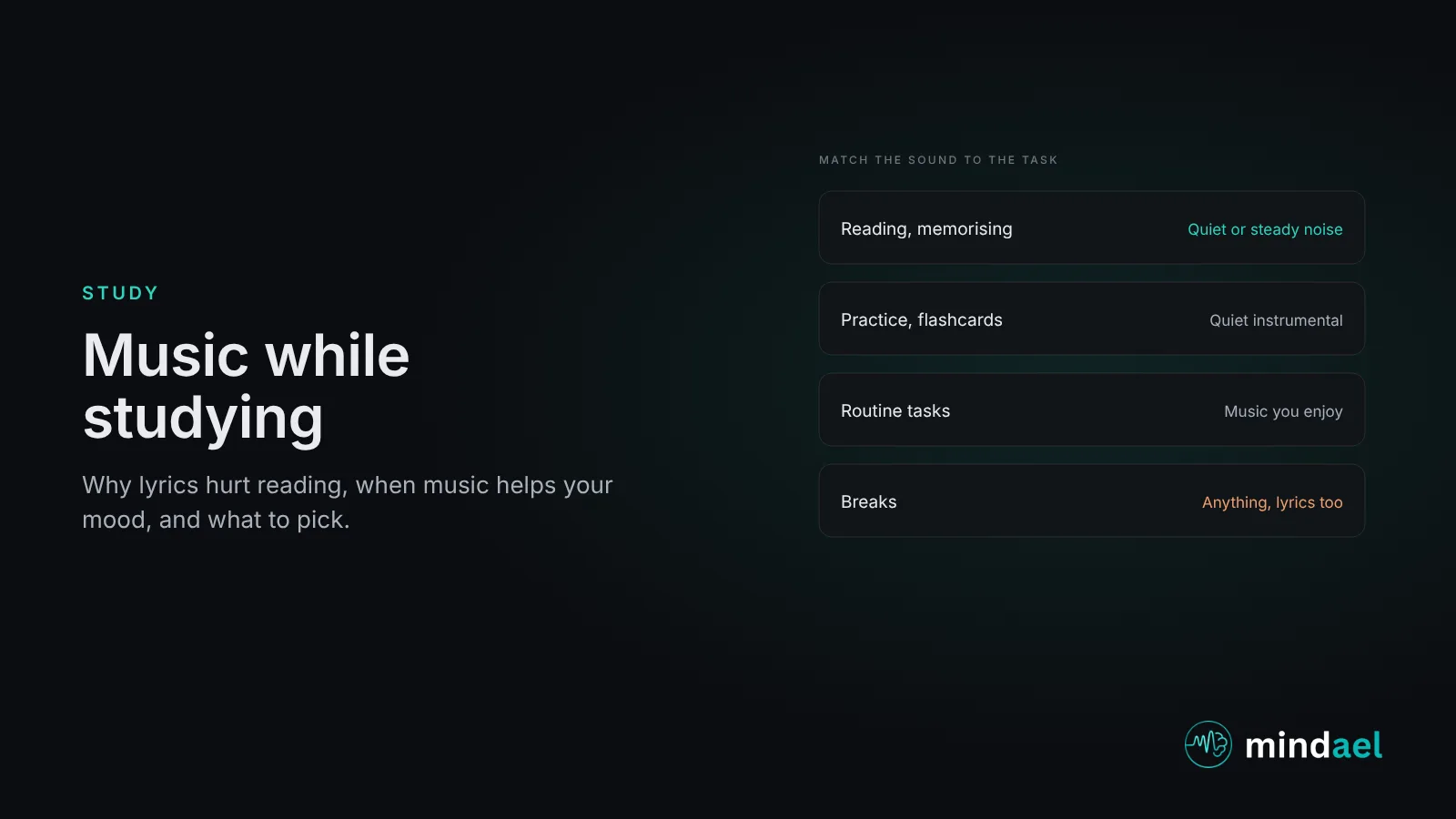
Match the sound to the task
| Task | Best sound |
|---|---|
| Reading, memorising, writing | Quiet, or a steady noise such as brown noise |
| Maths practice, notes, flashcards you know | Quiet instrumental music |
| Tidying notes, routine tasks | Instrumental music you enjoy |
| Breaks | Anything you like, lyrics included |
If the room is noisy, a steady noise masks voices without adding words of its own; our best noise for studying guide compares brown, pink and white. Pair it with a study timer so the music or noise starts and ends with each block.
The short version
Lyrics hurt reading and memory, even in songs you love. Music helps mostly by lifting your mood, which matters for starting and staying with it. Choose instrumental, familiar, steady, quiet music for routine work, silence or steady noise for hard reading, and save favourite songs for breaks. For words-free sound under a study block, Mindael is free to download on the App Store, and our study sounds guide has more.
Words-free sound for the study block.
Mindael has brown and pink noise generated to spec, rain recorded without loops, soft drones and beta beats made in our studio, two at a time, with no lyrics to compete with your reading. Free to download, no account, works offline.
- Brown noise, rain, drones and beta beats
- No vocals, nothing to compete with your reading
- Free to download, no account, works offline
 Free · No account needed · Works offline
Frequently asked questions
Is it good to listen to music while studying?
It depends on the task and the music. Instrumental music at a low volume is fine for routine tasks, while music with lyrics hurts reading comprehension and memory. Music you enjoy can lift your mood, which helps most before you start or in breaks.
What is the best music to listen to while studying?
Instrumental, familiar, steady and fairly quiet: ambient, soft piano, lo-fi without vocals or slow classical. Avoid songs with words and anything with sudden changes in volume or tempo.
Why do lyrics make studying harder?
Your brain processes words automatically, so lyrics compete with the words you are reading or trying to remember. In one study, comprehension was lower with lyrical music whether people liked the songs or not.
Is silence better than music for studying?
For hard reading and memorising, often yes. In a reading study, comprehension was best in quiet and with instrumental music. A steady noise such as brown noise is a good middle ground if the room is noisy.
Does classical music make you smarter?
No. The famous Mozart effect turned out to be about mood and arousal: any music that lifts your mood briefly helps some tasks, and the effect disappears when mood is accounted for.
How loud should study music be?
Quiet enough that you could ignore it. Loud music raises arousal too much and pulls attention, especially during reading.
Sources
- Perham N, Currie H. Does listening to preferred music improve reading comprehension performance? Applied Cognitive Psychology, 2014.
- Kämpfe J, Sedlmeier P, Renkewitz F. The impact of background music on adult listeners: a meta-analysis. Psychology of Music, 2011.
- Thompson WF, Schellenberg EG, Husain G. Arousal, mood, and the Mozart effect. Psychological Science, 2001.
This article is part of our study and learning guide. Hear the sounds in this article in the Mindael sound library, or see our app comparison checklists.