
Piano Music for Studying: Why Soft Piano Works, What to Avoid, and How to Use It
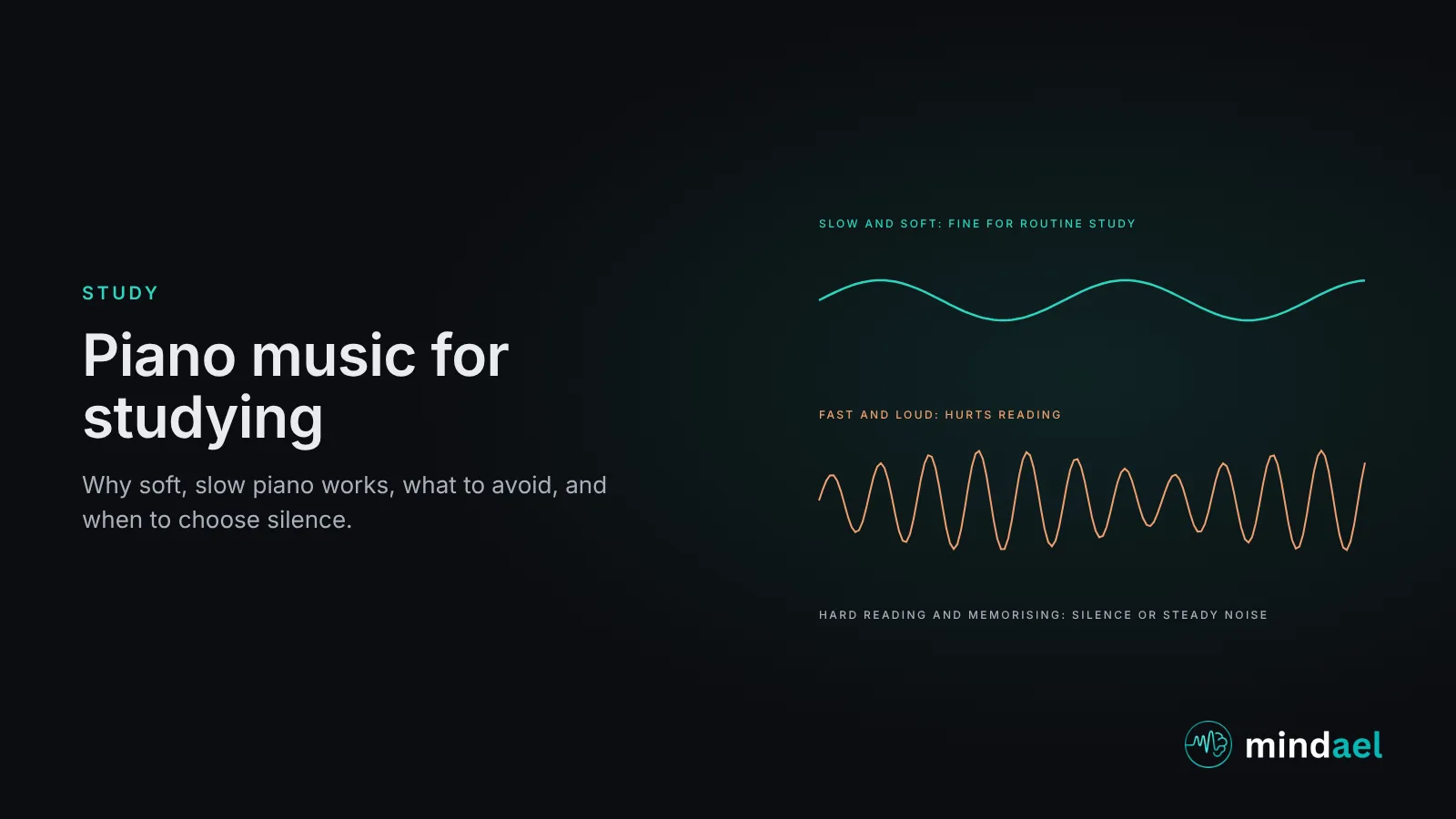
Piano is one of the most popular kinds of study music because it has no words, a soft attack and a steady pace. That matters: lyrics compete with reading, and in a reading study comprehension was best in quiet and with instrumental music, worst with lyrics. Pace and volume matter too. When the same Mozart piano piece was played fast and loud, reading comprehension dropped below silence, while slow and quiet versions did not hurt. So the best piano music for studying is slow, soft, familiar and fairly quiet, with no sudden swells. Save it for routine study and lighter reading; for the hardest reading and memorising, silence or a steady noise is often better. If you searched because you want to learn piano yourself, short practice sessions spread over days beat one long session: in a piano study, practice followed by sleep improved accuracy.
Piano music for studying is popular for good reasons: no words, a soft sound and a steady pace. But not all piano helps. This guide explains which piano music suits study, what the research says about pace and volume, when to switch to silence, and a few tips if you are learning piano yourself. We make Mindael, a sound app with words-free focus sounds, free to download on the App Store.
Why piano suits studying
The biggest cost of study music is words. In a reading study, people scored best in quiet and with instrumental music, and worst with music that had lyrics, even songs they liked (Perham and Currie, 2014). Solo piano has no lyrics, so it avoids that cost. Its sound is also soft and rounded, without the harsh edges of a drum kit or electric guitar. Our guide to listening to music while studying covers music more broadly.
Slow and soft, not fast and loud
Piano is not automatically safe. In one study, people read while the same Mozart piano piece played in four versions: slow or fast, quiet or loud. Comprehension fell below silence only in the fast and loud version (Thompson et al., 2012). Fast tempo and high volume raise arousal and pull attention away from the page.
What to look for:
- Slow. Gentle tempo, no rapid runs.
- Soft and even. No big swells from quiet to loud.
- Familiar. Pieces you know pull less attention than new ones.
- Quiet. Low enough that you could forget it is on.
Piano does not make you smarter
The famous “Mozart effect” turned out to be about mood. Music that lifted people’s mood and energy helped them briefly on a spatial task, and the effect disappeared once mood and arousal were taken into account (Thompson et al., 2001). That is still useful: if soft piano makes it easier to sit down and keep going, it is doing a job.
When to switch to silence or noise
For dense reading, memorising and writing, even soft piano can be too much. Silence is often best. If the room is noisy, a steady sound such as brown noise covers voices without adding melody of its own; our best noise for studying guide compares the options. Pair either with a study timer so each block has a clear start and end.
If you want to learn piano online
Many people searching for study piano want to learn to play. The same science of study applies. In a piano study, people who practised and then slept before being tested played more accurately than those tested minutes later (Simmons, 2012). So practise in short sessions on most days rather than one long weekend block, and let sleep do part of the work.
The short version
Soft, slow, familiar piano at a low volume is good study music for routine work. Fast, loud pieces hurt reading. For hard reading and memorising, choose silence or a steady noise. For words-free sound under a study block, Mindael is free to download on the App Store, and our study sounds guide has more.
A steady layer under your study piano.
Mindael has brown and pink noise generated to spec, rain recorded without loops and soft drones made in our studio, two at a time, with no words to compete with your reading. Play one under quiet piano, or on its own when you need silence with the room noise covered. Free to download, no account, works offline.
- Brown noise, rain and soft drones
- No vocals, nothing to compete with your reading
- Free to download, no account, works offline
 Free · No account needed · Works offline
Frequently asked questions
Is piano music good for studying?
Yes, if it is slow, soft and fairly quiet. Piano has no lyrics to compete with reading. In one study, the same piano piece hurt reading comprehension only when it was played fast and loud.
What is the best piano music for studying?
Slow, soft pieces you already know: gentle solo piano, slow classical movements or ambient piano. Avoid dramatic pieces with big swells in volume or fast runs.
Does classical piano make you smarter?
No. The so-called Mozart effect came down to mood and arousal. Music that lifts your mood can help briefly, but it does not raise intelligence.
Should I listen to piano music or silence when studying?
For routine study, soft piano is fine and can make it easier to keep going. For dense reading or memorising, silence or a steady noise such as brown noise is often better.
How loud should study piano be?
Quiet enough to ignore. Loud music raises arousal and pulls attention from the page.
Can I learn piano online by myself?
Yes, many people do with online lessons and videos. Keep sessions short, practise on most days rather than in one long block, and sleep on it: in a piano study, practice followed by sleep improved accuracy.
Sources
- Thompson WF, Schellenberg EG, Letnic AK. Fast and loud background music disrupts reading comprehension. Psychology of Music, 2012.
- Perham N, Currie H. Does listening to preferred music improve reading comprehension performance? Applied Cognitive Psychology, 2014.
- Thompson WF, Schellenberg EG, Husain G. Arousal, mood, and the Mozart effect. Psychological Science, 2001.
- Simmons AL. Distributed practice and procedural memory consolidation in musicians' skill learning. Journal of Research in Music Education, 2012.
This article is part of our study and learning guide. Hear the sounds in this article in the Mindael sound library, or see our app comparison checklists.