

Study Timer: How to Use One for Studying That Sticks, With Block Lengths, Self-Testing and Spacing
A study timer keeps you at the desk, but what you do inside each block decides how much you remember. Pick a block length that suits the material: 25 minutes for review or a subject you are avoiding, 45 to 50 minutes for problem sets and writing. Spend at least part of each block testing yourself, because in a classic experiment students who practised recalling a text remembered more of it a week later than students who reread it, and a major review rated self-testing and spreading study over days as the two most useful techniques. Plan blocks for each subject across several days rather than one long session. Take the breaks: fixed breaks on a timer left students less tired and more motivated than breaks they chose themselves. A steady sound under each block covers the room.
A study timer is the simplest way to start studying and keep going: set it, work until it ends, take a break. But the timer only gets you to the desk. What you do inside each block decides how much is still there on exam day. This article covers block lengths, what to do inside a block, and how to plan blocks across a week. We make Mindael, a sound app with a focus timer, free to download on the App Store, but any timer works for the method.
Pick a block length for the material
25 minutes, 5 off for flashcards, review and subjects you are avoiding. A short block makes starting easy. Our 25 minute timer article explains why it works.
45 to 50 minutes, 10 off for problem sets, essays and coding, which take a while to warm up and suffer from being cut off.
After three or four blocks, take a longer break of 20 to 30 minutes. Try one length for a week before you decide.
Inside the block: test yourself
The most common study habit, rereading and highlighting, is one of the weakest. A major review of ten study techniques rated practice testing and spreading study over time as the two with the highest usefulness, and rereading and highlighting as low (Dunlosky et al., 2013).
In a classic experiment, students who read a text and then practised recalling it remembered more a week later than students who read it again, even though rereading made them feel more confident (Roediger and Karpicke, 2006). So split each block: read or work through new material for the first part, then close the book and test yourself for the rest. Write what you remember, do practice questions, or use flashcards.
Across the week: spread the blocks
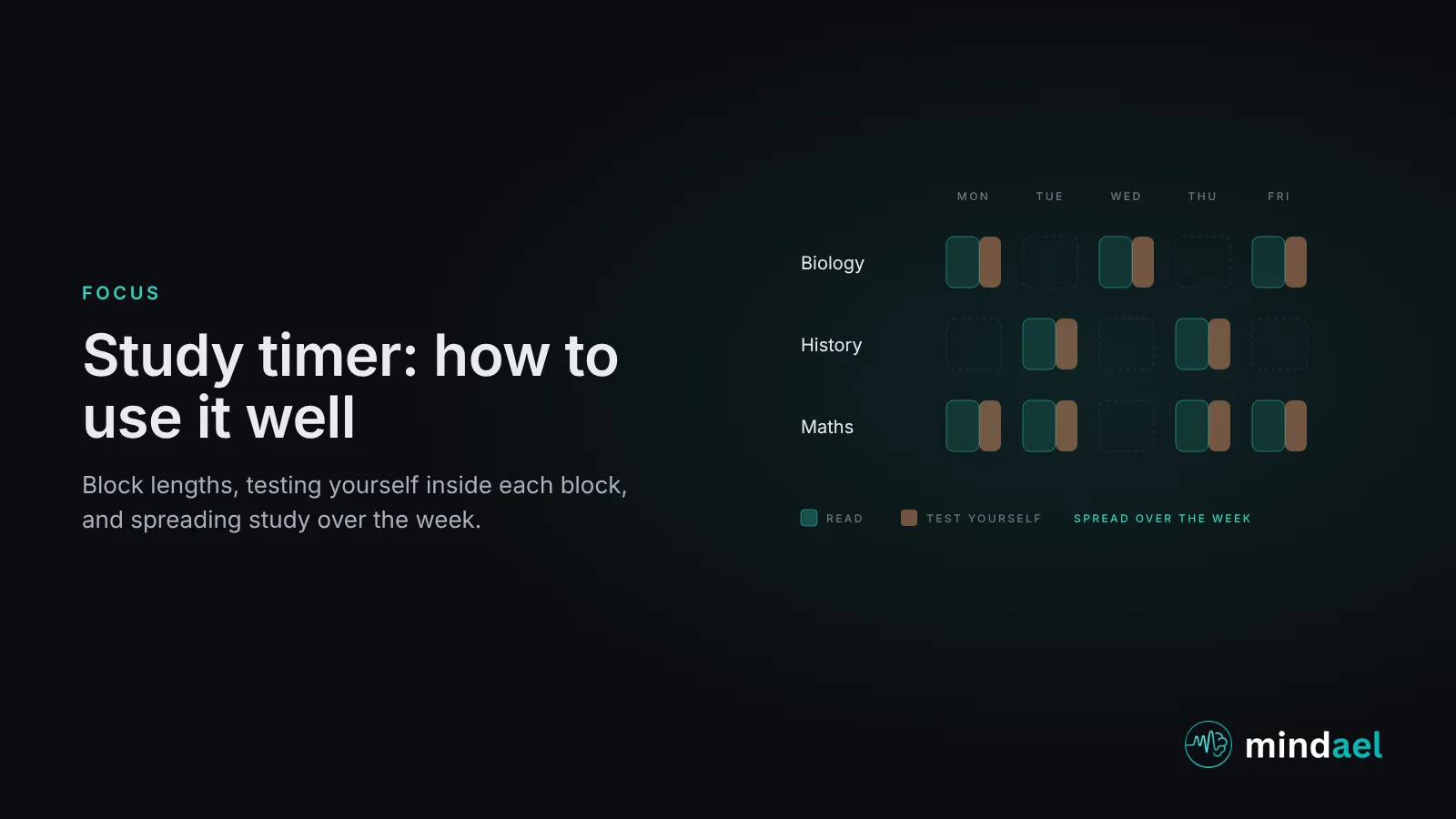
Four blocks of one subject on one evening teach less than the same four blocks spread over a week. A review of hundreds of experiments found that spacing study sessions apart improved long-term recall, and the longer you need to remember something, the wider the gaps should be (Cepeda et al., 2006).
So plan in blocks per subject per day. Two blocks of biology on Monday, Wednesday and Friday beats six blocks on Thursday night. Our Pomodoro time management article shows how to plan a day in blocks.
Take the breaks
In a study of students, those who took breaks at fixed times on a timer reported less fatigue and more motivation than those who took breaks whenever they chose (Biwer et al., 2023). A meta-analysis found that breaks of up to 10 minutes raised energy and lowered fatigue (Albulescu et al., 2022). Stand up, move, drink water and stay off your phone; a video turns a 5 minute break into 30.
A sound under the block
A steady sound without words covers the flatmates, the library and the café, and becomes a cue that a block has started. Brown noise is the most popular choice; rain works too. Our best study noise article compares them, the study timer app checklist lists what a timer app should do, and the focus apps for studying checklist covers keeping the phone out of the session.
The short version
Pick 25 or 50 minute blocks to suit the material. Spend part of each block testing yourself instead of rereading. Spread each subject over several days. Take the breaks away from the screen. Put a steady sound under each block. For a focus timer that fades the sound instead of beeping, Mindael is free to download on the App Store, and our study sounds guide has the full setup.
Study in blocks. Study in sound.
Mindael has brown noise generated to spec, rain recorded without loops and beta beats made in our studio, two at a time, with a focus timer that fades the sound at the end of each block. Free to download, no account, works offline, in the library or on the train.
- Brown noise, rain and beta beats, studio-made
- A focus timer that fades at the end of each block
- Free to download, no account, works offline
 Free · No account needed · Works offline
Frequently asked questions
What is the best study timer length?
There is no single best number. 25 minutes with a 5 minute break suits review, flashcards and subjects you are avoiding. 45 to 50 minutes with a 10 minute break suits problem sets, essays and anything that takes a while to warm up. Try one length for a week before judging it.
What should I do during a study block?
One subject, one goal, and part of the block spent testing yourself: close the book and write down or say what you remember, do practice questions, or use flashcards. Rereading feels productive but is one of the weakest ways to learn.
How many study blocks should I do a day?
Most students manage 4 to 8 good blocks a day around classes, more in exam season. Count completed blocks rather than hours, and spread each subject over several days rather than one long session.
Should I use a Pomodoro timer for studying?
It works well for many students, especially to get started. The Pomodoro rhythm is 25 minutes on and 5 off, with a longer break after four blocks. Change the length if 25 minutes keeps cutting you off mid-problem.
What should I do in study breaks?
Step away from the screen: stand, stretch, drink water, look out of a window. Avoid starting a video or social media, which tend to stretch a 5 minute break into 30.
Should I listen to something while studying?
A steady sound without words, such as brown noise or rain, helps many people stay in the block and covers distracting noise. Music with lyrics tends to compete with reading and writing.
Sources
- Dunlosky J, Rawson KA, Marsh EJ, Nathan MJ, Willingham DT. Improving students' learning with effective learning techniques: promising directions from cognitive and educational psychology. Psychological Science in the Public Interest, 2013.
- Roediger HL, Karpicke JD. Test-enhanced learning: taking memory tests improves long-term retention. Psychological Science, 2006.
- Cepeda NJ, Pashler H, Vul E, Wixted JT, et al. Distributed practice in verbal recall tasks: a review and quantitative synthesis. Psychological Bulletin, 2006.
- Biwer F, et al. Understanding effort regulation: comparing "Pomodoro" breaks and self-regulated breaks. British Journal of Educational Psychology, 2023.
- Albulescu P, et al. "Give me a break!" A systematic review and meta-analysis on the efficacy of micro-breaks for increasing well-being and performance. PLOS ONE, 2022.
This article is part of our study and learning guide. Hear the sounds in this article in the Mindael sound library, or see our app comparison checklists.