

Instrumental Music for Studying: Calm or Upbeat, and How to Match It to the Task
Instrumental music for studying works better than songs with lyrics, because words compete with reading and memory. Within instrumental music, the two dials that matter are tempo and volume. Tempo changes arousal and mode changes mood: in one study, faster versions of the same piece raised arousal and a major key lifted mood, and both tracked performance on a spatial task. Too much arousal hurts reading, though: fast and loud piano dropped reading comprehension below silence, while slow or quiet versions did not. So use calm, slow instrumental music for reading and careful work, and save upbeat instrumental for routine, repetitive tasks or an energy dip, where a lift helps. In a workplace study, developers' mood and quality of work were lowest with no music, though they spent longest on task without it. Keep the volume low, pick tracks you know, and switch to silence or steady noise for the hardest reading.
Instrumental music for studying is the usual advice for a reason: no words means nothing competing with the words you read. But instrumental music covers everything from slow piano to driving electronic tracks, and they do not work the same way. This guide explains when calm instrumental music helps, when upbeat helps, and how to build a study playlist. We make Mindael, a sound app with words-free focus sounds, free to download on the App Store.
Why instrumental beats lyrics
Your brain processes words automatically, so lyrics pull on the same resources you use to read and remember. In a reading study, people scored best in quiet and with instrumental music, and worst with music that had lyrics, whether they liked the songs or not (Perham and Currie, 2014).
Tempo and volume matter more than genre
Two dials do most of the work. Tempo changes arousal and key changes mood: when researchers played faster and slower, major and minor versions of the same piece, faster versions raised arousal, a major key lifted mood, and both tracked how well people did on a spatial task (Husain et al., 2002).
There is a ceiling, though. When the same piano piece was played fast and loud, reading comprehension fell below silence; slow or quiet versions did not hurt (Thompson et al., 2012). A little lift helps; too much pulls attention away from the page.
Calm or upbeat: match it to the task
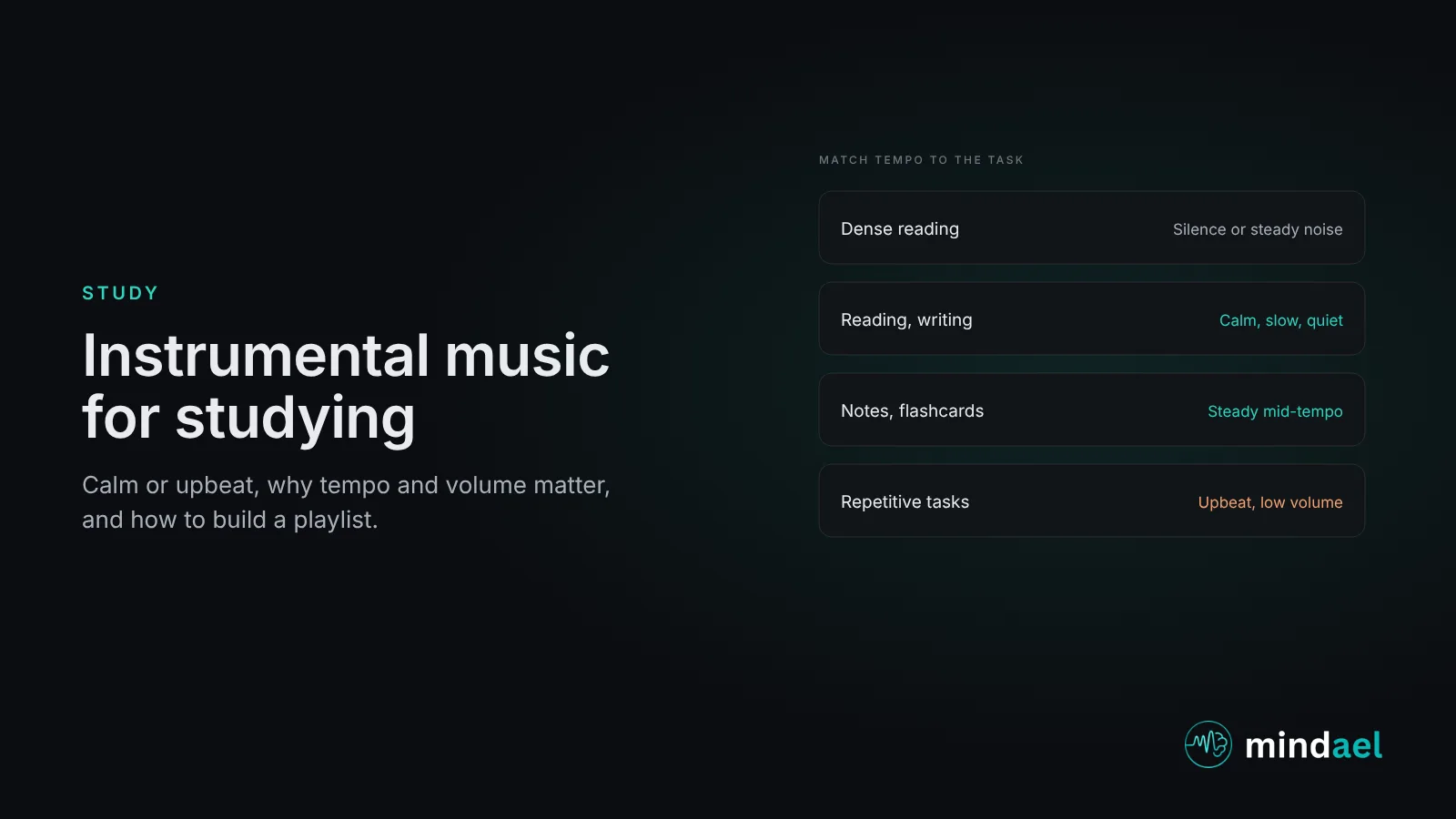
| Task | Instrumental music |
|---|---|
| Dense reading, memorising | Silence, or a steady noise such as brown noise |
| Reading, writing, problem sets | Calm, slow, quiet tracks |
| Notes, flashcards you know, tidying | Steady mid-tempo tracks |
| Repetitive tasks, an energy dip | Upbeat instrumental at a low volume |
Upbeat music earns its place on dull work. In a five-week workplace study, software developers’ mood and quality of work were lowest when music was taken away, though they spent longest on task without it (Lesiuk, 2005). Music that keeps you willing to keep going has a job, as long as it is not the hardest part of the work.
Building a study playlist
- Familiar tracks. New music pulls attention as you follow it.
- No sudden drops or swells. Steady from start to finish.
- Low volume. Quiet enough to forget it is on.
- One playlist per block. Start it with a study timer and stop it when the block ends, so the music becomes a cue to begin.
The short version
Choose instrumental over lyrics. Use calm, slow, quiet tracks for reading and careful work, upbeat instrumental for routine tasks and energy dips, and silence or steady noise for the hardest reading. For words-free sound under a study block, Mindael is free to download on the App Store, our how to concentrate better guide has more focus habits, and our study sounds guide has more.
Steady, words-free sound for every study block.
Mindael has brown and pink noise generated to spec, rain recorded without loops, soft drones and beta beats made in our studio, two at a time, with no lyrics to compete with your reading. Free to download, no account, works offline.
- Brown noise, rain, drones and beta beats
- No vocals, nothing to compete with your reading
- Free to download, no account, works offline
 Free · No account needed · Works offline
Frequently asked questions
Is instrumental music good for studying?
Yes, more than songs with lyrics. In a reading study, comprehension was best in quiet and with instrumental music and worst with lyrics. Keep it fairly slow and quiet for reading.
Should study music be calm or upbeat?
Calm for reading, memorising and careful work. Upbeat for routine, repetitive tasks or when your energy dips. Fast and loud music hurt reading comprehension in one study.
What instrumental music is best for studying?
Music you know, at a steady pace and low volume: ambient, soft piano, slow classical, acoustic guitar or lo-fi without vocals. Avoid tracks with sudden drops or big swells.
Does upbeat instrumental music help you study?
It can lift energy and mood, which helps you start and keeps dull tasks moving. For dense reading, the extra arousal tends to get in the way, so switch to something calmer.
How loud should instrumental study music be?
Quiet enough to forget it is playing. Loud music raises arousal and pulls attention from the page.
Is silence better than instrumental music?
For the hardest reading and memorising, often yes. A steady noise such as brown noise is a good middle ground if the room is noisy.
Sources
- Husain G, Thompson WF, Schellenberg EG. Effects of musical tempo and mode on arousal, mood, and spatial abilities. Music Perception, 2002.
- Thompson WF, Schellenberg EG, Letnic AK. Fast and loud background music disrupts reading comprehension. Psychology of Music, 2012.
- Perham N, Currie H. Does listening to preferred music improve reading comprehension performance? Applied Cognitive Psychology, 2014.
- Lesiuk T. The effect of music listening on work performance. Psychology of Music, 2005.
This article is part of our study and learning guide. Hear the sounds in this article in the Mindael sound library, or see our app comparison checklists.