

25 Minute Timer: Why 25 Minutes Works, How to Use It, and When to Pick a Different Length
A 25 minute timer is the classic Pomodoro block: long enough to make real progress on one task, short enough that starting feels easy. The number is a convention, not a scientific constant, but the idea behind it holds up: in a study of students, fixed breaks on a timer left them less tired and more motivated than breaks they chose themselves, a meta-analysis found short micro-breaks improved vigour and reduced fatigue, and a lab study found that brief breaks kept attention from sliding on a long task. To use one well, pick a single task, start the timer, keep the phone out of reach, and stop when it ends for a 5 minute break away from the screen. Use shorter blocks of 10 to 15 minutes to get started on a dreaded task, longer ones of 45 to 50 minutes for deep work, and 1 minute interval timers for exercise or breathing.
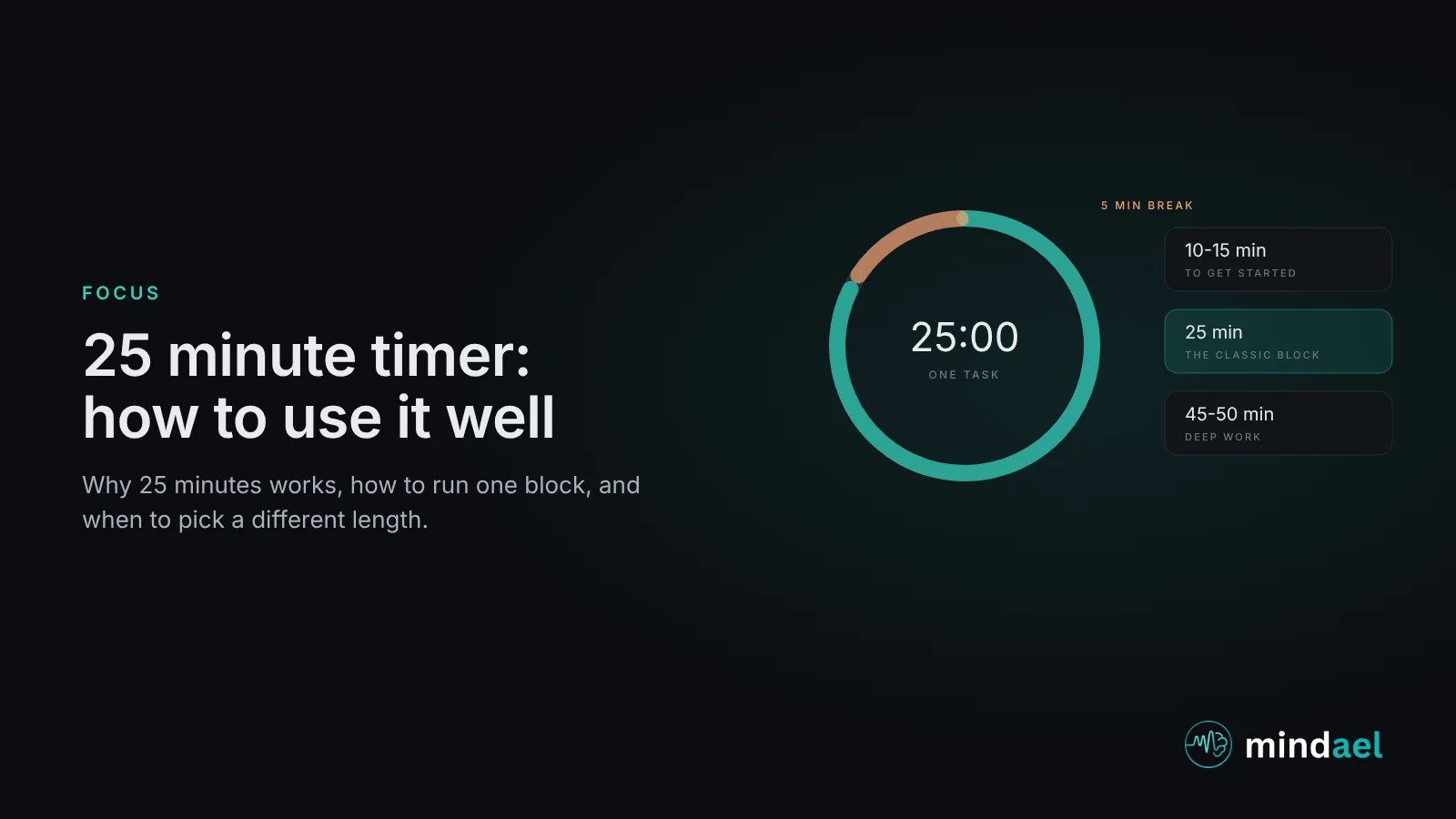
A 25 minute timer is probably the most used focus tool there is. Set it, work on one thing until it rings, take a short break, repeat. It is the block at the heart of the Pomodoro Technique, and it works for reasons that have little to do with the number 25. This article explains why, how to run a block well, and when a different length suits you better. We make Mindael, a sound app with a focus timer that fades the sound at the end of each block, free to download on the App Store.
Why 25 minutes works
It makes starting easy. “Work on the report” is open-ended. “Work on the report until the timer rings” has an end in sight, which is the main reason a short block gets avoided tasks started.
Fixed breaks protect your energy. In a study of students, those who took breaks at fixed times on a timer reported less fatigue and more motivation than those who took breaks whenever they chose (Biwer et al., 2023).
Short breaks help. A meta-analysis of micro-break studies found breaks of up to 10 minutes raised vigour and lowered fatigue (Albulescu et al., 2022). In a lab study, people who took two brief breaks during a long, dull task kept their performance steady, while those who worked straight through slowly got worse (Ariga and Lleras, 2011).
The number 25 itself is a convention from the original technique. What matters is a block short enough to start and a break you actually take.
How to run one 25 minute block
- Choose one task and write it down. “Draft section 2”, not “work”.
- Put the phone out of reach, face down in another room if you can. In one study, even a notification you did not check disrupted attention (Stothart et al., 2015).
- Start the timer and a steady sound, brown noise or rain, low.
- Work only on that task. If another thought appears, write it on a scrap of paper and return.
- Stop when it ends, even mid-sentence. Write one line about where you were.
- Take 5 minutes away from the screen. Stand, stretch, water, window.
After four blocks, take a longer break of 15 to 30 minutes. Our Pomodoro guide covers the full method and what breaks it.
When a different length fits better
10 to 15 minutes for a task you are dreading or a day when focus is low. Once you have started, you can always run a second block.
45 to 50 minutes for deep work that takes a while to warm up, such as writing, coding or design, with a 10 minute break.
1 minute intervals are a different tool: for exercise, stretching or breathing practice, a repeating short timer keeps the rhythm. For a calm count, our box breathing guide is a good place to start.
Try a length for a week before judging it. Our focus timer guide matches lengths to tasks, and our Pomodoro time management article explains how to plan a whole day in blocks.
What to listen to
A steady, wordless sound helps many people stay in the block and covers office or household noise. Brown noise is the most popular choice; rain and pink noise work too. Our best study noise article compares them, and how to focus better covers the rest of a focus routine.
The short version
Twenty-five minutes on one task, phone away, a steady sound, then a real 5 minute break. Fixed breaks and short blocks have research behind them; the exact number does not. Go shorter to get started, longer for deep work. For a focus timer that fades the sound instead of beeping, Mindael is free to download on the App Store.
Twenty-five minutes, one sound.
Mindael has brown noise generated to spec, rain recorded without loops and beta beats made in our studio, two at a time, with a focus timer that fades the sound at the end of the block instead of beeping. Free to download, no account, works offline.
- Brown noise, rain and beta beats, studio-made
- A focus timer that fades instead of beeping
- Free to download, no account, works offline
 Free · No account needed · Works offline
Frequently asked questions
Why 25 minutes?
It is the block length the Pomodoro Technique made popular: long enough to finish a meaningful piece of one task, short enough that starting does not feel like a commitment. There is nothing special about 25 itself; what research supports is working in fixed blocks with planned short breaks.
What should I do when the 25 minute timer ends?
Stop, even mid-sentence, write one line about where you were, and take a 5 minute break away from the screen: stand, stretch, get water, look out of a window. After four blocks, take a longer break of 15 to 30 minutes.
Is 25 minutes too short for deep work?
For some work, yes. Writing, coding or design that takes a while to warm up often suits 45 to 50 minute blocks with a 10 minute break. Use 25 minutes for tasks you are avoiding or for days when focus is low.
What is a 1 minute interval timer for?
Interval timers repeat short timed periods, often for exercise (work for a minute, rest for a minute), stretching or breathing practice. They are a different tool from a 25 minute focus timer, which runs one longer block.
Should I listen to something during a 25 minute timer?
A steady sound without words, such as brown noise or rain, helps many people stay in the block and covers distracting noise. Avoid music with lyrics for reading or writing tasks.
How many 25 minute blocks can I do in a day?
Most people manage 8 to 12 focused blocks on a good day, not 16. Count completed blocks rather than hours, and plan your day around the number you can actually do.
Sources
- Biwer F, et al. Understanding effort regulation: comparing "Pomodoro" breaks and self-regulated breaks. British Journal of Educational Psychology, 2023.
- Albulescu P, et al. "Give me a break!" A systematic review and meta-analysis on the efficacy of micro-breaks for increasing well-being and performance. PLOS ONE, 2022.
- Ariga A, Lleras A. Brief and rare mental "breaks" keep you focused: deactivation and reactivation of task goals preempt vigilance decrements. Cognition, 2011.
- Stothart C, Mitchum A, Yehnert C. The attentional cost of receiving a cell phone notification. Journal of Experimental Psychology: Human Perception and Performance, 2015.
This article is part of our pomodoro guide. Hear the sounds in this article in the Mindael sound library, or see our app comparison checklists.