

Focus Timer: How to Pick the Right Length, Fixed vs Flexible Sessions, and Breaks That Help
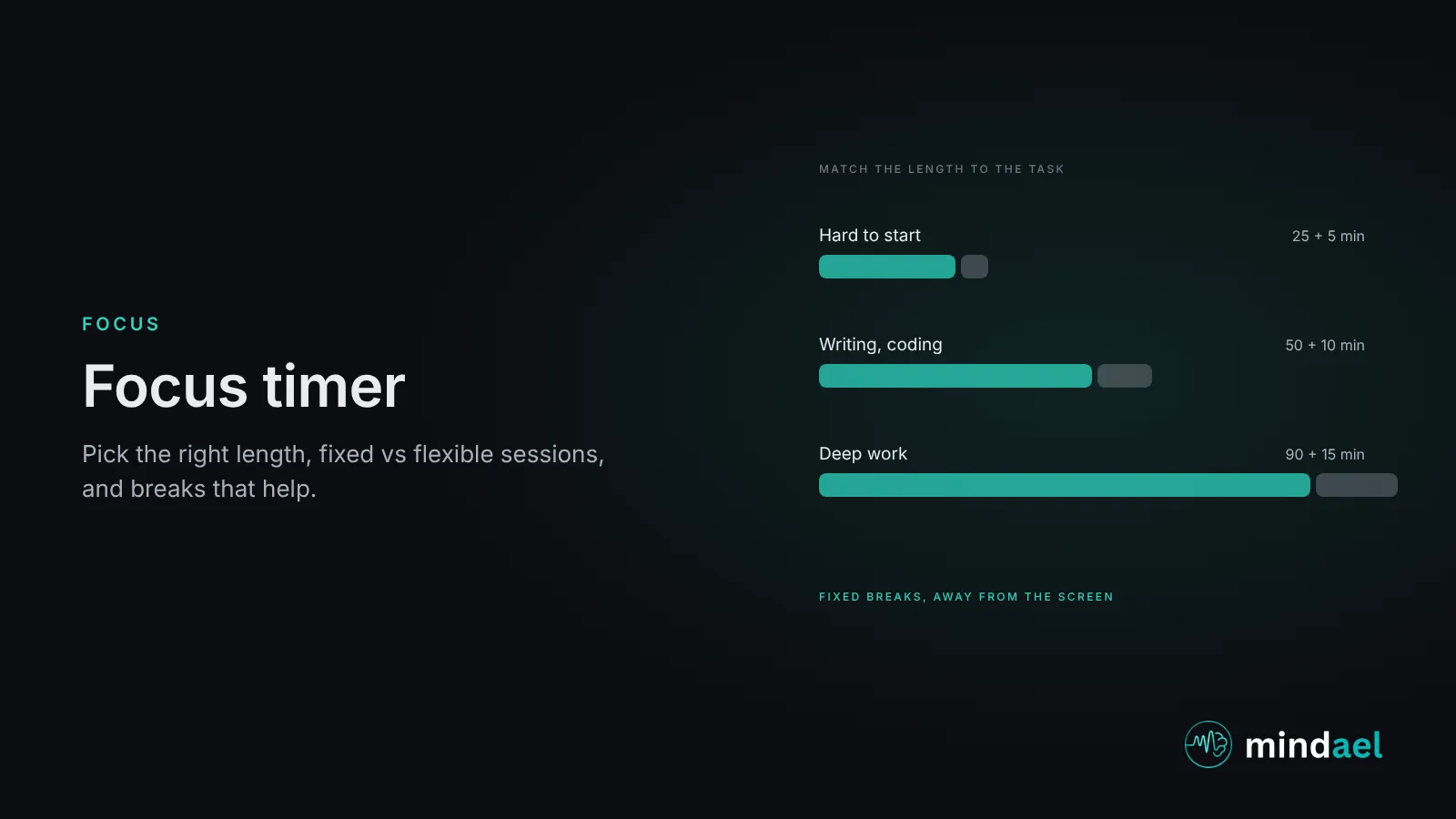
A focus timer turns 'work on this' into a block with a clear start and end, which makes it easier to begin and to stop. The length should fit the task: 25 minutes for tasks you find hard to start, 45 to 50 for work that needs warm-up, 90 for deep work you enjoy. In a study of students, fixed, timed breaks led to less fatigue and more motivation than breaks taken whenever people felt like it. Short breaks themselves help: in a lab study, brief, rare switches away from a long task kept performance steady, while people who never broke slowed down. In a workday study, breaks taken earlier in the shift and spent on something people liked restored more energy. So set a focus timer to a length that fits the task, take the break when it rings, do something you enjoy in it, and do not save all your breaks for the afternoon.
A focus timer turns “work on this” into a block with a start and an end. That small change makes it easier to begin, harder to drift and easier to stop for a real break. This guide covers how to pick the length, fixed vs flexible sessions, and what research shows about breaks. We make Mindael, a focus sound app with a Pomodoro timer, free to download on the App Store.
Pick the length for the task
There is no single right number. Fit it to the work:
| Task | Focus timer length |
|---|---|
| Something you keep avoiding | 25 minutes, then 5 off |
| Writing, coding, problem sets | 45 to 50 minutes, then 10 off |
| Deep work you enjoy | 90 minutes, then 15 to 20 off |
| Admin, email | One 25-minute block for all of it |
If you check the clock often, the block is too long. If you are always mid-sentence when it rings, it may be too short. Our 25 minute timer guide covers the classic Pomodoro length in depth.
Fixed or flexible?
It is tempting to work until you feel like stopping. In a study of students, those who took fixed, timed breaks reported less fatigue and more motivation than students who broke whenever they wanted (Biwer et al., 2023). A timer makes the break happen before you run down.
Breaks that help
Short breaks keep focus steady. In a lab study, people doing a long, dull task who briefly switched to another task twice kept their performance up, while those who never stopped slowed down (Ariga and Lleras, 2011).
Do something you like. In a workday study, breaks spent on activities people preferred, and breaks taken earlier in the shift, restored more energy (Hunter and Wu, 2016). Stand, stretch, get water, look out of a window. Do not save every break for the afternoon.
Focus timer or Pomodoro: what is the difference?
The Pomodoro Technique is one specific focus timer: 25 minutes of work, 5 minutes off, and a longer break after four rounds. A focus timer is the wider idea, any timed block of single-task work followed by a break. Pomodoro is a good default because the block is short enough to start without dread. It is not the right length for everything.
Use the classic 25 and 5 when the problem is starting. Move to longer blocks when the problem is being interrupted just as you get going. Our Pomodoro guide covers the full method and the sounds that suit it.
What counts as one task
A focus timer only works if the block has one job. “Work on the report” is too loose; “write the methods section” is a task. Before you press start:
- Name the task in one line and write it where you can see it.
- Close what you do not need: other tabs, chat, email.
- Put the phone out of reach, not just face down.
- Keep a scrap of paper for stray thoughts. When something unrelated pops up, write it down and go back. That is what keeps the block intact.
If you finish early, use the remaining minutes to review what you did. Do not start a second task inside the same block.
When the timer does not work
- You ignore the bell. Make the break something you want: a coffee, a walk to the window. A break you look forward to is easier to take.
- You cannot settle in the first ten minutes. That is normal. Start with the smallest possible step, such as opening the file and writing one sentence.
- You keep getting interrupted. Tell people when your block ends, and batch replies into the break. Two protected blocks a day beat eight broken ones.
- The task is too big. Split it until one piece fits in one block.
- You feel worse on a timer. Some people do, especially in creative work that needs a long run-up. Try 90-minute blocks, or use the timer only for tasks you avoid.
Focus timers for studying and for ADHD
For studying, pair the timer with active methods: test yourself in the block, check answers in the break. Our study timer guide has a full plan for a study day.
For ADHD, shorter blocks and a visible countdown often work better than long ones, because the end is always in sight. Start with 10 or 15 minutes, add a steady sound to cover distractions, and build up. Our ADHD sounds guide explains why steady noise helps some people with ADHD start and stay on a task.
How to set one up today
- Write down one task for the block.
- Pick a length from the table above.
- Start a steady sound such as brown noise with the timer, so the sound becomes a cue to begin.
- Stop when it rings, even mid-sentence; leave a note of the next step.
- Take the break away from the screen.
For more on staying with a task, see how to focus better and our Pomodoro time management guide.
The short version
A focus timer works because it gives each block a clear end and makes breaks happen. Match the length to the task, take fixed breaks, spend them on something you enjoy and take some early in the day. For steady focus sounds with a Pomodoro timer, Mindael is free to download on the App Store, and our Pomodoro sounds guide has more.
A focus block that starts with a sound.
Mindael has brown and pink noise generated to spec, rain recorded without loops and beta beats made in our studio, two at a time, with a Pomodoro timer for focus blocks and breaks. Free to download, no account, works offline.
- Brown noise, rain and beta beats
- A Pomodoro timer for blocks and breaks
- Free to download, no account, works offline
 Free · No account needed · Works offline
Frequently asked questions
What is a focus timer?
A timer that splits work into blocks with a clear start and end, usually followed by a short break. The Pomodoro method's 25 minutes is the best known, but any length can work.
How long should a focus timer be?
Match it to the task: 25 minutes for tasks you avoid, 45 to 50 for work that needs warm-up, 90 for deep work you enjoy. Shorten it if you keep checking the clock.
Are fixed breaks better than flexible ones?
In one study, students who took fixed, timed breaks reported less fatigue and more motivation than those who broke whenever they wanted.
What should I do in a focus timer break?
Something you enjoy that is not more screen work: stand up, stretch, get water, look out of a window. In a workday study, preferred break activities restored more energy.
Is a focus timer the same as Pomodoro?
Pomodoro is one kind of focus timer, with 25-minute blocks and 5-minute breaks. A focus timer can use any length.
Should I play sound during a focus session?
A steady sound without words, such as brown noise or rain, can cover distracting noise. Start it with the timer so it becomes a cue to begin.
Sources
- Biwer F, et al. Understanding effort regulation: comparing "Pomodoro" breaks and self-regulated breaks. British Journal of Educational Psychology, 2023.
- Ariga A, Lleras A. Brief and rare mental "breaks" keep you focused: deactivation and reactivation of task goals preempt vigilance decrements. Cognition, 2011.
- Hunter EM, Wu C. Give me a better break: choosing workday break activities to maximize resource recovery. Journal of Applied Psychology, 2016.
This article is part of our pomodoro guide. Hear the sounds in this article in the Mindael sound library, or see our app comparison checklists.