
Free Calming Apps: What Actually Calms You Down, and What a Good One Needs
Calming apps come in a few kinds: sound apps, breathing guides, meditation timers and simple games. They all try to do the same thing, which is to bring a racing body and mind down a notch. Mindael is a free calming app for iPhone with rain and ocean recorded without loops, brown and pink noise, soft drones and an on-screen breathing guide, and it is free to download on the App Store. Here is what each kind of calming app does well, what the research shows, and what to look for in a free one.
A calming app helps in two ways: in the moment, by giving your attention something steady and slowing your breathing, and over weeks, by making a calming habit easy to repeat. A meta-analysis of randomised trials found that smartphone interventions reduced anxiety symptoms modestly, more against waitlist controls than against active ones. Slow breathing at about six breaths a minute is linked to higher heart rate variability and lower anxiety, and listening to music before a stressor helped the nervous system recover faster in one lab study. A good free calming app offers steady sounds without audible loops, a slow breathing guide, offline play and no account or sign-up wall. Use it for two to five minutes when tension rises, and keep it as a support, not a replacement for care if anxiety is heavy or lasting.
What to look for, and how Mindael covers it
| What you need | In Mindael |
|---|---|
| A steady sound to rest on | Rain and ocean recorded without loops, brown and pink noise generated to spec, soft drones made in our studio |
| Slow breathing, guided | 4-7-8 and slow six-a-minute breathing on screen, with a sound underneath |
| Mix two sounds | Ocean under a soft drone, or rain over brown noise, each with its own level |
| Works offline | Every sound is on the phone; works in flight mode, on a train or in a waiting room |
| No sign-up wall | No account needed to start listening |
| Nothing loud or sudden | Soft, steady sounds with no sudden changes in volume |
| Price | Free to download on the App Store |
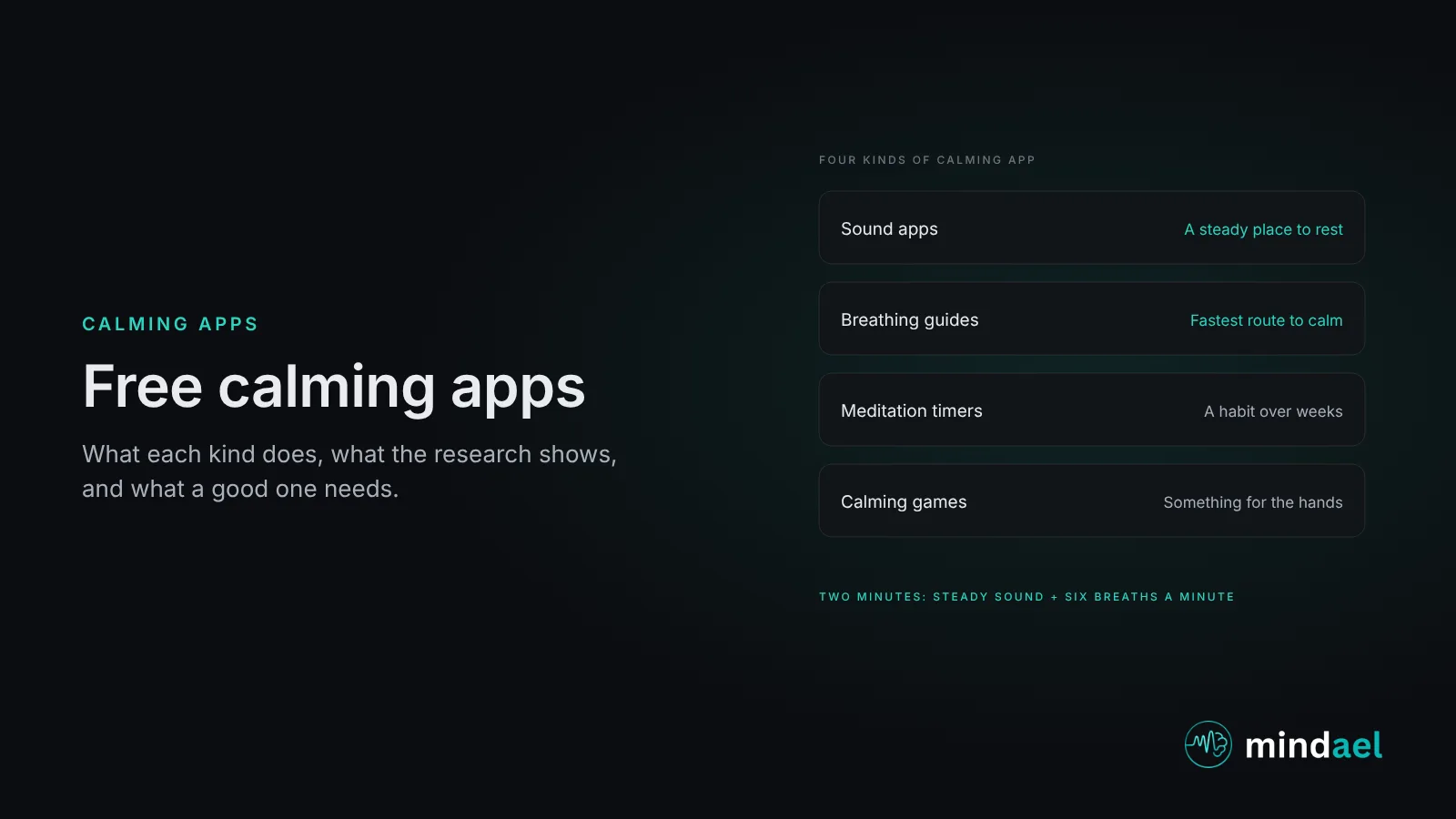
Four kinds of calming app
Sound apps play something steady in the background: rain, ocean, noise colours or soft drones. They help by giving attention a place to rest and by covering sudden noises that keep you on edge.
Breathing guides show you when to breathe in and out. They are the quickest route to calm, because slowing the breath slows the body.
Meditation apps and timers help you build a daily practice. They matter less in a tense moment and more over weeks. Our best meditation app guide covers them.
Calming games give your hands and eyes something simple to do. They can help some people switch off, though the research on them is thin.
Many people do best with a sound and a breathing guide together, which is what Mindael focuses on.
What the research shows
A meta-analysis of nine randomised trials found that smartphone interventions reduced anxiety symptoms more than control conditions. The effect was moderate against waitlists and small against active treatments, and the authors noted there is no evidence that apps alone beat standard therapy (Firth et al., 2017).
Slow breathing has some of the clearest evidence for calm in the moment. A systematic review linked breathing at around six breaths a minute to higher heart rate variability, more relaxed brain activity and lower anxiety (Zaccaro et al., 2018). Our calm breathing guide shows how.
Sound helps too, in a more limited way. In a lab study, people who listened to relaxing music before a stress test recovered faster on measures of the autonomic nervous system, though not on every stress measure (Thoma et al., 2013).
What a good free calming app needs
Steady sounds without audible loops. A seam that repeats every minute pulls attention back. Long recordings or generated noise avoid it.
A slow breathing guide. A visual pace of about six breaths a minute, with a longer out-breath.
Offline play and no sign-up wall. When you are tense, you want sound in two taps, not a login screen.
Nothing jarring. Soft, even sounds with no sudden jumps in volume.
A two-minute calming routine
Put on ocean waves or soft rain at a low volume. Breathe in through the nose for four and out for six. Drop your shoulders on each out-breath. After two minutes, notice whether your breathing has settled on its own. For more ideas, see how to calm down, and if anxiety is the main reason you are looking, our best apps for anxiety guide goes further.
How to switch in five minutes
- Download Mindael and pick one soundFree on the App Store, no account. Ocean or rain for a soft background, brown noise if the room is noisy.
- Slow your breathingFollow the on-screen guide, or breathe in for four and out for six, about six breaths a minute.
- Give it two to five minutesMost of the change comes in the first few minutes. Let the sound carry on afterwards if it helps.
- Use it at the same momentsBefore a meeting, on the commute home, before bed. A calming habit works better than a rescue tool you forget.
- Know when an app is not enoughIf anxiety is strong, lasting or getting in the way of daily life, talk to a doctor or therapist.
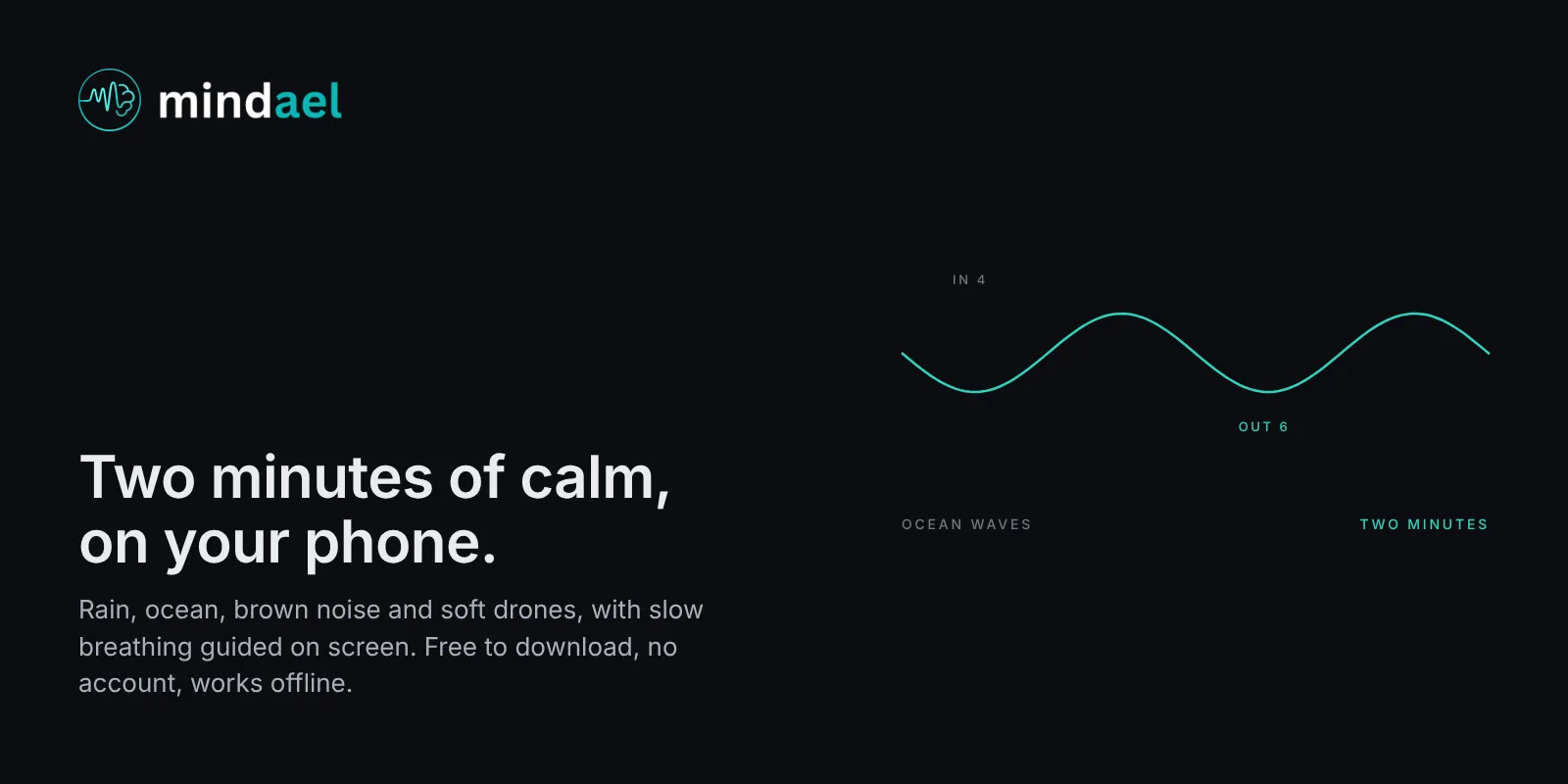
Two minutes of calm, on your phone.
Mindael has rain and ocean recorded without loops, brown and pink noise generated to spec and soft drones made in our studio, two at a time, and guides 4-7-8 and slow six-a-minute breathing on screen. Free to download, no account, works offline.
- Rain, ocean, brown noise and soft drones
- Slow breathing guided on screen
- Free to download, no account, works offline
 Free · No account needed · Works offline
Frequently asked questions
What is the best free calming app?
One that gives you a steady sound and a slow breathing guide, works offline and lets you start without an account. Mindael does all of that and is free to download on iPhone.
Do calming apps actually work?
Modestly. A meta-analysis of randomised trials found that smartphone interventions reduced anxiety symptoms more than control conditions, with bigger effects against waitlists than against active treatments. They work best as a regular habit.
Are there free apps like Calm?
Yes. Several apps offer calming sounds and breathing for free. Mindael is free to download with rain, ocean, noise colours and an on-screen breathing guide; it is a sound app, so it has no spoken stories.
What is the fastest way to calm down with an app?
Put on a steady sound and slow your breathing to about six breaths a minute, with a longer out-breath, for two to five minutes.
Can a calming app replace therapy for anxiety?
No. Trials found apps help modestly, and there is no evidence that apps alone outperform standard psychological treatment. Use one as a support alongside care if anxiety is heavy.
Which sound is most calming?
It varies, but steady, slow and fairly low sounds work for most people: ocean waves, soft rain, brown noise or a soft drone. Our noise colours guide explains the difference between brown, pink and white.
Sources
- Firth J, et al. Can smartphone mental health interventions reduce symptoms of anxiety? A meta-analysis of randomized controlled trials. Journal of Affective Disorders, 2017.
- Zaccaro A, et al. How breath-control can change your life: a systematic review on psycho-physiological correlates of slow breathing. Frontiers in Human Neuroscience, 2018.
- Thoma MV, et al. The effect of music on the human stress response. PLoS ONE, 2013.