
Best Apps for Anxiety: What Actually Helps, What the Research Says, and Where Mindael Fits
Apps for anxiety do help, modestly: across dozens of randomised trials, smartphone apps reduced anxiety symptoms by a small to moderate amount, most when they taught a skill people kept using. They are not a substitute for treatment, and an app that adds noise, streaks and notifications can make an anxious day worse. This page is the checklist of what an anxiety app should do, in the moment and over weeks, where each item comes from, and where Mindael, a calm sound app, fits and where it does not. Free to download on the App Store.
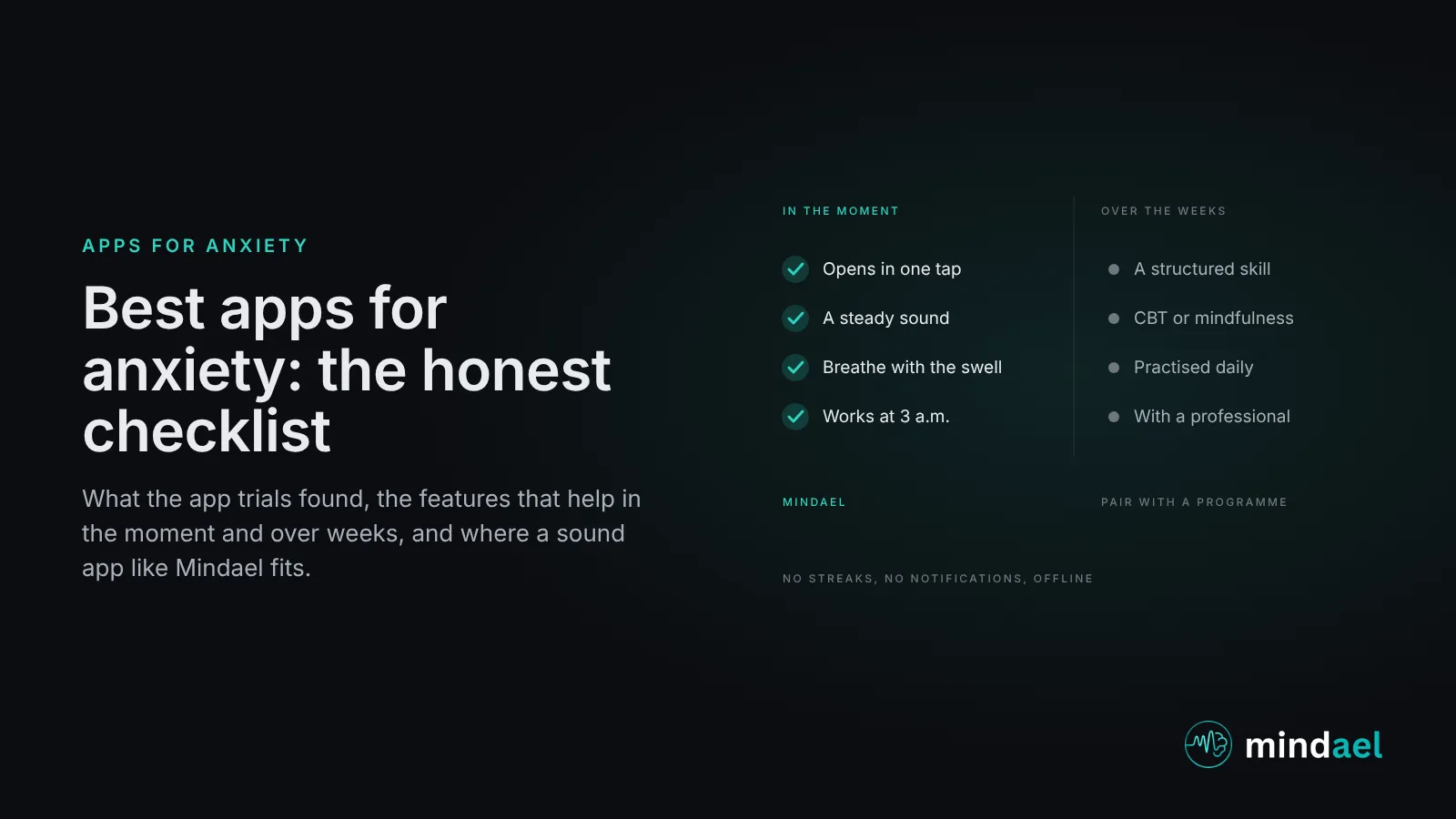
The best app for anxiety depends on the job. For a spike in the moment: something that opens fast and gives the body a steady sound to slow the breath with. For the weeks between: a structured skill, usually cognitive behavioural therapy or mindfulness, practised daily. Meta-analyses of randomised trials find apps reduce anxiety symptoms by a small to moderate amount, more when built on CBT. Mindael covers the first job: rain, ocean, brown noise and calm tones made in our studio, mixed two at a time, offline and with no account, free to download. It is not a therapy programme; if anxiety is persistent, a doctor or therapist and a structured programme come first.
What to look for, and how Mindael covers it
| What you need | In Mindael |
|---|---|
| Opens in one tap, nothing to read | The last sound you played is there; press play. No feed, no news, no daily quote |
| A steady sound for the body | Rain and ocean recorded without loops, brown and pink noise generated to spec, a 432 Hz drone |
| Something to slow the breath with | Ocean waves rise and fall slowly enough to breathe in on the swell and out on the fall |
| Works at night | Brown noise or rain at a low level for the 3 a.m. version of the same worry |
| No streaks, no notifications | Mindael never pings you and keeps no score, so it cannot add a worry of its own |
| Works offline, no account | Every sound is on the phone, on the train, in the waiting room, in airplane mode |
| A structured programme for the weeks | Not something Mindael does. Pair it with a CBT or mindfulness course, ideally with a professional |
| Price | Free to download on the App Store |
Two jobs, two kinds of app
Searches for the best apps for anxiety usually blur two different needs. One is the spike: the racing heart before a meeting, the 3 a.m. loop, the train that has stopped in a tunnel. The other is the weeks: anxiety that is there most days and shapes what you do. The research on apps is mostly about the second job, and the features that help with the first are different. Knowing which job you are hiring the app for is most of the choice. Our calming music for anxiety guide covers the in-the-moment side in full.
What the research found
Apps help, modestly. A 2017 meta-analysis of nine randomised trials found smartphone interventions reduced anxiety symptoms by a small to moderate amount, more against waiting-list controls than against other active treatments (Firth et al., 2017). A larger 2019 analysis of 66 trials found improvements in generalised and social anxiety and stress, largest when the app was built on cognitive behavioural therapy principles, but no clear effect on panic or post-traumatic stress (Linardon et al., 2019).
Mindfulness, which many apps teach, has strong evidence behind it as a course: in a 2023 trial, an eight-week mindfulness-based stress reduction programme was as effective as a standard anxiety medicine for adults with anxiety disorders (Hoge et al., 2023). That was a taught, weekly course with daily practice, which is the honest bar for an app claiming to do the same.
The checklist, explained
Opens in one tap, nothing to read. In a spike, a home screen of articles, moods to log and new content is one more thing for an anxious mind to process. The right app opens on the sound you used last.
A steady sound for the body. Anxiety is a body in gear, and the fastest route down goes through the body. In a stress experiment, people who listened to a recording of rippling water before a stress test showed the lowest cortisol response of the three groups (Thoma et al., 2013). Ocean waves, rain and brown noise are the sounds most of our listeners use.
Something to slow the breath with. Slow breathing, around six breaths a minute with a longer out-breath, shifts the body towards its resting state (Zaccaro et al., 2018). A slow ocean swell is a timer you do not have to look at: in on the rise, out on the fall. The technique is in our abdominal breathing article.
No streaks, no notifications. An anxious person does not need an app that reminds them they missed a day. Calm tools should not generate their own small worries.
A structured programme, for the weeks. This is where CBT and mindfulness courses earn their place, and where a doctor or therapist adds the most. Mindael does not do this part, and we would rather say so than pretend.
Where Mindael fits
Mindael is the sound: one tap to ocean or rain, the same every time, offline, no account, nothing to keep up. Practise five minutes a day while calm so the sound becomes a cue, and use it at the first sign of a spike. Our how to calm your nerves article has the five-minute routine, and how to calm down has the fastest techniques. For anxiety that is there most days, add a structured programme and talk to a doctor; if you are in crisis, contact your local emergency number or a crisis line now.
How to switch in five minutes
- Download MindaelFree on the App Store, no account. Set it up on a calm day, not in the middle of a spike.
- Choose your spike sound nowOcean waves or rain. One sound, always the same, so that over weeks it becomes a cue the body learns.
- Run it once a day while calmFive minutes: sound on, breathe in for four, out for six, attention on the sound. Practising calm is what makes it available when anxious.
- Use it at the first signEarbuds in, the same sound, the same breath. Five minutes before deciding anything.
- Add a structured skillFor anxiety that comes back most days, a CBT or mindfulness programme, with a doctor or therapist if you can, is the part that changes the weeks.
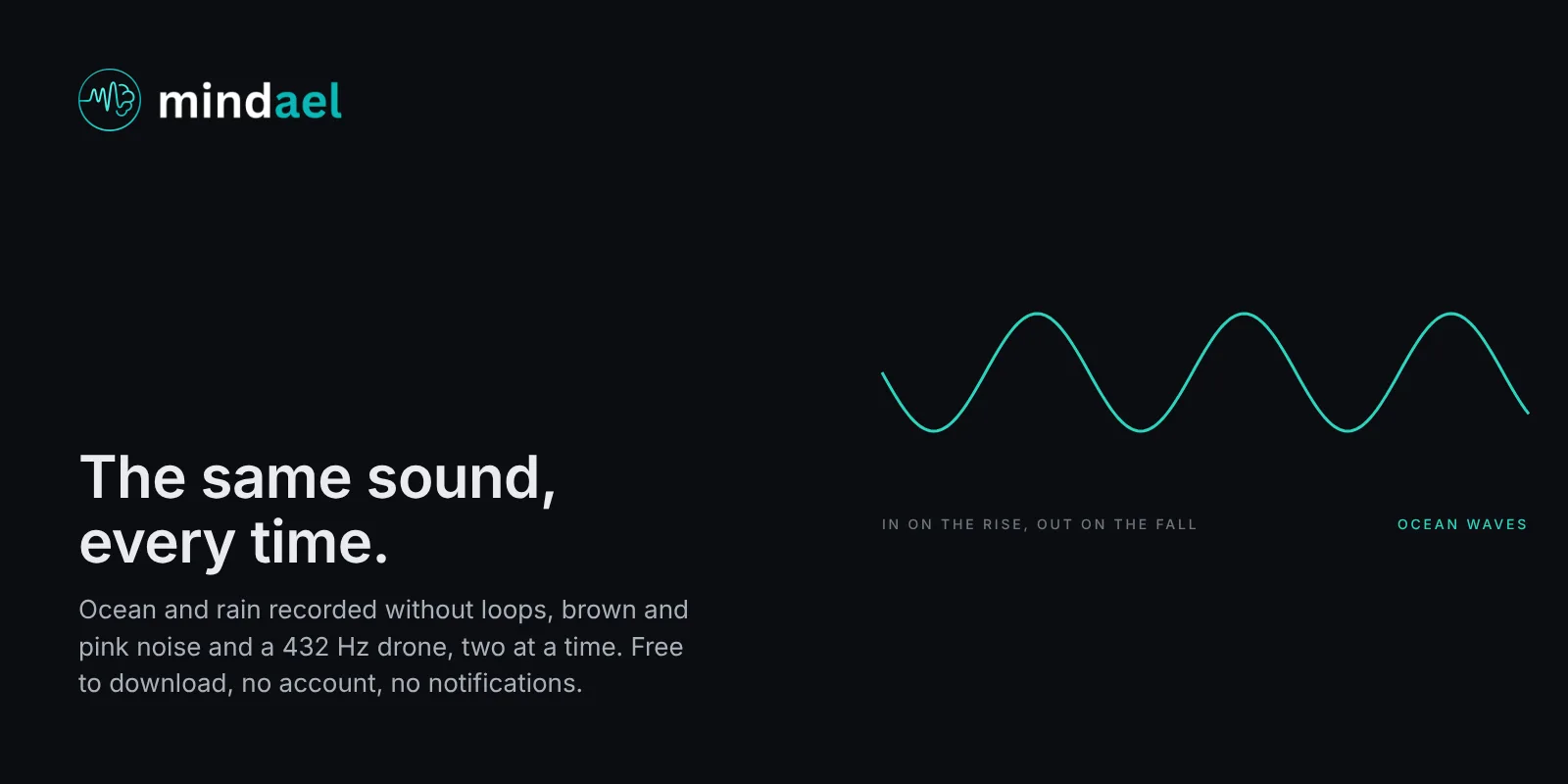
The same sound, every time.
Mindael has ocean and rain recorded without loops, brown and pink noise generated to spec and a 432 Hz drone made in our studio, two at a time. Free to download, no account, no notifications, works offline. Practise with it calm; use it when you are not.
- Ocean, rain, brown and pink noise and calm tones, studio-made
- One tap to the sound you used last
- Free to download, no account, works offline
 Free · No account needed · Works offline
Frequently asked questions
What is the best app for anxiety?
It depends on the job. For a spike in the moment, an app that opens fast and gives you a steady sound to breathe with; Mindael is built for that, free to download. For anxiety most days, an app that teaches a structured skill such as CBT or mindfulness, ideally with professional support, because that is what the trials found works best.
Do anxiety apps actually work?
Modestly. A meta-analysis of nine randomised trials found smartphone interventions reduced anxiety by a small to moderate amount, and a larger analysis of 66 trials found improvements in generalised and social anxiety, stronger when the app was based on cognitive behavioural therapy. They were not shown to help panic disorder or post-traumatic stress on their own.
Is Mindael a therapy app?
No. Mindael is a sound app: rain, ocean, noise and calm tones made in our studio. It helps in the moment and at night, as a steady sound to breathe with and rest attention on. It does not teach CBT or replace a therapist or doctor.
What sound helps with anxiety?
Something slow and steady with no words: ocean waves, rain, brown noise or a low drone. In one study, people who listened to a recording of rippling water before a stress test had the lowest cortisol response. The same sound every time works better than variety, because it becomes a cue.
Can an app help with a panic attack?
It can help you ride one out: a steady sound in the ears and a slow out-breath give the body something to follow. It cannot treat panic disorder. If panic attacks are frequent, or if this is the first one, see a doctor; chest pain or trouble breathing needs urgent care.
Are there free apps for anxiety?
Mindael is free to download with no account. Many CBT and mindfulness programmes have free tiers or are available through health services; ask your doctor what is offered where you live.
Sources
- Firth J, et al. Can smartphone mental health interventions reduce symptoms of anxiety? A meta-analysis of randomized controlled trials. Journal of Affective Disorders, 2017.
- Linardon J, et al. The efficacy of app-supported smartphone interventions for mental health problems: a meta-analysis of randomized controlled trials. World Psychiatry, 2019.
- Hoge EA, et al. Mindfulness-based stress reduction vs escitalopram for the treatment of adults with anxiety disorders: a randomized clinical trial. JAMA Psychiatry, 2023.
- Thoma MV, et al. The effect of music on the human stress response. PLOS ONE, 2013.
- Zaccaro A, et al. How breath-control can change your life: a systematic review on psycho-physiological correlates of slow breathing. Frontiers in Human Neuroscience, 2018.