

Meditation Timer: How Long to Sit, How to Set It, and Why a Timer Helps More Than It Seems
A meditation timer does one quiet job: it holds the time so you do not have to. Without one, part of your attention keeps checking the clock; with one, you can let go until it ends. How long should it be? Short is fine. Four 20-minute sessions reduced anxiety and fatigue in beginners, and 13 minutes a day for eight weeks improved mood, attention and memory in people who had never meditated, while four weeks was not enough. In a review of 203 trials, longer programs did not reliably reduce distress more than shorter ones, and in eight-week courses people who practised more at home did somewhat better. So pick a length you will keep: 5 minutes to start, 10 as a daily habit, 20 when it feels easy. Set the timer, put the phone face down, choose a gentle ending instead of a loud alarm, and sit at the same time each day.
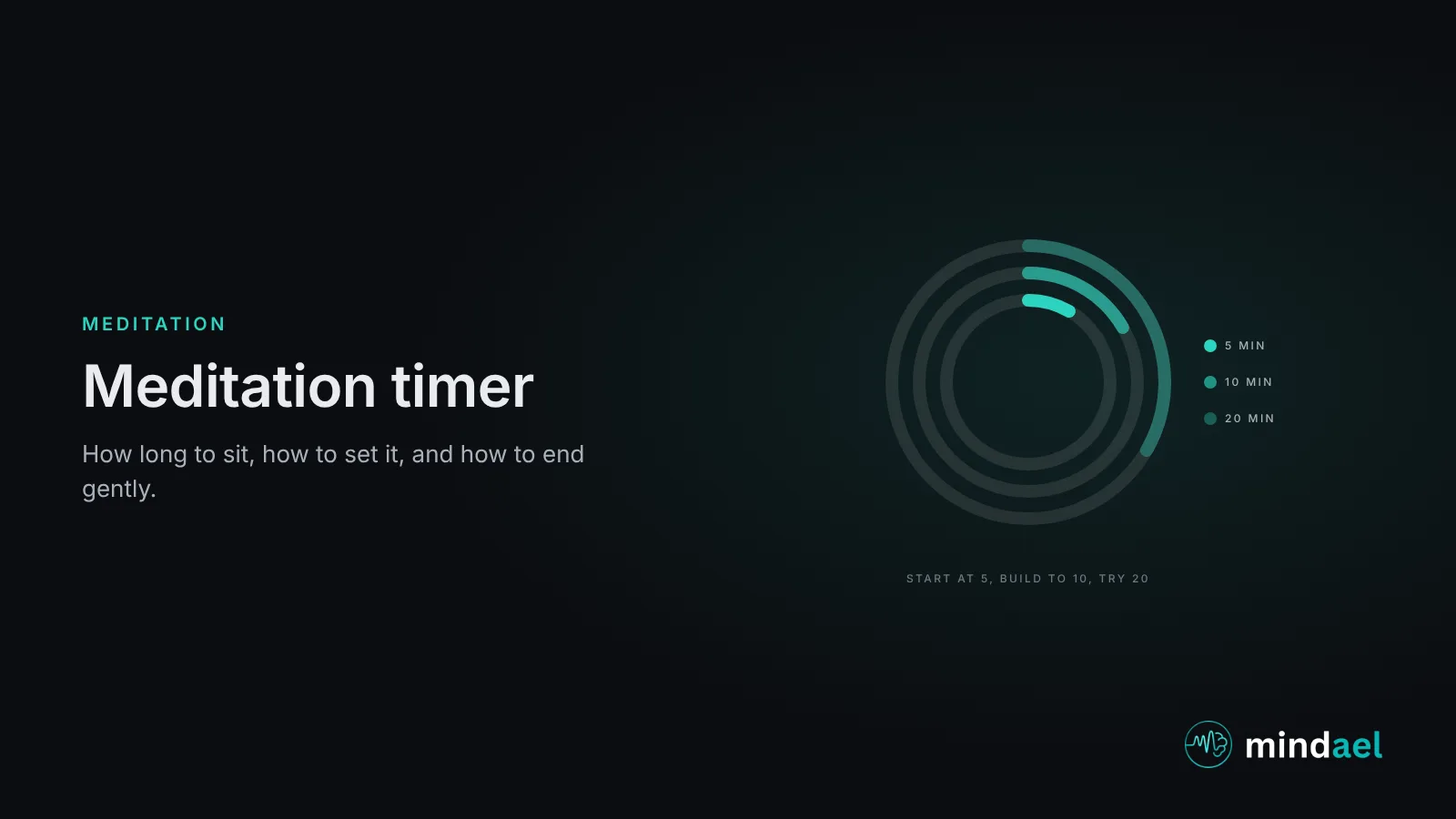
A meditation timer sounds like the least important part of meditating, but it does a quiet, useful job: it holds the time so you do not have to. Without one, part of your mind keeps wondering how long it has been. With one, you can let go until it ends. This guide covers how long to sit, how to set a timer well, and what the research says about short sessions. We make Mindael, a sound app with a timer that fades, free to download on the App Store.
Why a timer helps
- It removes clock-watching. Checking the time is a thought you keep returning to, which is the opposite of resting attention.
- It sets a promise. “Ten minutes” is a small, finished task. Open-ended sitting is easy to cut short.
- It ends gently. A good timer finishes with a soft tone or a fade, so you come out of stillness calm rather than startled.
How long to meditate
There is no magic number, and short sessions count:
- 4 sessions of 20 minutes reduced anxiety and fatigue in beginners compared with listening to an audiobook (Zeidan et al., 2010).
- 13 minutes a day for eight weeks improved mood, attention, memory and emotional regulation in people who had never meditated; after four weeks the changes were not yet there (Basso et al., 2019).
- More is not automatically better. A dose-response review of 203 trials found longer mindfulness programs did not reliably reduce depression, anxiety or stress more than shorter ones (Strohmaier, 2020).
- Regular practice helps. In eight-week courses, people completed about 30 minutes of home practice a day, and those who practised more had somewhat better outcomes (Parsons et al., 2017).
So a sensible ladder is 5 minutes to start (our 5-minute meditation walks through one), 10 minutes as a daily habit, and 20 minutes once ten feels easy. Weeks matter more than minutes.
How to set it up
- Pick the length before you sit, and do not change it mid-session.
- Choose a gentle ending: a soft tone, a bell or a sound that fades. A ringing alarm undoes the calm in one second.
- Put the phone face down, notifications off, out of reach if you can.
- Add a steady sound if the room is noisy. Low rain or a soft drone covers traffic and voices without pulling attention.
- Same time, same place. Tie it to something you already do every day.
Ideas for different lengths
- 1 minute: six slow breaths, out longer than in. Good before a meeting.
- 5 minutes: breath counting from one to ten, then start again. See our breathing meditation guide.
- 10 minutes: a short body scan, or the three-part practice in our stress meditation guide.
- 20 minutes: sitting with the breath, then sounds, then whatever comes up.
For work rather than meditation, the same idea runs the 25 minute timer used in the Pomodoro method.
The short version
A meditation timer frees you from watching the clock and lets the session end gently. Short sessions help: 13 minutes a day for eight weeks improved mood and attention in beginners, and longer programs were not reliably better. Start at 5 minutes, build to 10, try 20 when it feels easy, and pick a soft ending. For calm sounds with a timer that fades, Mindael is free to download on the App Store, and our meditation sounds guide has more.
A sound that ends your sit gently.
Mindael has rain and ocean recorded without loops, soft drones and singing bowl tones made in our studio, two at a time, with a timer that fades the sound out at the length you choose. Free to download, no account, works offline.
- Rain, ocean, drones and singing bowls
- A timer that fades out instead of ringing
- Free to download, no account, works offline
 Free · No account needed · Works offline
Frequently asked questions
How long should I set my meditation timer?
Five minutes to start, ten as a daily habit, twenty once ten feels easy. In one study, 13 minutes a day for eight weeks improved mood and attention in beginners, while four weeks was not enough.
Is a 10 minute meditation long enough?
Yes. Brief daily practice shows benefits in studies, and a review of 203 trials found longer programs did not reliably reduce distress more than shorter ones. Doing it daily matters more than the number.
Is there a free meditation timer?
The timer in your phone's clock app is free and works. What helps is a gentle ending: a soft tone or a sound that fades, rather than a ringing alarm that jolts you out of stillness.
Should I use a bell at the end?
Many traditions use a bell because it ends the session gently. Any soft sound or slow fade works the same way; the goal is to finish calm, not startled.
Can I meditate with sound playing?
Yes. A low, steady sound such as rain or a soft drone can cover noise and give attention somewhere to rest. Keep it quiet and avoid music with lyrics.
What time of day is best for a timed meditation?
Whenever you will repeat it. Linking it to something you already do, like the first coffee or brushing your teeth, makes it far more likely to stick.
Sources
- Basso JC, McHale A, Ende V, Oberlin DJ, Suzuki WA. Brief, daily meditation enhances attention, memory, mood, and emotional regulation in non-experienced meditators. Behavioural Brain Research, 2019.
- Zeidan F, Johnson SK, Diamond BJ, David Z, Goolkasian P. Mindfulness meditation improves cognition: evidence of brief mental training. Consciousness and Cognition, 2010.
- Strohmaier S. The relationship between doses of mindfulness-based programs and depression, anxiety, stress, and mindfulness: a dose-response meta-regression of randomized controlled trials. Mindfulness, 2020.
- Parsons CE, Crane C, Parsons LJ, Fjorback LO, Kuyken W. Home practice in mindfulness-based cognitive therapy and mindfulness-based stress reduction: a systematic review and meta-analysis of participants' mindfulness practice and its association with outcomes. Behaviour Research and Therapy, 2017.
This article is part of our meditation guide. Hear the sounds in this article in the Mindael sound library, or see our app comparison checklists.