

Chime Bowl Meditation: How to Use a Meditation Bowl, a Ten-Minute Practice, and What the Research Shows
Chime bowl meditation uses the tone of a singing bowl, also called a meditation bowl, as the object of attention: you strike or rim the bowl, listen to the sound until it fades completely, and start again when your mind wanders. The fading tone gives attention a clear, gentle anchor and a natural start and end. To play a bowl, rest it on your flat palm or a cushion, strike the rim softly with the mallet, or run the mallet slowly around the outside rim to make it sing. A simple practice: three strikes to begin, ten minutes of listening to a struck tone every minute or so, three strikes to end. The research is early. In an observational study of 62 adults, a one-hour singing bowl meditation was followed by less tension, anger, fatigue and low mood, with the largest drop in tension among newcomers. A systematic review found only four studies and said the evidence is too limited to recommend singing bowls as therapy. Use one as a pleasant meditation aid, not as treatment.
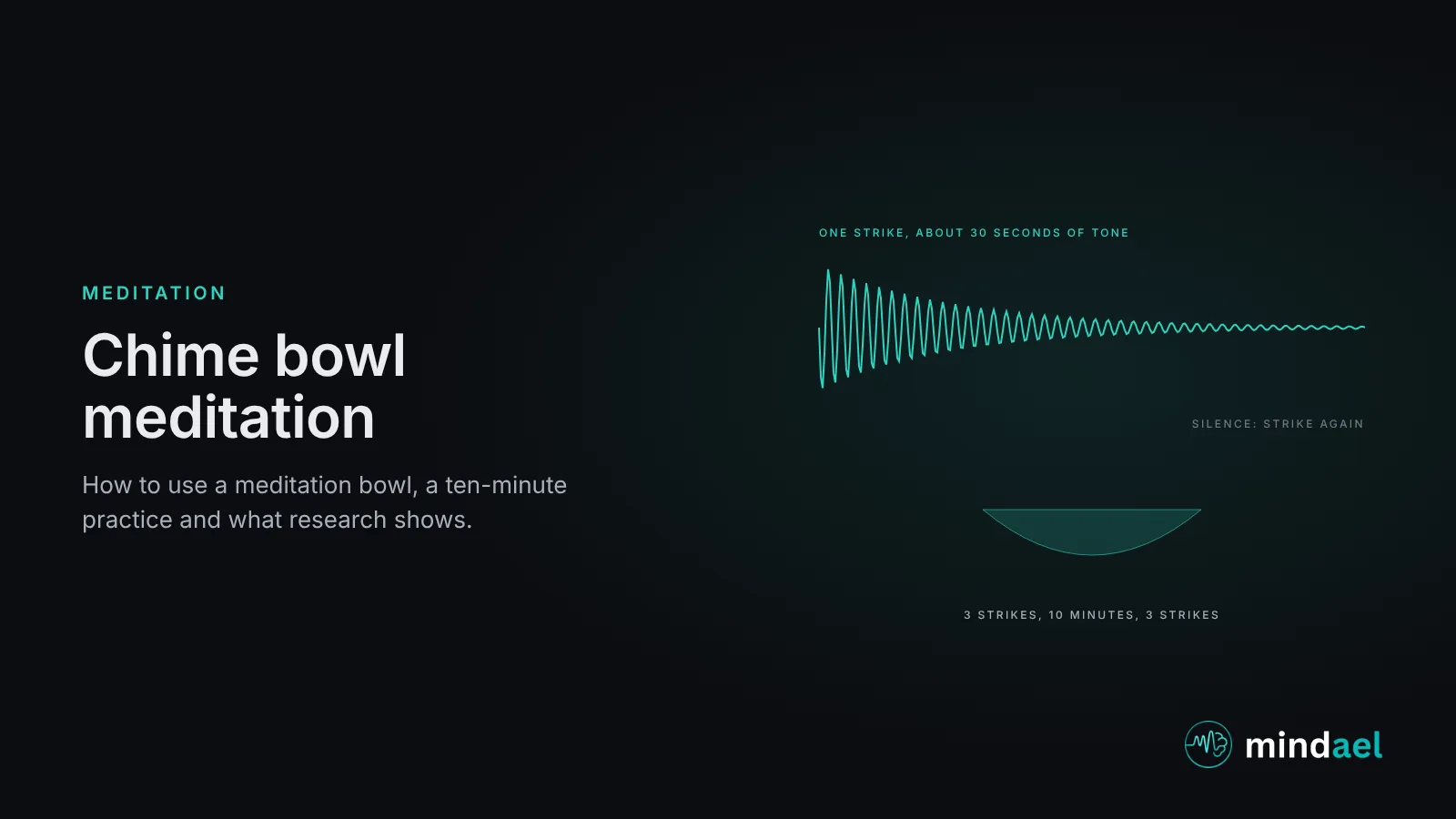
Chime bowl meditation uses the tone of a singing bowl, also called a meditation bowl, as the anchor for attention. You strike the bowl, listen until the sound has completely faded, and start again. A fading tone is an unusually good object for meditation: it is pleasant, it changes slowly, and it ends on its own, which tells you exactly when to listen again. We make Mindael, a sound app with singing bowl tones, free to download on the App Store.
How to play a meditation bowl
- Hold it so it can ring. Rest the bowl on a flat palm with fingers spread, or on a small cushion. Gripping the sides stops the vibration.
- Strike for a single tone. Tap the outside rim gently with the padded end of the mallet, then listen. A soft strike gives a long, clean tone; a hard one buzzes.
- Rim it to make it sing. Press the mallet against the outside rim and circle it slowly and steadily, like stirring thick soup. After a few rounds the bowl begins to hum and the note builds.
- Choose the size by the tone. Larger bowls are deeper and ring longer; smaller ones are brighter. For meditation, look for a tone that lasts 20 seconds or more.
A ten-minute chime bowl practice
- Settle (1 minute). Sit comfortably, bowl in front of you. Three slow breaths, out longer than in.
- Open (three strikes). Strike the bowl three times, letting each tone fade completely before the next.
- Listen (8 minutes). Strike once a minute or so. Follow the tone as it thins out, and notice the exact moment you can no longer hear it. When thoughts pull you away, the next strike brings you back.
- Close (three strikes). Three final tones, then sit for a few breaths in the silence.
A meditation timer can keep track of the ten minutes so you do not have to. If you have no bowl, a recorded bowl tone works the same way at a low volume.
What the research shows
The research is promising but early. In an observational study of 62 adults, a one-hour singing bowl meditation was followed by significantly less tension, anger, fatigue and depressed mood, and people new to this kind of meditation had the largest drop in tension (Goldsby et al., 2017). There was no control group, so some of that change could come from lying down and resting for an hour.
A systematic review found only four peer-reviewed studies of singing bowls. They reported improvements in distress, anxiety, fatigue and mood, but the authors concluded that with so few studies and a real risk of bias, singing bowl therapy cannot yet be recommended (Stanhope and Weinstein, 2020). Meditation itself has a stronger base: even four short sessions reduced anxiety and fatigue in beginners (Zeidan et al., 2010).
So treat the bowl as what it is: a lovely, simple anchor for meditation, not a therapy. Claims that specific bowls tune specific chakras are tradition rather than science; our chakra healing guide covers that honestly.
The short version
Chime bowl meditation means listening to a singing bowl’s tone until it fades, then striking again. Rest the bowl on a flat palm, strike softly or rim it slowly, and try ten minutes with three strikes to open and close. Early studies found less tension and better mood after bowl meditation, but the evidence is thin, so enjoy it as a meditation aid. For bowl tones at any time, Mindael is free to download on the App Store, and our meditation sounds guide has more.
A bowl tone to rest your attention on.
Mindael has singing bowl tones and soft drones made in our studio, with rain and ocean recorded without loops to sit underneath, two at a time. Press play, close your eyes and follow the tone. Free to download, no account, works offline.
- Singing bowl tones, drones, rain and ocean
- Two sounds at once, kept low
- Free to download, no account, works offline
 Free · No account needed · Works offline
Frequently asked questions
What is chime bowl meditation?
A meditation that uses the tone of a singing bowl as the focus. You strike or rim the bowl, listen until the sound has completely faded, and return to the sound whenever your mind wanders.
How do you use a meditation bowl?
Rest it on a flat palm or cushion so it can vibrate. Strike the rim gently with the mallet for a single tone, or press the mallet against the outside rim and circle it slowly and steadily to make the bowl sing.
Does singing bowl meditation work?
Early studies are encouraging. In 62 adults, a singing bowl meditation was followed by less tension, anger and fatigue. But a systematic review found only four studies and said the evidence is too limited to call it a therapy.
What size of meditation bowl should I get?
Larger bowls give deeper, longer tones; smaller ones are brighter and shorter. For meditation, a medium bowl of about 12 to 18 cm that sustains its tone for 20 seconds or more is a good start.
Can I meditate with a recorded singing bowl?
Yes. A recording gives you the same anchor without needing to strike the bowl. Keep the volume low so the tone is something to rest on rather than something loud.
Are singing bowls a treatment for anxiety?
No. They can be a calming part of a meditation practice, but the research is too limited to treat them as therapy. If anxiety is severe or lasting, talk to a doctor.
Sources
- Goldsby TL, Goldsby ME, McWalters M, Mills PJ. Effects of singing bowl sound meditation on mood, tension, and well-being: an observational study. Journal of Evidence-Based Complementary and Alternative Medicine, 2017.
- Stanhope J, Weinstein P. The human health effects of singing bowls: a systematic review. Complementary Therapies in Medicine, 2020.
- Zeidan F, Johnson SK, Diamond BJ, David Z, Goolkasian P. Mindfulness meditation improves cognition: evidence of brief mental training. Consciousness and Cognition, 2010.
This article is for general information and is not medical advice. Singing bowls are not a treatment for any condition. If stress or anxiety is severe or lasting, please talk to a doctor.
This article is part of our meditation guide. Hear the sounds in this article in the Mindael sound library, or see our app comparison checklists.