

Chakra Healing: What It Means, a Practice for Each Chakra, and What Sound Can and Cannot Do
In the yoga tradition the seven chakras are centres along the spine, each linked with an area of life: safety at the root, creativity at the sacral, confidence at the solar plexus, love at the heart, expression at the throat, insight at the brow and connection at the crown. Chakras are not structures science can measure, and there is no evidence that one can be blocked or healed in a physical sense. What 'chakra healing' usually means in practice is spending time with the area of life a chakra stands for, through breath, posture, sound and reflection, and those practices do have research behind them. Slow breathing shifts the body toward rest. Chanting 'OM' was linked with calmer activity in emotion-related brain areas, and reciting a mantra slowly brought breathing to about six breaths a minute. Singing bowl meditation was followed by less tension and better mood. Specific frequencies for specific chakras are tradition, not science. Use a practice for one chakra a day, five to ten minutes, with a steady tone underneath.
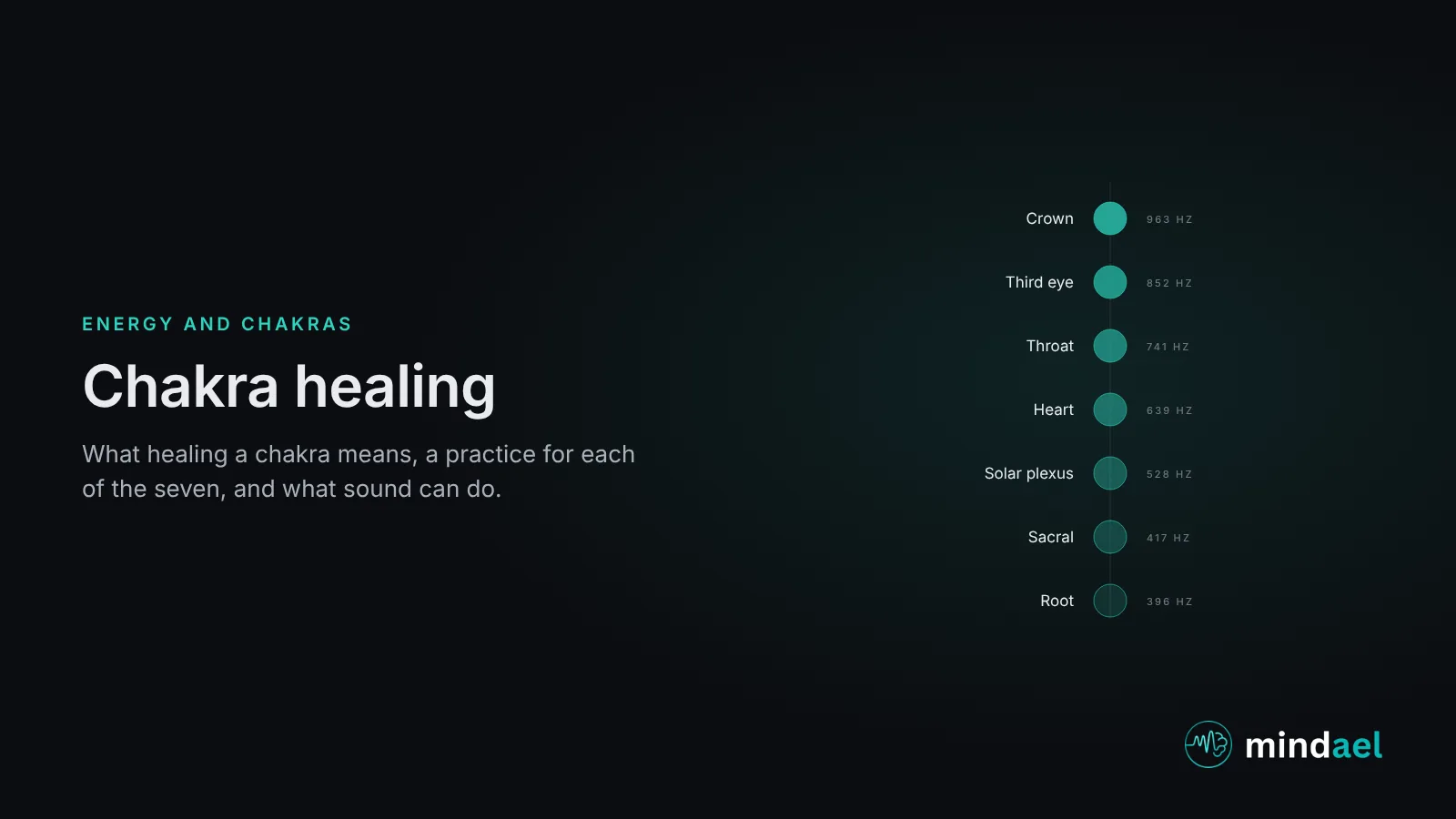
Chakra healing is one of the most searched spiritual practices, and one of the most overpromised. In the yoga tradition, the seven chakras are centres along the spine, each linked with an area of life. “Healing” one means bringing that area back into balance. This article explains what that means in practice, gives a simple exercise for each chakra, and is honest about what sound and science can and cannot say. We make Mindael, a sound app with solfeggio tones, drones and singing bowls, free to download on the App Store.
What chakra healing means
Chakras are not structures anatomy can find, and there is no scientific evidence that a chakra can be blocked or repaired. They are a map, centuries old, that ties places in the body to parts of life: safety, creativity, confidence, love, expression, insight, connection.
Read that way, “my heart chakra is blocked” usually means something real and human: it is hard to open up, or to forgive. Chakra healing, in practice, is spending time with that theme, through breath, posture, sound and reflection. Those practices are where the research is. Our chakra meditation guide covers the seven centres and the tone paired with each.
What the research covers
Slow breath. Breathing at about six breaths a minute, with a long exhale, shifts the nervous system toward rest (Zaccaro et al., 2018).
Chanting. In a small brain-imaging study, chanting “OM” was linked with reduced activity in emotion-related brain areas, a pattern the authors compared with calming (Kalyani et al., 2011). Reciting a yoga mantra slowly brought breathing down to about six breaths a minute and strengthened healthy heart-rate rhythms (Bernardi et al., 2001).
Singing bowls. After a singing bowl meditation, people reported less tension, anger and fatigue and better mood; it was an observational study without a control group (Goldsby et al., 2017).
Specific frequencies. The pairing of a solfeggio tone with each chakra is tradition. No study shows a frequency acts on a particular chakra. A steady tone is useful as an anchor for attention, and that is how we suggest using one.
A practice for each chakra
Five to ten minutes, one chakra a day, a steady tone underneath.
Root (safety). Stand barefoot, feel the weight in your feet, breathe in for four and out for six. Our root chakra meaning article goes deeper.
Sacral (creativity, pleasure). Slow circles of the hips, standing or sitting, attention below the navel. Then five minutes making something with no goal.
Solar plexus (confidence). Hand under the ribs, belly breathing, then name one thing you will do today that takes a little courage.
Heart (love, kindness). Write three specific things you are grateful for. In randomised studies, a regular gratitude list lifted mood (Emmons and McCullough, 2003).
Throat (expression). Hum on the out-breath for two minutes, or chant “OM” slowly. Then say, or write, one honest thing you have been holding back.
Brow (insight). Sit with eyes closed, attention between the eyebrows, and simply watch thoughts come and go. The breathing meditation guide has the method.
Crown (connection). Sit in silence or with a soft drone and let attention widen to the whole room, then the sounds beyond it.
The short version
Chakra healing, in practice, means time with the area of life each chakra stands for, through breath, movement, sound and reflection. The practices have research behind them; chakras themselves and frequency pairings are tradition. Five to ten minutes a day, one chakra at a time, with a steady tone as the anchor. For the seven solfeggio tones, drones and singing bowls, Mindael is free to download on the App Store.
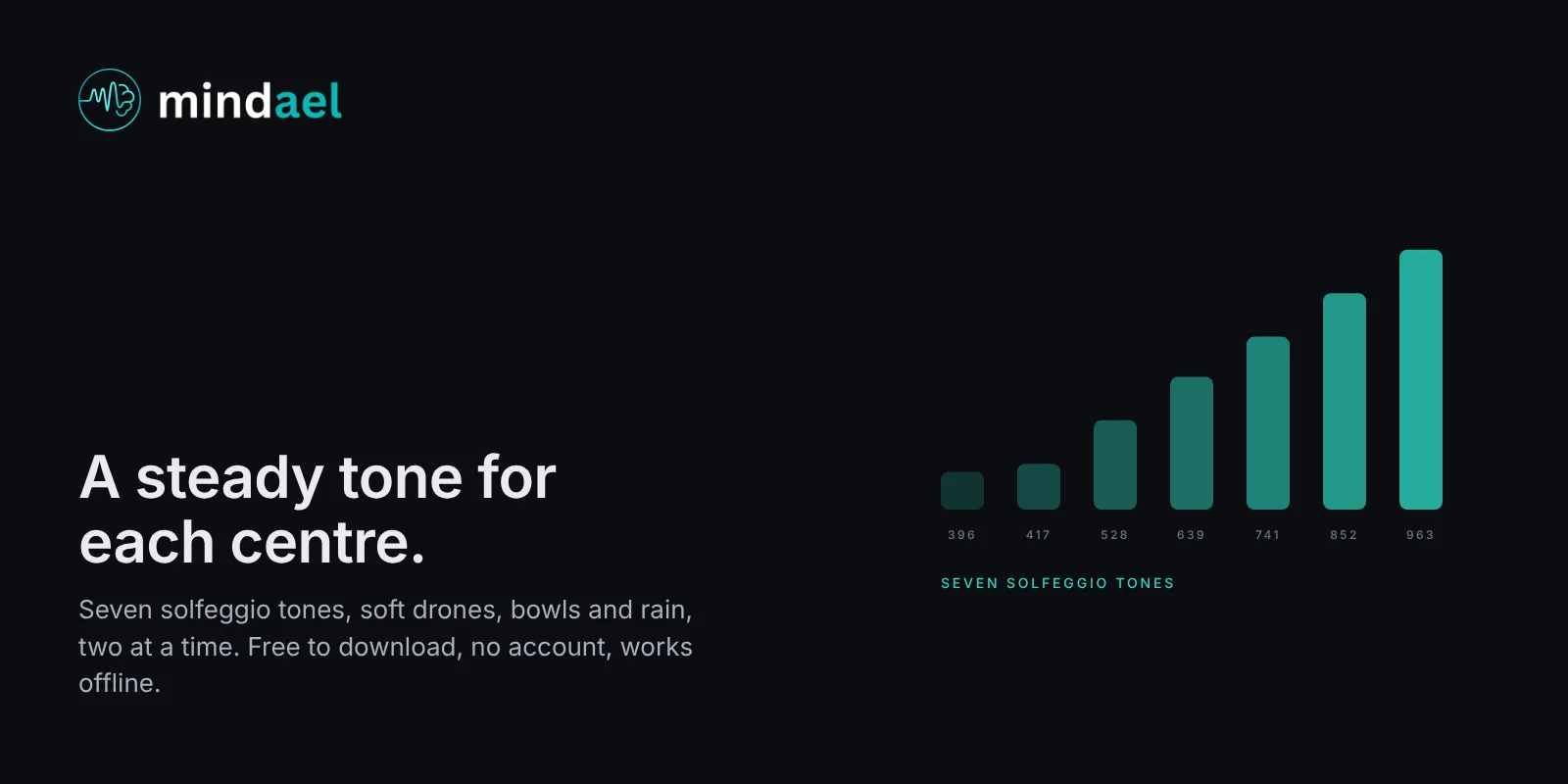
A steady tone for each centre.
Mindael has the seven solfeggio tones, from 396 Hz to 963 Hz, made in our studio to the exact frequency, with soft drones, singing bowl tones and rain to sit underneath, two at a time. Free to download, no account, works offline. The tone is the anchor; the practice is yours.
- Solfeggio tones, drones and singing bowls
- Two sounds at once, exact frequencies
- Free to download, no account, works offline
 Free · No account needed · Works offline
Frequently asked questions
What is chakra healing?
In the tradition, it means bringing a chakra, and the area of life it stands for, back into balance. In practice it is time spent with that theme through breath, posture, sound and reflection. Chakras are not physical structures, and there is no scientific evidence they can be blocked or healed.
How do you heal your root chakra?
In the tradition, the root chakra is about safety and stability. Practices include standing barefoot with attention on the feet, slow breathing with a long exhale, and steady routines. Our root chakra meaning article covers it in depth.
What is chakra healing music?
Music or tones used during chakra meditation, often singing bowls, drones or solfeggio tones paired with each chakra. Singing bowl meditation was followed by less tension and better mood in a study, but the pairing of specific frequencies with specific chakras is tradition, not science.
How do you heal your throat chakra?
The throat chakra is linked with expression. Humming, chanting 'OM' slowly and saying one honest thing you have been holding back are common practices. Slow chanting naturally slows the breath, which calms the body.
How long does chakra healing take?
There is no fixed time. Five to ten minutes a day on one chakra, over weeks, is a reasonable practice. Treat it as reflection and relaxation, not a fix for a problem.
Can chakra healing replace medical treatment?
No. Chakra practice can be a calming, meaningful routine, but it is not a treatment for any physical or mental health condition. If something is wrong, see a doctor.
Sources
- Goldsby TL, et al. Effects of singing bowl sound meditation on mood, tension, and well-being: an observational study. Journal of Evidence-Based Complementary and Alternative Medicine, 2017.
- Kalyani BG, et al. Neurohemodynamic correlates of 'OM' chanting: a pilot functional magnetic resonance imaging study. International Journal of Yoga, 2011.
- Bernardi L, Sleight P, Bandinelli G, et al. Effect of rosary prayer and yoga mantras on autonomic cardiovascular rhythms: comparative study. BMJ, 2001.
- Zaccaro A, et al. How breath-control can change your life: a systematic review on psycho-physiological correlates of slow breathing. Frontiers in Human Neuroscience, 2018.
- Emmons RA, McCullough ME. Counting blessings versus burdens: an experimental investigation of gratitude and subjective well-being in daily life. Journal of Personality and Social Psychology, 2003.
This article is for general information and is not medical advice. Chakras are a spiritual and traditional concept, not a medical one, and chakra practice is not a treatment for any condition. If you have physical or mental health concerns, please see a doctor.
This article is part of our energy, chakras and reiki guide. Hear the sounds in this article in the Mindael sound library, or see our app comparison checklists.