

Alarm With Sunrise: Do Sunrise Alarm Clocks Work, What the Research Shows, and the Sound Half of a Gentle Wake
A sunrise alarm, or dawn simulator, slowly brightens a lamp over the last 20 to 30 minutes before your wake time, so light reaches you before sound does. The research is small but encouraging. In laboratory studies, an artificial dawn reduced complaints of morning grogginess, called sleep inertia, and in one small study light in the last 30 minutes of sleep improved alertness and performance after waking. It did not shift the body clock in two weeks of use, and another small study found no effect on performance, so expect a gentler wake rather than a new sleep schedule. The sound matters too: in a survey of waking sounds, people who woke to melodic alarms reported less grogginess than those who woke to plain beeps. The best setup pairs gradual light with a melodic alarm, a fixed wake time, and real daylight soon after you get up.
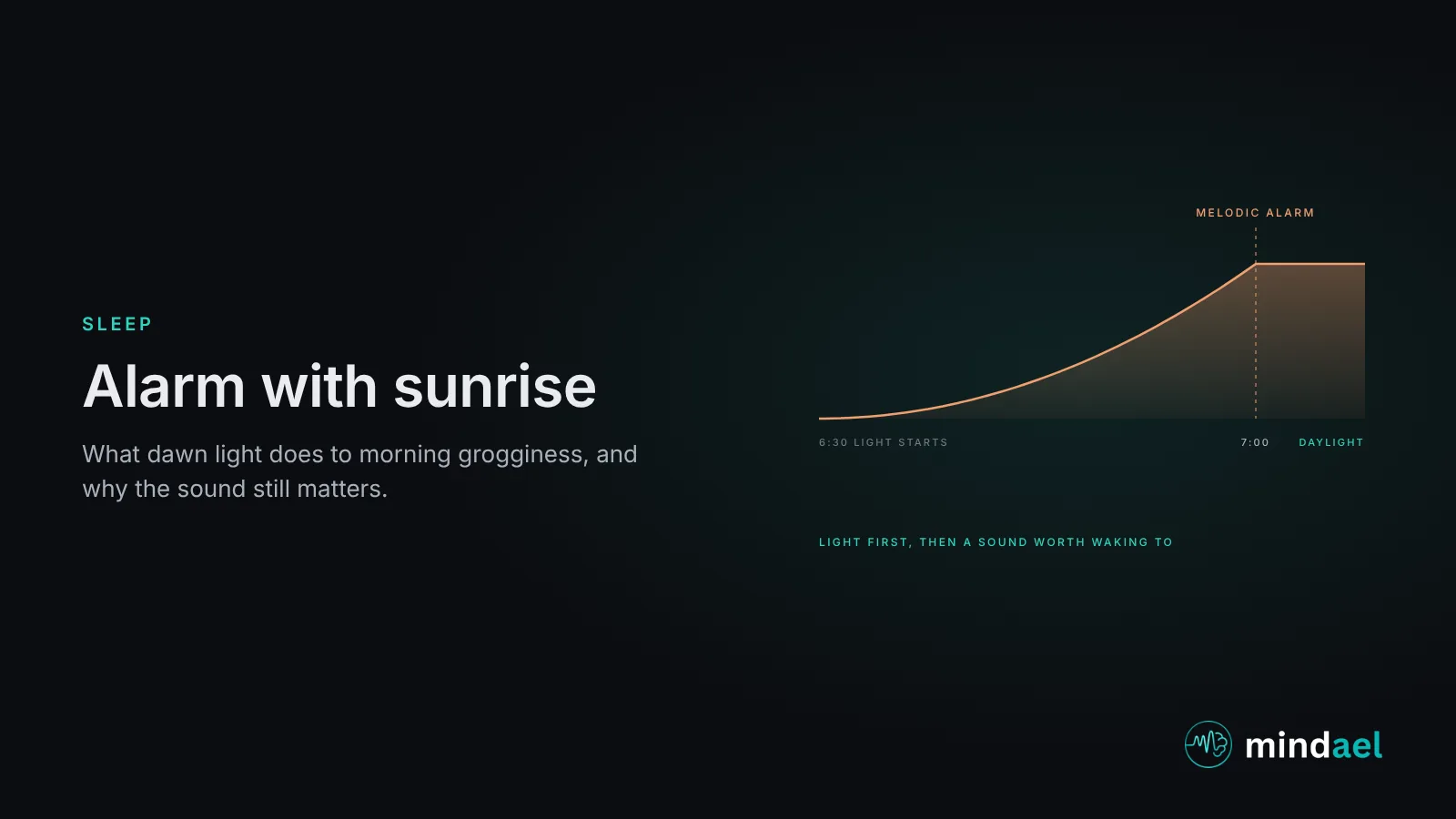
An alarm with sunrise, often called a sunrise alarm clock or dawn simulator, slowly brightens a lamp before your wake time, so light reaches you before sound does. The idea is simple: in nature you would wake to a brightening sky, not a beep in the dark. This article covers what the research shows, what a sunrise alarm can and cannot do, and why the sound at the end matters just as much. We make Mindael, a sound app with melodic wake sounds, free to download on the App Store.
What a sunrise alarm does
Over the last 20 to 40 minutes before your alarm, the lamp moves from a dim red-orange glow to bright, warm white. Light passes through closed eyelids, and the gradual change is meant to bring you up from deep sleep into lighter sleep before the alarm sounds.
That matters because waking from deep sleep is what makes mornings feel worst. The grogginess after waking, called sleep inertia, is stronger when the alarm catches you in deep sleep (Tassi and Muzet, 2000). Our cycles of sleep article explains why that happens more on some mornings than others.
What the research shows
The studies are small but point the same way. In laboratory studies, an artificial dawn of about 30 minutes reduced people’s complaints of sleep inertia; it did not shift the timing of the body clock over two weeks, so the effect seems to come from the waking itself (Giménez et al., 2010). In another small study of people who found mornings hard, light in the last 30 minutes of sleep improved alertness and some measures of performance after waking (Thompson et al., 2014). Not every study found a performance benefit, so treat a sunrise alarm as a gentler wake, not a fix for short nights.
The sound still matters
A lamp alone may not get you out of bed, so most sunrise alarms end with a sound. Which one makes a difference. In a survey of waking sounds, people who woke to alarms they rated as melodic reported less grogginess, while plain, neutral beeps were linked with more (McFarlane et al., 2020). It was a small, self-reported study, but it matches what most people feel.
So pair the light with a melodic alarm at a moderate volume. Our morning guide has more on choosing a wake sound and on snoozing.
A simple gentle-wake setup
- Light first. A sunrise lamp or smart bulb set to brighten over 30 minutes before wake time.
- A melodic sound at wake time. Not a beep; something with a tune and a soft start.
- The same wake time every day. A regular time trains the body clock more than any gadget.
- Real daylight soon after. Open the curtains or step outside within the first hour.
- A steady night before. A low sound such as rain or brown noise protects the deep sleep the morning depends on.
The short version
A sunrise alarm brightens a lamp before you wake, and small studies found it reduced morning grogginess, though it does not shift your body clock or replace a full night. The sound at the end matters as much as the light: melodic alarms were linked with less grogginess than beeps. Use both, with a fixed wake time and daylight soon after. Mindael has no light, but for the sound half, melodic wake sounds and a sleep sound for the night before, Mindael is free to download on the App Store.
The sound half of a gentle wake.
Mindael has an alarm with melodic wake sounds such as Rainy Morning, Crystal Dawn and Zen Wake, and rain, ocean and brown noise for the night before. Free to download, no account, works offline. Pair it with a sunrise lamp: light first, then a sound worth waking to.
- Melodic wake sounds, no harsh beeps
- Sleep sound and alarm in one app
- Free to download, no account, works offline
 Free · No account needed · Works offline
Frequently asked questions
Do sunrise alarm clocks work?
For many people they make waking gentler. In small laboratory studies, an artificial dawn reduced complaints of morning grogginess and in one study improved alertness after waking. The studies are small and not all found an effect on performance, so think of it as a comfort rather than a cure for tiredness.
How long before waking should a sunrise alarm start?
Most studies used about 30 minutes of gradually brightening light before the wake time. Many lamps let you choose 20 to 40 minutes; 30 is a reasonable default.
Can I make a sunrise alarm without a lamp?
You can leave the curtains slightly open toward an east-facing window, or put a smart bulb on a timer. In winter, when it is still dark at wake time, a lamp is the only way to get light before you wake.
Is a sunrise alarm better than a sound alarm?
They work best together. The light starts the wake gently, and a melodic sound at the end makes sure you get up. In a survey, people who woke to melodic alarms reported less grogginess than people who woke to beeps.
Does a sunrise alarm help with winter mornings?
It can make dark mornings feel easier. Dawn simulation has also been studied for seasonal low mood, but if your mood drops every winter, talk to a doctor about light therapy rather than relying on an alarm.
Does Mindael have a sunrise alarm?
Mindael has an alarm with gentle, melodic wake sounds, but no light. Pair it with a sunrise lamp or a smart bulb for the light half.
Sources
- Giménez MC, Hessels M, van de Werken M, de Vries B, Beersma DGM, Gordijn MCM. Effects of artificial dawn on subjective ratings of sleep inertia and dim light melatonin onset. Chronobiology International, 2010.
- Thompson A, et al. Effects of dawn simulation on markers of sleep inertia and post-waking performance in humans. European Journal of Applied Physiology, 2014.
- McFarlane SJ, Garcia JE, Verhagen DS, Dyer AG. Alarm tones, music and their elements: analysis of reported waking sounds to counteract sleep inertia. PLOS ONE, 2020.
- Tassi P, Muzet A. Sleep inertia. Sleep Medicine Reviews, 2000.
This article is for general information and is not medical advice. If you feel very sleepy most mornings despite a full night in bed, or your mood drops every winter, please talk to a doctor.
This article is part of our morning and waking up guide. Hear the sounds in this article in the Mindael sound library, or see our app comparison checklists.