
A Sleep Cycle Alternative: What Sleep Cycles Are, What Tracking Can and Cannot Tell You, and Sound for Sleep
Searches for "sleep cycle" mix two things: the sleep cycle itself, the pattern of stages your brain moves through each night, and apps built around tracking it. This page explains the first, what the research says about phone-based tracking, and why we built Mindael around sound instead of measurement. Mindael is free to download on the App Store. It does not track your sleep; it helps you fall asleep and stay asleep with sound.
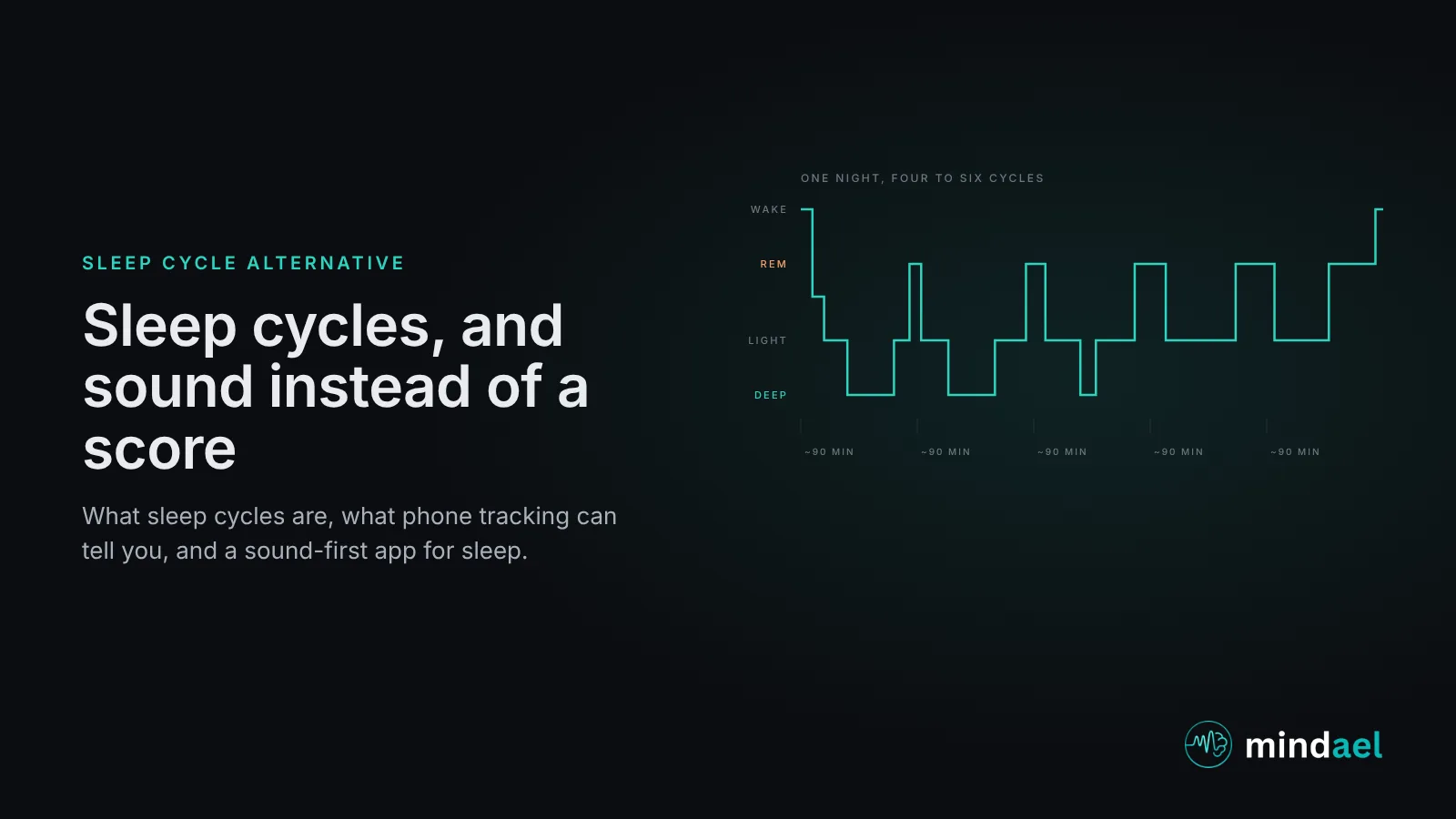
A sleep cycle lasts roughly 90 minutes and repeats four to six times a night, moving through light sleep, deep sleep and REM, with more deep sleep early in the night and more REM toward morning. Phone sleep apps can estimate sleep and wake reasonably in healthy sleepers, but a review of validation studies found their accuracy dropped in people who sleep poorly, which is exactly who uses them. Paying too much attention to the numbers can backfire: sleep clinicians have described patients whose worry about tracker scores made their sleep worse. If what you want is to sleep better rather than to measure it, Mindael is a sound-first alternative: rain, ocean, noise colors and delta beats, mixing, a fading sleep timer and offline playback. It does not track sleep stages.
What to look for, and how Mindael covers it
| What you need | In Mindael |
|---|---|
| A sound to fall asleep to | Rain and ocean recorded without loops, soft drones and delta beats from our studio |
| Masking for a noisy room | White, pink and brown noise generated to spec |
| Mixing | Rain over brown noise, or a delta beat under ocean waves: two sounds at once |
| A timer that fades | The sound fades out instead of stopping, so it does not wake you |
| A gentle wake sound | Soft wake sounds instead of a beep |
| Works offline | Every sound is on the phone; nothing streams at night |
| No scores to worry about | Mindael does not track sleep stages or grade your night |
| Price | Free to download on the App Store |
What a sleep cycle is
Sleep is not one state. Through the night your brain moves through a repeating pattern: a drift into light sleep, a longer stretch of light sleep, deep slow-wave sleep, and REM, the stage most linked with vivid dreams. One pass through that pattern is a sleep cycle. It lasts roughly 90 minutes on average, and most adults go through four to six a night.
The cycles are not identical. Deep sleep is concentrated in the first cycles of the night, and REM periods get longer toward morning. The balance also changes with age: a meta-analysis of sleep studies from childhood to old age found that the share of deep sleep falls as people get older (Ohayon et al., 2004). Our deep sleep music article explains what that means for sound at night.
What phone tracking can and cannot tell you
Sleep stages are measured in a lab with brain-wave recordings. A phone on the mattress or the bedside table can only estimate them from movement and sound. A review of validation studies found that smartphone sleep apps were reasonably close to wrist actigraphy at telling sleep from wake in healthy sleepers, but their accuracy dropped in people with poor sleep efficiency (Fino and Mazzetti, 2019). That is a problem, because people who sleep poorly are the ones most likely to use them.
There is also a cost to watching the numbers. Sleep clinicians coined the term orthosomnia for patients who became so focused on improving their tracker scores that the worry itself made their sleep worse (Baron et al., 2017). If a morning score leaves you anxious, the score is not helping.
Why we built Mindael around sound
We think the useful part of a sleep app is the part that works at 11 p.m., not the graph at 7 a.m. A steady sound helps with the two things that most often stand between people and sleep: a noisy room and a busy mind. In a lab study, broadband sound shortened the time healthy adults took to fall asleep by 38 percent in a model of a bad night (Messineo et al., 2017).
So Mindael gives you the sound: rain, ocean, white, pink and brown noise, and delta beats, two at a time, with a timer that fades. Our sleep sounds guide has the full setup, and the best sleep app checklist covers what a sleep app needs more generally.
What Mindael does not do
It does not track sleep, record your night, detect sleep stages or grade your sleep. If you want a record, a short sleep diary, bedtime, wake time and how rested you feel, is accurate enough to spot patterns and is what sleep clinicians often ask for. And whatever app you use, the change that helps sleep cycles most is free: a fixed wake time every day. Our how to fall asleep fast article covers the rest of the routine.
How to switch in five minutes
- Download MindaelFree on the App Store, no account needed.
- Pick a sound for the roomRain or pink noise for a noisy room, brown noise or a delta beat for a busy mind.
- Set a fading timer30 to 45 minutes covers most people's time to fall asleep. Steady noise can run longer if the room is loud.
- Keep the phone across the roomVolume low, screen down. The less you look at the phone at night, the better.
- Keep a fixed wake timeThe same time every day, weekends included. It does more for your sleep cycles than any setting.
Sleep better, without the score.
Mindael has rain and ocean recorded without loops, white, pink and brown noise generated to spec and delta beats made in our studio, two at a time, with a timer that fades. Free to download, no account, works offline. A sound for the night instead of a graph in the morning.
- Rain, ocean, noise colors and delta beats, studio-made
- Two sounds at once, fading timer
- Free to download, no account, works offline
 Free · No account needed · Works offline
Frequently asked questions
What is a sleep cycle?
One pass through the stages of sleep: light sleep, deep sleep and REM, lasting roughly 90 minutes. Most adults go through four to six cycles a night. Deep sleep is concentrated in the first cycles and REM gets longer toward morning.
What are the stages of the sleep cycle?
Stage N1 is the drift into sleep, N2 is light sleep and takes up the largest share of the night, N3 is deep or slow-wave sleep, and REM is the stage linked with vivid dreams. The order and length change across the night.
How accurate are phone sleep trackers?
For telling sleep from wake in good sleepers, reasonably close to wrist actigraphy. For sleep stages and for people who sleep poorly, much less so. A review of validation studies found accuracy dropped in people with low sleep efficiency.
Does Mindael track sleep?
No. Mindael is a sound app. It helps you fall asleep and stay asleep with rain, ocean, noise colors and binaural beats, and it does not measure or score your night.
Can tracking my sleep make it worse?
For some people, yes. Sleep clinicians coined the term orthosomnia for patients who became so focused on improving their tracker data that the worry itself made their sleep worse. If a score makes you anxious, try a week without it.
How long is a sleep cycle?
Around 90 minutes on average, but it varies between people and across the night, typically from about 70 to 120 minutes. That is why timing your sleep to exact 90-minute blocks is only a rough guide.
Sources
- Ohayon MM, et al. Meta-analysis of quantitative sleep parameters from childhood to old age in healthy individuals. Sleep, 2004.
- Fino E, Mazzetti M. Monitoring healthy and disturbed sleep through smartphone applications: a review of experimental evidence. Sleep and Breathing, 2019.
- Baron KG, et al. Orthosomnia: are some patients taking the quantified self too far? Journal of Clinical Sleep Medicine, 2017.
- Messineo L, et al. Broadband sound administration improves sleep onset latency in healthy subjects in a model of transient insomnia. Frontiers in Neurology, 2017.