

Self Affirmation: What It Really Means, Why Some Affirmations Backfire, and How to Write Ones You Believe
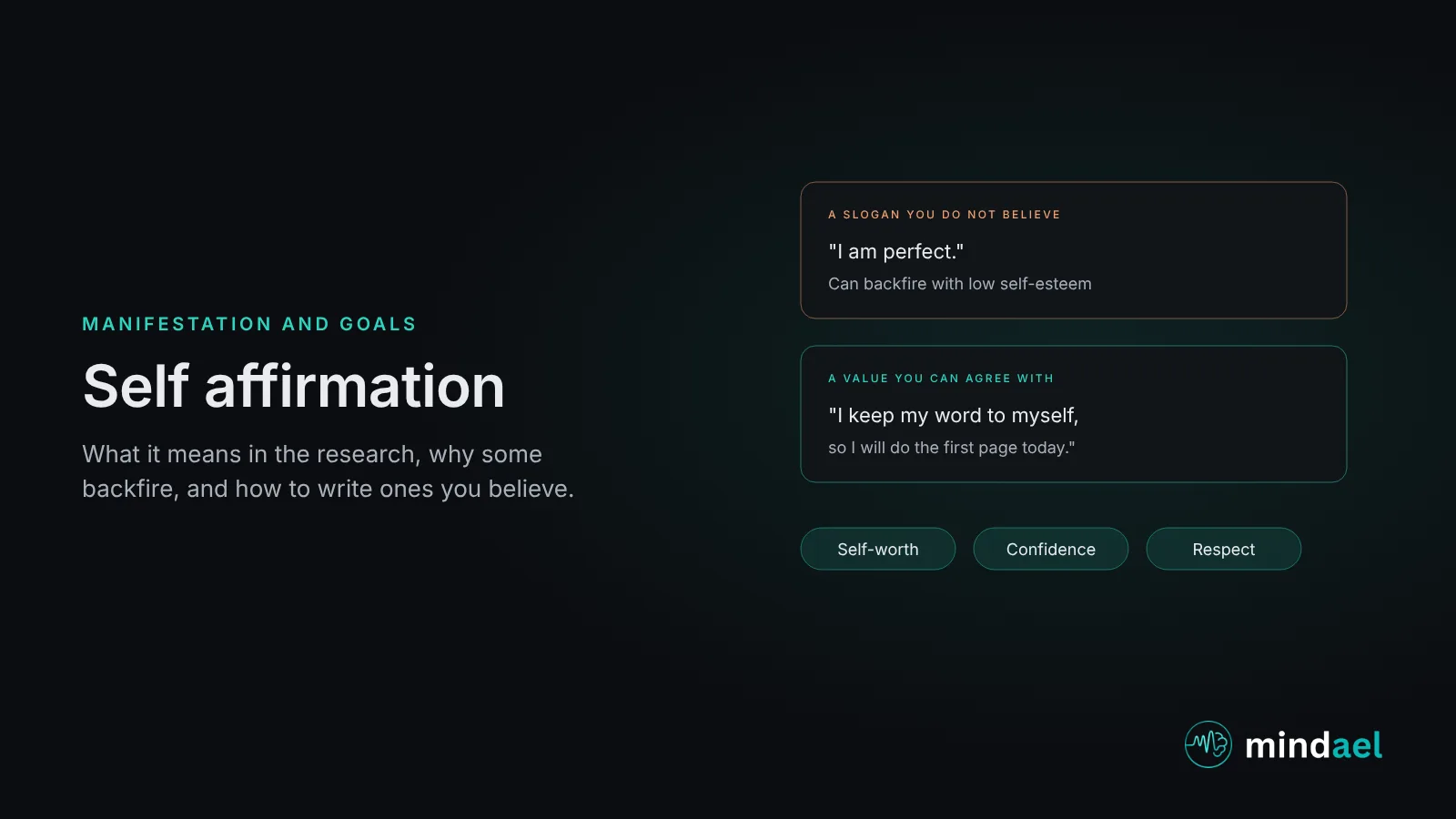
In psychology, self-affirmation is not repeating 'I am amazing'. It means reminding yourself of what you value most, such as honesty, family or curiosity, and it has been tested in many studies. Reflecting on your values helped people stay open and steady under threat, and a meta-analysis found small positive effects on accepting health messages, intentions and behaviour. Positive statements you do not believe are different: in a well-known study, repeating 'I am a lovable person' lifted mood for people with high self-esteem and made people with low self-esteem feel worse. So write self-worth, self-confidence and self-respect affirmations as values and actions you can honestly agree with: 'I keep my word to myself, so I will do the first page today', not 'I am perfect'. Say them slowly, at the same time each day, and pair each with one small act.
Self affirmation sounds like standing in front of a mirror saying “I am amazing”. In psychology it means something quieter and better tested: reminding yourself of what you value. That difference explains why some affirmations help and others make people feel worse. This article covers what the research means by self-affirmation, why some statements backfire, and how to write self-worth, self-confidence and self-respect affirmations you can actually believe. We make Mindael, a sound app many people use for a few quiet minutes each day, free to download on the App Store.
What the research means by self-affirmation
In the studies, self-affirmation usually means a short exercise: pick the value that matters most to you, such as family, honesty, humour or creativity, and write for a few minutes about why. A review of this research found that reflecting on values helped people stay open and steady when they faced a threat to how they see themselves, such as criticism or a hard test, with some effects lasting well beyond the exercise (Cohen and Sherman, 2014).
A meta-analysis of health studies found small positive effects of self-affirmation on accepting difficult health messages, on intentions to change, and on behaviour itself (Epton et al., 2015). Small, but real, and from a few minutes of writing.
Why some affirmations backfire
Positive statements about yourself are a different thing. In a well-known set of experiments, people repeated “I am a lovable person”. Those with high self-esteem felt a little better. Those with low self-esteem felt worse than if they had said nothing (Wood et al., 2009). When a statement is far from what you believe, the gap is what you notice.
So the rule is simple: if you would argue with the sentence, change it until you would not.
How to write affirmations you believe
- Start from a value, not a wish. “I care about keeping my word” rather than “I am unstoppable”.
- Use your own words. A sentence you would say to a friend, not a slogan.
- Keep it believable today. “I am learning to speak up” is easier to agree with than “I am fearless”.
- Add one action. “So today I will ask one question in the meeting.” The action is where the value turns into evidence.
Examples: self-worth, confidence and respect
Self-worth. “My worth is not decided by one bad day.” “I matter to the people I look after, and I look after myself too, so I will go to bed on time tonight.”
Self-confidence. “I have done hard things before; I can do the first step of this one.” “I am allowed to be a beginner, so I will practise for ten minutes.”
Self-respect. “I keep promises to myself, so I will do the first page today.” “My time matters; I will say no to one thing that does not fit.”
Self-concept. “I am someone who keeps going after a setback.” Pick the identity you are building, then name one act that proves it.
A two-minute daily practice
Same time each day, before the phone. Put on a steady sound such as rain or a soft 528 Hz tone. Breathe slowly for a minute. Read your two or three sentences on an out-breath, once each, slowly. Then do the action. Our morning affirmations guide has a five-minute version, and the manifesting on paper article shows how the 369 method uses written statements.
The short version
Self-affirmation works best as values, not slogans. Write two or three sentences you can honestly agree with, about what you care about, and add one action to each. Statements you do not believe can make you feel worse, so change the words until you would not argue with them. For a quiet sound to start the day with, Mindael is free to download on the App Store.

Two minutes, your own words.
Mindael has rain and ocean recorded without loops, a 528 Hz tone and theta beats made in our studio, two at a time, for the same quiet minutes each day. Free to download, no account, works offline. The sound sets the moment; the words are yours.
- Rain, ocean, 528 Hz and theta beats
- Two sounds at once, the same sound every day
- Free to download, no account, works offline
 Free · No account needed · Works offline
Frequently asked questions
What is self affirmation?
In psychology, it means reflecting on the values that matter most to you, such as kindness, honesty or creativity. In everyday use, it also means positive statements about yourself. The first has a solid research base; the second works only when you believe the statement.
Do self affirmations work?
Values affirmations do: across many studies they helped people stay open under stress and had small positive effects on health behaviour. Generic positive statements can backfire for people with low self-esteem, because the gap between the words and what they believe is what they notice.
What are good self-worth affirmations?
Ones you can agree with today. 'I matter to the people I care for.' 'My worth is not decided by one bad day.' 'I treat myself the way I would treat a friend.' Add one action to each.
What are words of affirmation to yourself?
Short sentences you say or write to yourself about what you value and how you want to act. Use your own words, keep them believable, and say them slowly rather than many times fast.
How often should I say self affirmations?
Once a day is enough, at the same time, for two to five minutes. Many studies used a single short writing exercise about values, so length matters less than meaning it.
Can self affirmations help with low self-esteem?
Values affirmations are a gentle place to start. Big positive statements can make low self-esteem feel worse. If low mood or self-criticism is heavy and lasting, a doctor or therapist is the right next step.
Sources
- Cohen GL, Sherman DK. The psychology of change: self-affirmation and social psychological intervention. Annual Review of Psychology, 2014.
- Epton T, Harris PR, Kane R, van Koningsbruggen GM, Sheeran P. The impact of self-affirmation on health-behavior change: a meta-analysis. Health Psychology, 2015.
- Wood JV, Perunovic WQE, Lee JW. Positive self-statements: power for some, peril for others. Psychological Science, 2009.
This article is for general information and is not medical or psychological advice. Affirmations are a small daily practice, not a treatment. If low mood, anxiety or harsh self-criticism lasts or gets in the way of daily life, please talk to a doctor or therapist.
This article is part of our affirmations and spiritual practice guide. Hear the sounds in this article in the Mindael sound library, or see our app comparison checklists.